How to Automate Vendor Contract Risk Analysis with AI
-
 Balachandran Sivakumar
 - 14 May, 2026
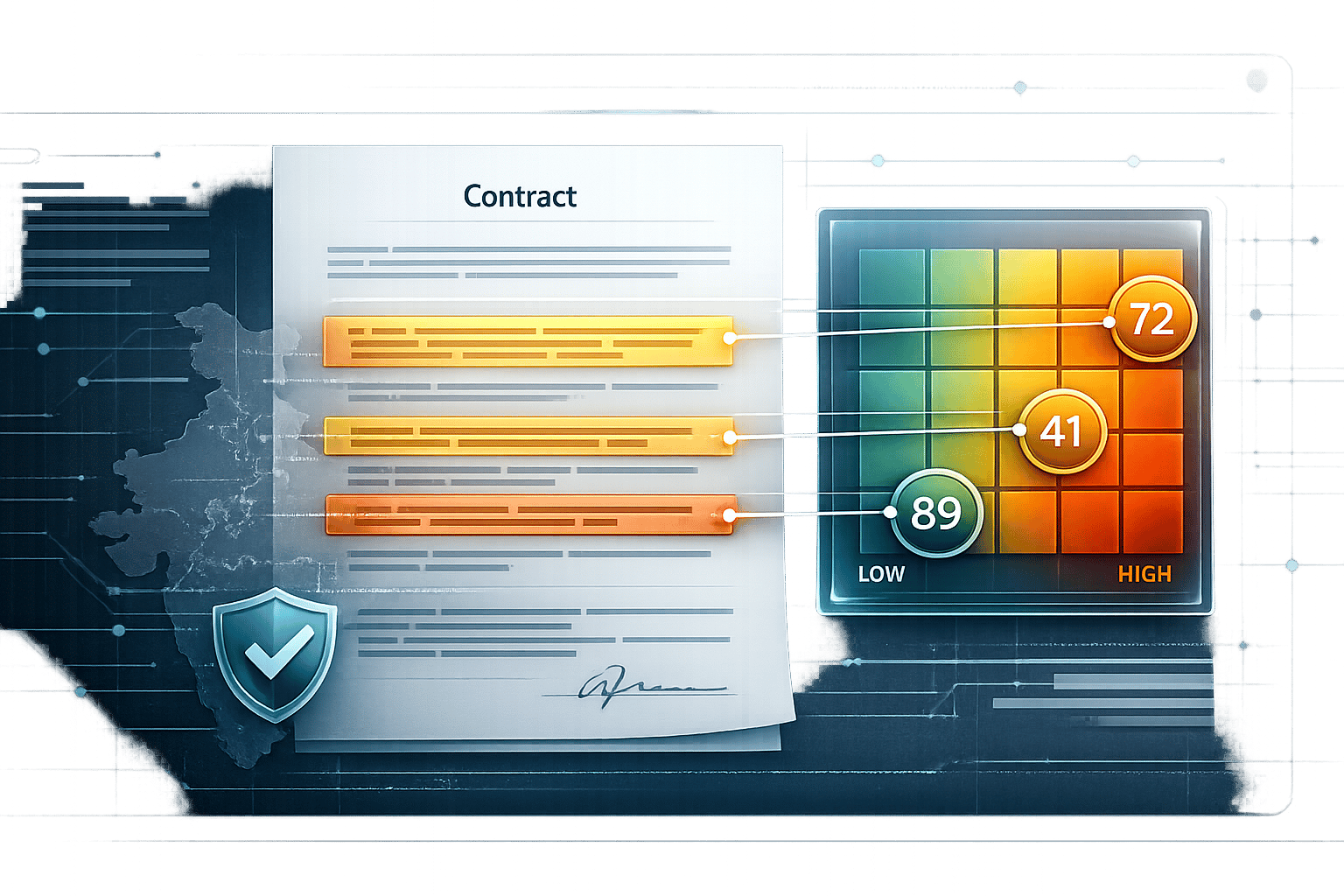
AI can transform how you manage vendor contract risks. Here’s why:
- Manual reviews are error-prone and time-consuming. In India, regulatory requirements like the DPDP Act and RBI guidelines make traditional methods inadequate.
- AI enables continuous monitoring. It uses Natural Language Processing (NLP) to identify risks, flag missing clauses, and ensure compliance with frameworks such as ISO 27001 and SOC 2.
- Efficiency improves dramatically. AI reduces contract review time by 40-60% and cuts errors by 94%.
For Indian organisations, this shift is crucial to handle complex vendor ecosystems, ensure compliance, and avoid regulatory penalties. By integrating AI into your Governance, Risk, and Compliance (GRC) programmes, you can automate risk analysis, manage vendor obligations, and maintain audit readiness effortlessly.
Key Takeaways
- AI automates clause analysis, risk scoring, and compliance mapping.
- Focus areas include data privacy, breach notifications, SLAs, and audit rights.
- AI tools like CISOGenie integrate with GRC systems, enabling real-time risk visibility and continuous compliance.
This approach saves time, reduces risks, and ensures your vendor contracts stay aligned with India’s evolving regulatory landscape.
Mapping Vendor Contract Risks to Compliance Frameworks
Understanding vendor contract requirements and aligning them with compliance frameworks is crucial. Without precise mapping, even advanced AI tools can generate noise instead of identifying genuine risks.
Key Risk Areas in Vendor Contracts
Vendor contracts often present risks that intersect with compliance frameworks. For example:
- data privacy clauses (breach notifications, residency, sub-processor approvals) for DPDP alignment,
- SLA commitments (uptime, RTO/RPO, service credits) for SOC 2 expectations,
- outsourcing and resilience clauses (step-in rights, chronic failure triggers, price protection) for RBI/SEBI contexts,
- technical controls (audit rights, encryption, access control) for ISO 27001 compliance.
Missing clauses can be riskier than bad clauses. If contracts do not define deletion timelines or transition support, obligations may become unenforceable. AI tools are useful for detecting these omissions at scale.
“The fastest teams do not review every clause deeply. They let AI surface the 10 percent that actually matters.”
Building a Reusable Risk Playbook
A risk playbook defines acceptable language, fallback positions, escalation rules, and scoring logic. This gives AI a consistent basis for defensible risk decisions.
A common weighted model:
- Control Adequacy: 40%
- Remedy Strength: 25%
- Exposure and Tail Risk: 20%
- Change/Exit Risk: 15%
You can then apply tiered requirements by vendor criticality. High-risk vendors handling sensitive personal data may require stronger assurance (e.g., SOC 2 Type II), while low-risk vendors can follow lighter controls.
Framework-Specific Requirements for Indian Enterprises
| Framework | Key Contractual Alignment Areas | AI Extraction Focus |
|---|---|---|
| DPDP Act (India) | Data processing, breach notification, data residency | Breach windows (<=72 hours), sub-processor approvals, data deletion timelines |
| ISO 27001 | Access control, encryption, supplier relationships | Audit rights, pen-test cadence, security certifications |
| SOC 2 | Confidentiality, availability, processing integrity | SLA/uptime commitments, RTO/RPO, liability caps |
| RBI/SEBI | Outsourcing risk, operational resilience, financial stability | Step-in rights, chronic failure triggers, price protection |
Designing an AI-Driven Contract Risk Workflow
Once your playbook and mappings are ready, design a workflow that converts contract text into actionable risk decisions.
Step 1: Define Scope and Success Metrics
Start with a pilot: top vendors by spend, business criticality, or sensitive-data exposure. Track:
- baseline review cycle time,
- contract processing capacity,
- exception rate,
- and backlog.
Then centralise contract sources (CLM, e-sign, SharePoint, drives) into one ingestion path.
Step 2: Build a Clause Library and Risk Playbook
Your library should encode approved language and fallback options. Example automation checks:
| Sample Playbook Check | AI Automation Rule |
|---|---|
| Security | Flag breach notice windows over 72 hours; propose fallback language. |
| Privacy | Require DPDP clauses when Indian resident data is in scope. |
| Liability | Flag low caps; route for legal escalation. |
| Exit Rights | Require timed return/deletion obligations with proof. |
Step 3: Configure AI for Clause Analysis and Risk Scoring
AI/NLP can extract clauses, compare against your library, and score deviations. It can also detect hidden issues that manual reviews miss, such as silent auto-renewals or ambiguous failure definitions.
Human oversight is still required for:
- high-impact clauses,
- low-confidence AI flags,
- and final negotiation positions.
Integrating AI-Driven Risk Analysis with GRC Programs
Linking Contract Risk to Vendor Management
Feed clause-level risk scores into a unified Vendor Risk Index so contract risk becomes part of the vendor profile alongside security posture and performance indicators.
Automating Evidence Collection for Compliance Audits
Use an Evidence Centre that links every risk score to clause, file version, and mapping control. This creates clear traceability for audits under DPDP, ISO 27001, and SOC 2.
Getting Portfolio-Wide Risk Visibility
AI updates risk continuously as contracts, vendors, and obligations change. That helps detect “risk drift” and trigger remediation tasks in tools like JIRA or ServiceNow.
Embedding AI into Day-to-Day Compliance Operations
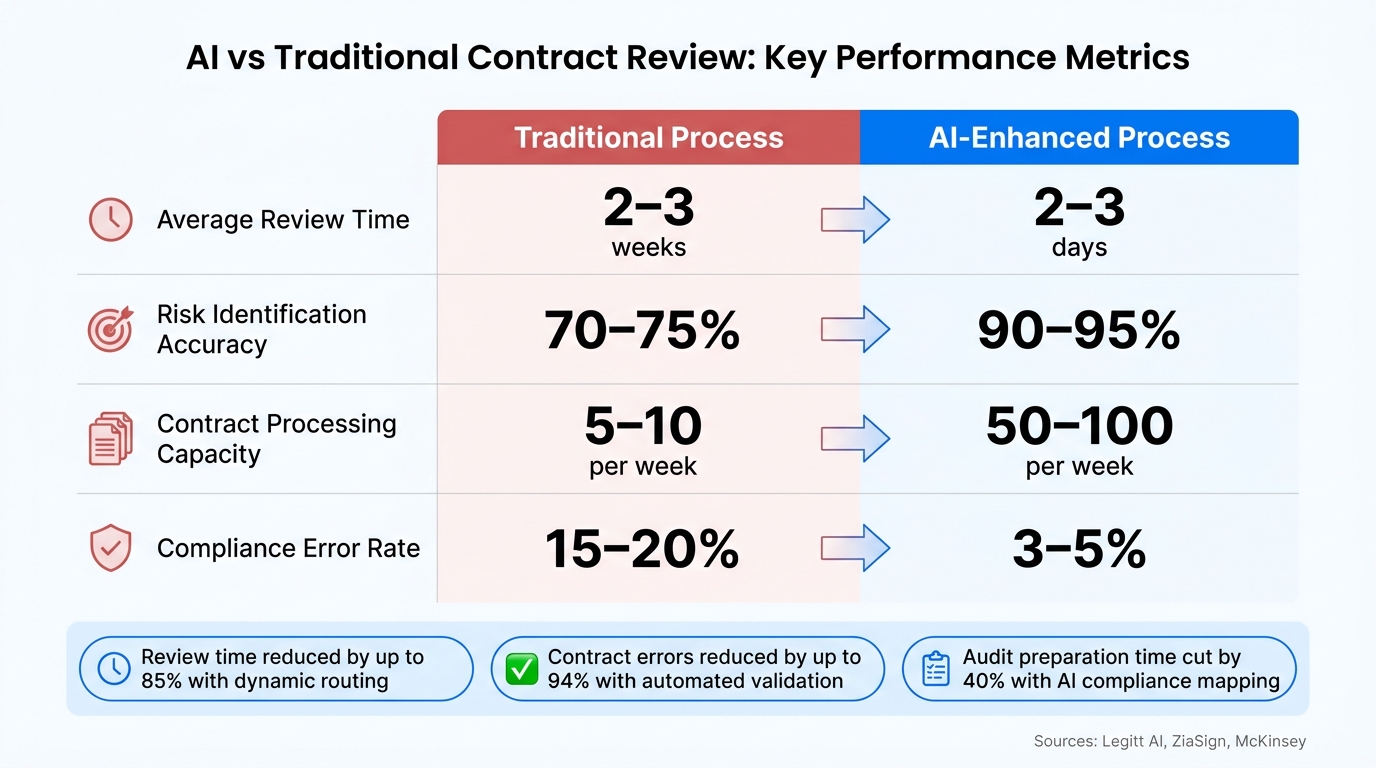
AI vs Traditional Contract Review: Key Performance Metrics
The goal is to turn contract analysis from one-off projects into a continuous operating process.
Workflows for Regular Risk Reviews and Exceptions
Use risk-tiered routing:
- high score -> legal review,
- medium score -> delegated review,
- low score -> automated approval.
Prefer event-driven rechecks (new sub-processor, residency change, amended terms) over annual-only reviews.
Tracking Performance and Measuring Value
| Metric | Traditional Process | AI-Enhanced Process |
|---|---|---|
| Average Review Time | 2-3 weeks | 2-3 days |
| Risk Identification Accuracy | 70-75% | 90-95% |
| Contract Processing Capacity | 5-10 per week | 50-100 per week |
| Compliance Error Rate | 15-20% | 3-5% |
Track both speed and quality: exception closure rate, missed-risk rate, and audit prep effort.
Governance and Risk Considerations for AI Adoption
For sensitive legal documents, ensure secure processing environments and strong controls over access, retention, and model behavior.
Define clear ownership:
- Procurement -> intake and tiering
- Security/Privacy -> policy and controls
- Legal -> clause library and fallback language
- Finance -> commercial exposure and SLA credits
Conclusion: Moving Vendor Risk Management Forward with AI
Poor contract risk management can create major revenue leakage and compliance exposure. AI changes this by converting contract text into structured, monitorable risk data with faster review cycles and higher consistency.
For Indian organisations, this is especially important as vendor ecosystems grow and regulatory obligations under DPDP and sectoral guidance increase. Platforms like CISOGenie help connect clause-level risk to broader GRC evidence and control frameworks, enabling continuous audit readiness.
FAQs
Which contracts should we automate first?
Start with high-volume, high-risk, and frequently amended contracts - especially vendor agreements and procurement contracts where compliance obligations are dense.
How do we make AI risk scores audit-defensible?
Use transparent scoring logic, traceable inputs, documented decisions, and regular model validation against policy standards and human review.
How can we maintain continuous contract compliance during renewals and amendments?
Adopt event-driven AI monitoring that rechecks contract risk whenever terms, vendors, or regulatory expectations change, and links findings directly into remediation workflows.