Beyond ISO 27001: A Practical Guide to ISO 27017 and ISO 27018 for Cloud-First Organizations
-
 Shankar Jayaraman
 - 07 Aug, 2026
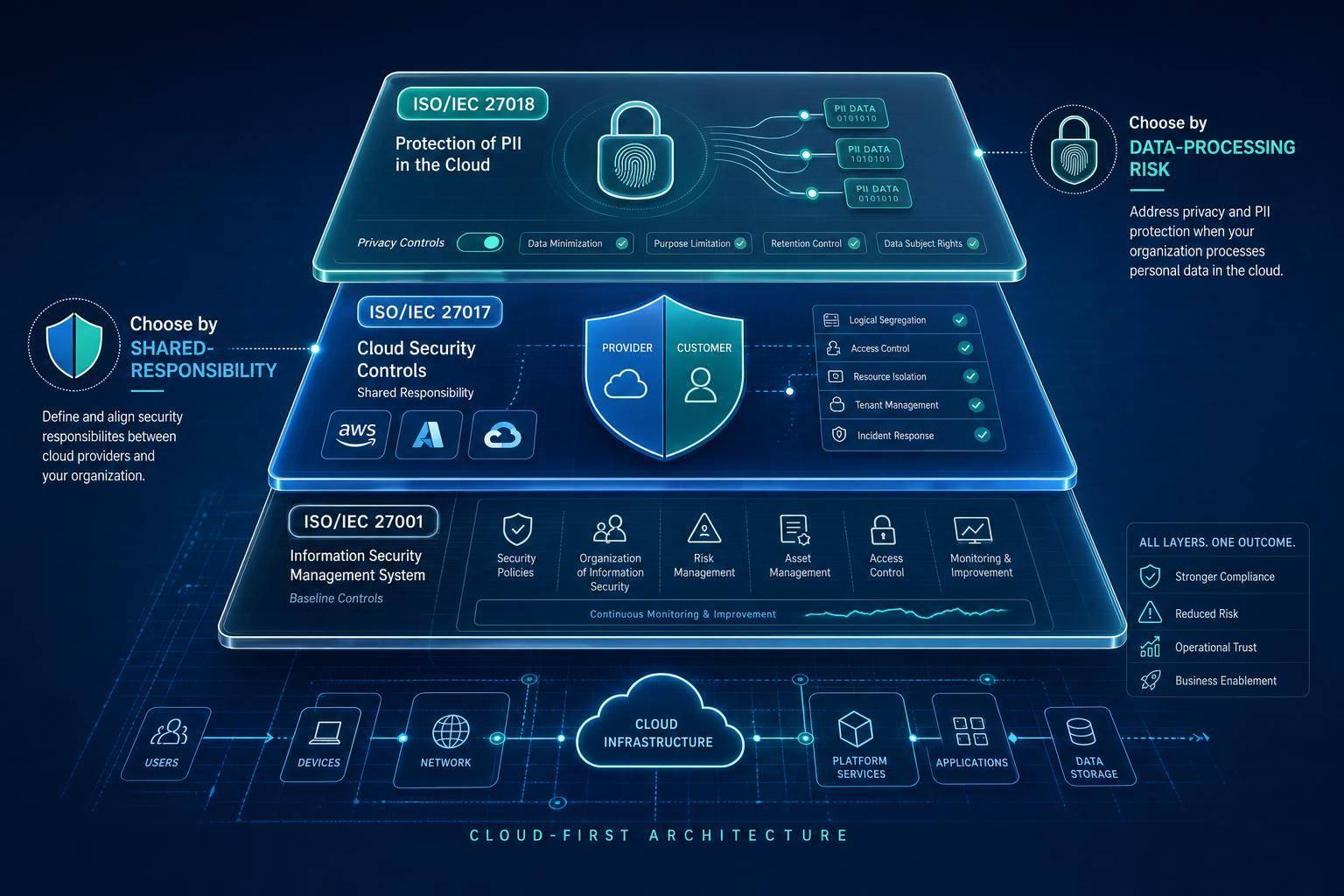
If I had to put it simply: start with ISO 27001, add ISO 27017 for cloud control gaps, and add ISO 27018 when you process customer PII in public cloud.
Here’s the short answer:
- ISO 27001 gives me the ISMS base.
- ISO 27017 helps when cloud roles are unclear, especially in SaaS, IaaS, and multi-cloud setups.
- ISO 27018 helps when I process personal data for customers and need tighter privacy controls.
- ISO 27017 and ISO 27018 are not standalone certifications. They sit within an ISO 27001 audit scope.
- Teams often add these extensions during surveillance or recertification, with ~1–2 extra audit days.
- When firms use 27001 + 27017 + 27018 together, some report 40%–60% less time spent on vendor security questionnaires.
If you’re deciding what to do next, I’d keep it this simple:
- Pick 27017 first if your pain point is shared responsibility, tenant isolation, VM hardening, or cloud audit findings.
- Pick 27018 first if your pain point is sub-processors, deletion of customer data, processor duties, or GDPR/DPDPA pressure.
- Keep one SoA and one control programme so the same evidence can support more than one framework.
Quick Comparison
| Standard | What I use it for | Best fit | Main trigger |
|---|---|---|---|
| ISO 27001 | ISMS base | Any organisation | Need a security management system |
| ISO 27017 | Cloud-specific security controls | Cloud-first firms, CSPs, SaaS | Shared responsibility and cloud setup gaps |
| ISO 27018 | PII protection in public cloud | SaaS, fintech, health-tech, processors | Customer data handling and privacy duties |
That’s the core decision in one view: fix the cloud gap first, the privacy gap next, and keep both tied to ISO 27001.
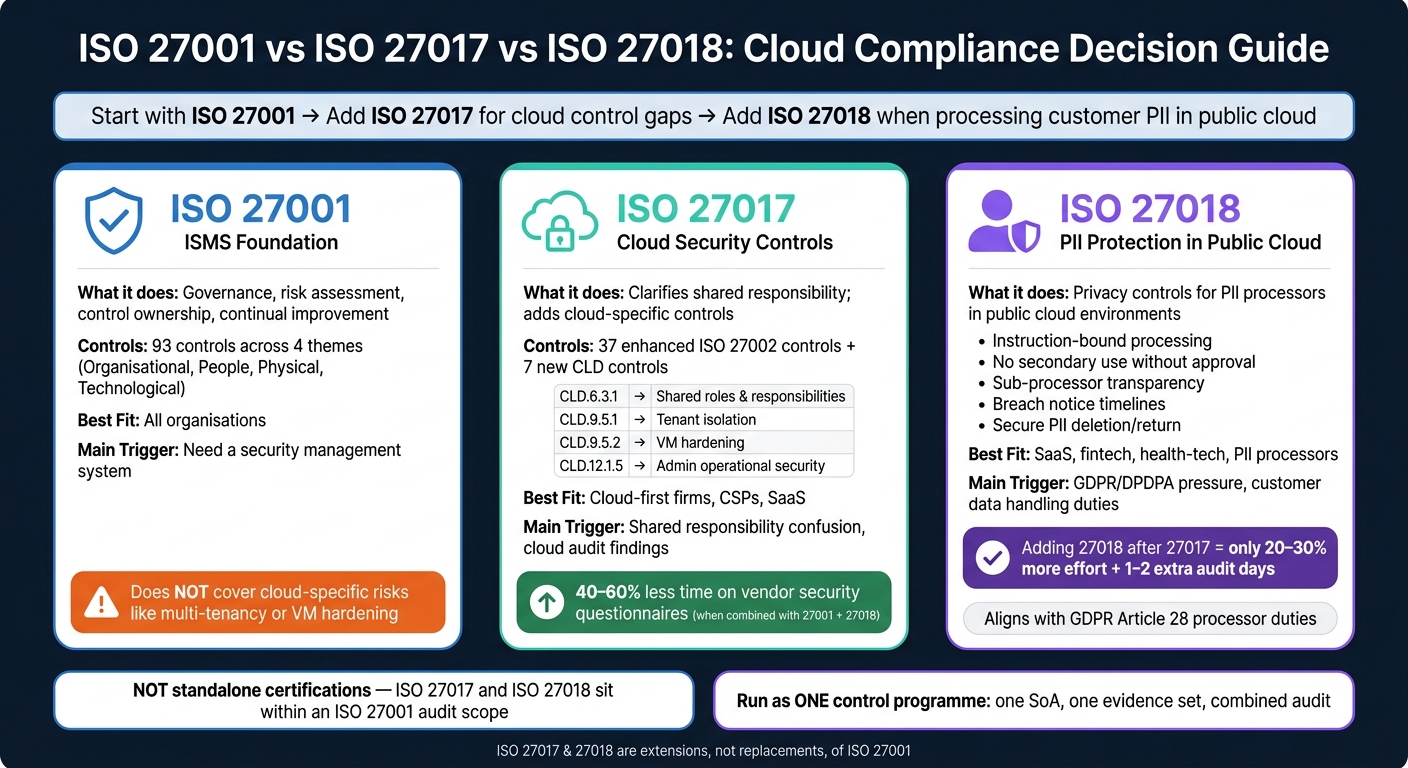
ISO 27001 vs ISO 27017 vs ISO 27018: Cloud Compliance Decision Guide
ISO 27001, ISO 27017, ISO 27018, ISO 27701 and ISO 42001 Explained
1. ISO 27001
ISO 27001 sets the backbone of an ISMS: governance, risk assessment, control ownership, and continual improvement. In the 2022 update, Annex A was grouped into 93 controls under four themes - Organisational, People, Physical, and Technological - down from 114 in the earlier version. That broad scope is the main point. It defines the management system, but not the nuts and bolts of cloud setup.
Because ISO 27001 is technology-neutral, it doesn’t spell out cloud-specific implementation. So there are gaps around risks such as multi-tenancy, VM hardening, hypervisor security, and data deletion and return controls. That’s why cloud-first teams often pair ISO 27001 with ISO 27017 and ISO 27018.
On its own, ISO 27001 is often enough for organisations with limited cloud-specific or PII duties. The usual trigger to go further is simple: a customer contract, government deal, or regulated engagement asks for cloud controls, or the business is processing customer data in a public cloud. In practice, many teams add these extensions during a surveillance or recertification audit, and the extension usually means 1–2 extra audit days. That’s where ISO 27017 comes in, with controls aimed at cloud use.
2. ISO 27017
ISO 27017 is a cloud security code of practice that builds on ISO 27002 for both cloud providers and cloud customers. Put simply, ISO 27001 sets up the ISMS, and ISO 27017 shows how that system should work in cloud setups. It adds cloud-focused guidance to 37 existing ISO 27002 controls and brings in 7 new “CLD” controls that do not exist in the base standard.
One thing to be clear about: ISO 27017 is not a standalone certification. It sits on top of an existing ISO 27001 ISMS. Its value shows up most clearly when cloud contracts make it hard to tell where the provider’s job ends and the customer’s job begins.
A key control here is CLD.6.3.1. It requires clear, written documentation of who is responsible for what between the cloud provider and the customer. That sounds simple, but in SaaS and multi-cloud setups, ownership often gets muddy. One team assumes the provider handles something. The provider assumes the customer does. That’s where audit trouble starts. Auditors often flag poor documentation of provider-versus-customer duties, and CLD.6.3.1 is meant to fix that gap.
ISO 27017 also deals with cloud risks that ISO 27001 does not spell out in enough detail. CLD.9.5.1 requires providers to show tenant isolation across compute, storage, and network layers. CLD.9.5.2 requires hardening of virtual machine images and hypervisors, which goes past normal on-premises controls.
The controls that help most are usually the ones that deal with the same weak spots auditors keep finding.
| New CLD Control | What It Governs | Typical Owner |
|---|---|---|
| CLD.6.3.1 | Shared roles and responsibilities | Provider & Customer |
| CLD.8.1.5 | Removal of cloud service customer assets | Provider |
| CLD.9.5.1 | Segregation in virtual computing environments | Provider |
| CLD.9.5.2 | Virtual machine hardening | Provider |
| CLD.12.1.5 | Administrator’s operational security | Provider |
| CLD.12.4.5 | Monitoring of cloud services | Customer |
| CLD.13.1.4 | Alignment of security management for virtual and physical networks | Provider |
ISO 27017 makes the most sense when shared responsibility is blurry, cloud isolation is a major concern, or enterprise customers want deeper cloud controls. Organisations that hold ISO 27001, 27017, and 27018 together report a 40%–60% drop in time spent completing vendor security questionnaires. That can save a lot of back-and-forth during due diligence and vendor risk reviews.
If cloud architecture keeps showing up in audit findings, customer checks, or vendor reviews, 27017 should move up the list. And while 27017 helps close cloud security gaps, 27018 focuses on personal data protection in public cloud environments.
A revised edition is expected in late 2026. So yes, the standard is still moving. But for now, the current control set remains the practical baseline.
3. ISO 27018
If ISO 27017 deals with cloud security ownership, ISO 27018 is about handling personal data in public cloud setups. It applies to cloud service providers and SaaS vendors acting as PII processors, not data controllers. So if your organisation processes customer names, email addresses, or behavioural data on behalf of another entity, this is the standard that maps most closely to those duties. In many cases, it becomes the next practical move once audit pressure shifts from plain cloud security to privacy.
ISO 27018 builds on ISO 27001 and ISO 27002 by adding privacy-focused controls for how PII is collected, processed, disclosed, and deleted in public cloud environments. One thing matters here: don’t present ISO 27018 as a standalone certification. It should be described as ISO 27001 certification with ISO 27018 controls in scope.
This is the part that fills the gap left by ISO 27017. In day-to-day terms, the controls that tend to matter most revolve around:
- sub-processor transparency
- secure return or deletion of PII
- purpose limitation
- lawful access requests
That means telling customers who your sub-processors are, giving advance notice before changes, passing privacy duties down through contracts, and setting out how PII is returned or deleted at the end of a contract. That includes backups too, within a defined timeframe.
| Privacy Principle | ISO 27018 Practical Requirement |
|---|---|
| Instruction-bound processing | Process PII only as instructed; obtain consent for additional processing |
| No secondary use without approval | Do not use PII beyond documented instructions |
| Limit retention and temporary copies | Define retention and deletion policies; restrict temporary file creation |
| Disclose sub-processors and storage locations | Notify customers of sub-processors and countries where PII may be stored or processed |
| Define breach notice timelines | Establish breach notification procedures with defined timelines |
ISO 27018 tends to move up the list for SaaS companies handling end-user data, healthcare tech firms dealing with PHI, and regulated businesses subject to GDPR, CCPA, or HIPAA. It also helps when enterprise procurement teams want proof of PII handling that goes beyond baseline security. If you already have ISO 27017 in place, adding ISO 27018 often takes only 20% to 30% more effort and may add just one to two days to the audit.
ISO 27018 also lines up closely with GDPR Article 28 processor duties. That’s a big reason it comes up during enterprise procurement and vendor due diligence. On paper, these controls look straightforward. The harder part is proving they work when audits start, customers ask hard questions, or a deletion request lands in your queue. That’s where ISO 27018 earns its keep: in manual reviews, audit speed, procurement scrutiny, and day-to-day proof that your PII handling process holds up.
How Each Standard Solves Cloud Compliance Challenges in Practice
Knowing what each standard covers is only half the job. The smarter way to prioritise is by the cloud gap it fixes: shared responsibility, PII handling, or audit pressure. That cuts through the noise and gets you to the next question fast: which control gap is hurting day-to-day operations first?
Shared responsibility confusion is where teams slip up most often. When a misconfiguration shows up, the first question is usually simple and painful: who was supposed to stop this? ISO 27017 deals with that directly. Its CLD.6.3.1 control requires you to define that split in writing, using a cloud-specific responsibility matrix for your own setup.
Then come two other common trouble spots: multi-tenancy risk and sub-processor complexity. ISO 27017 looks at tenant segregation and asks for proof across compute, storage, and network layers. ISO 27018 tackles the people and data side of the problem through sub-processor disclosure and change notices.
The table below links common cloud compliance issues to the standard involved and the kind of proof auditors usually ask for.
| Cloud Challenge | Standard | Typical Auditor Evidence Request |
|---|---|---|
| Shared Responsibility Confusion | ISO 27017 (CLD.6.3.1) | Detailed Responsibility Matrix (RACI); Service Level Agreements (SLAs) |
| Multi-tenancy Risk | ISO 27017 (CLD.9.5.1) | Hypervisor security configs; Logical network segregation diagrams; Penetration test reports showing tenant isolation |
| Sub-processor Complexity | ISO 27018 | Publicly available sub-processor list; Records of customer notification for sub-processor changes |
| PII Misuse or Retention | ISO 27018 | Data processing agreements (DPAs); PII flow maps; Data deletion certificates |
| Administrative Access Risk | ISO 27017 (CLD.12.1.5) | MFA enforcement logs; Least-privilege review records for cloud console access |
| Audit Fatigue | Combined programme | Centralised evidence store; Cross-framework control mapping |
The pattern is pretty clear. Each extension lines up with a specific audit failure point, not just a box in a policy document.
That’s why it helps to treat ISO 27001, 27017, and 27018 as one control programme. Done well, the same evidence can be reused across audits, which cuts duplicate testing and saves teams from repeating the same work.
Once those gaps are mapped, automation starts to matter. Cloud environments change all the time, so evidence has to stay current too. As an AI-native, agentic GRC platform, CISOGenie centralises control mapping and evidence collection across ISO 27001, ISO 27017, ISO 27018, SOC 2, GDPR, and India’s DPDPA, so one evidence set can support multiple frameworks, helping teams move towards continuous compliance instead of last-minute audit scrambling. That makes the trade-offs in the next section much easier to judge.
Pros, Cons, and Best-Fit Scenarios
For cloud-first organisations, the main question is simple: which gap will hurt you first - cloud operations, privacy duties, or both?
That’s where these standards help. But there’s a catch. You shouldn’t treat them like separate tracks. The better move is to use them together and close the biggest gap first.
| Standard | Key Advantages | Trade-offs | Best-Fit Organisation Type | Common Mistake if Adopted in Isolation |
|---|---|---|---|---|
| ISO 27001 | Baseline ISMS framework; technology-agnostic risk management. | Technology-neutral; leaves cloud-specific risks such as multi-tenancy, VM hardening, and shared responsibility open to interpretation. | All organisations seeking a baseline security posture. | Assuming ISO 27001 alone covers cloud shared responsibility and PII handling. |
| ISO 27017 | Clarifies shared responsibility; adds 7 cloud-specific controls that have no equivalent in ISO 27002. | Adds cloud-specific audit scope and documentation burden. | Cloud Service Providers (CSPs) and cloud-first enterprises. | Using generic responsibility matrices instead of service-specific documentation for the actual contractual arrangement. |
| ISO 27018 | Strengthens PII protection; supports sub-processor transparency; prohibits using PII for marketing. | Narrow focus on PII; does not cover general cloud infrastructure security such as VM segregation. | SaaS, fintech, and health-tech firms processing customer PII. | Treating privacy as paperwork instead of implementing operational controls such as data deletion and sub-processor reviews. |
The smart way to run this is as one control programme. That helps you avoid duplicate evidence, repeated testing, and extra audit work. A shared control set also makes evidence reuse much easier.
When you describe the outcome, be precise. Say ISO 27001 certified with ISO 27017 or ISO 27018 controls in scope - not “ISO 27017 certified” or “ISO 27018 certified.” Those controls should sit inside the same ISMS, not in separate compliance programmes.
Once the fit is clear, line up all three standards in one audit-ready control set. Keep one SoA across ISO 27001 Annex A, ISO 27017 CLD, and ISO 27018 privacy controls. That control map is what makes prioritisation, evidence reuse, and continuous compliance practical.
Conclusion
After you map the control gaps, the next call is pretty straightforward: look at maturity, cloud exposure, and how your organisation handles data.
ISO 27001 comes first. It forms the ISMS base and is the prerequisite for ISO 27017 and ISO 27018. If your ISO 27001 programme is still maturing, start there.
Once that base is in place, the next move depends on where the risk sits. If you work heavily in the cloud and shared-responsibility lines are blurry, ISO 27017 should be your first next step. It helps spell out who owns what between the cloud provider and the customer, which is a gap ISO 27001 does not cover by itself.
ISO 27018 follows when personal data is in scope. If you process large volumes of customer PII in a public cloud as a processor, ISO 27018 is the layer that shows stronger privacy discipline.
The practical approach is simple: review your ISO 27001 maturity, your cloud dependence, and your processor duties. Then close the biggest gap first, fold the extensions into your existing Statement of Applicability, and run a combined audit. That keeps the programme audit-ready, cuts duplicate evidence, and builds trust across ISO 27001, ISO 27017, ISO 27018, and related frameworks.
FAQs
Do I need ISO 27017 if I already have ISO 27001?
You don’t need ISO 27017 just to keep your ISO 27001 certification.
But once cloud-specific issues come into play, ISO 27017 starts to look less like a nice-to-have and more like a practical next step. That’s especially true when you need clearer direction on areas like shared responsibility, virtual machine hardening, and multi-tenant isolation.
The simplest way to look at it: ISO 27017 extends ISO 27001 for cloud use. It helps tighten cloud governance and gives clearer assurance that cloud-specific risks have been dealt with.
When should I prioritise ISO 27018 over ISO 27017?
Prioritise ISO 27018 if your organisation is a public cloud service provider that processes PII on behalf of customers.
ISO 27017 deals with general cloud security and shared responsibility. ISO 27018 goes a step further on privacy. It focuses on duties like data minimisation, purpose limitation, and clear disclosure around sub-processors or government access requests.
So if your goal is to reassure customers or meet strict privacy compliance requirements, ISO 27018 should come first.
How can I manage ISO 27001, 27017, and 27018 without duplicate audit work?
Treat ISO 27001, ISO 27017, and ISO 27018 as one layered framework, not three separate audits.
Here’s the simple way to look at it: ISO 27001 sits at the core. ISO 27017 and ISO 27018 build on top of it. They extend ISO 27001, which means they can’t be certified on their own.
So instead of running them as separate workstreams, fold ISO 27017 and ISO 27018 into your existing ISMS. Bring the controls together in one Statement of Applicability (SoA), rather than splitting them across multiple documents.
Your audit also stays straightforward: it remains a single ISO 27001 assessment. The difference is that the scope expands to include cloud services and PII protection.