CCPA vs GDPR vs DPDPA: What Global SaaS Teams Need to Operationalize Differently
-
 Shankar Jayaraman
 - 07 Aug, 2026
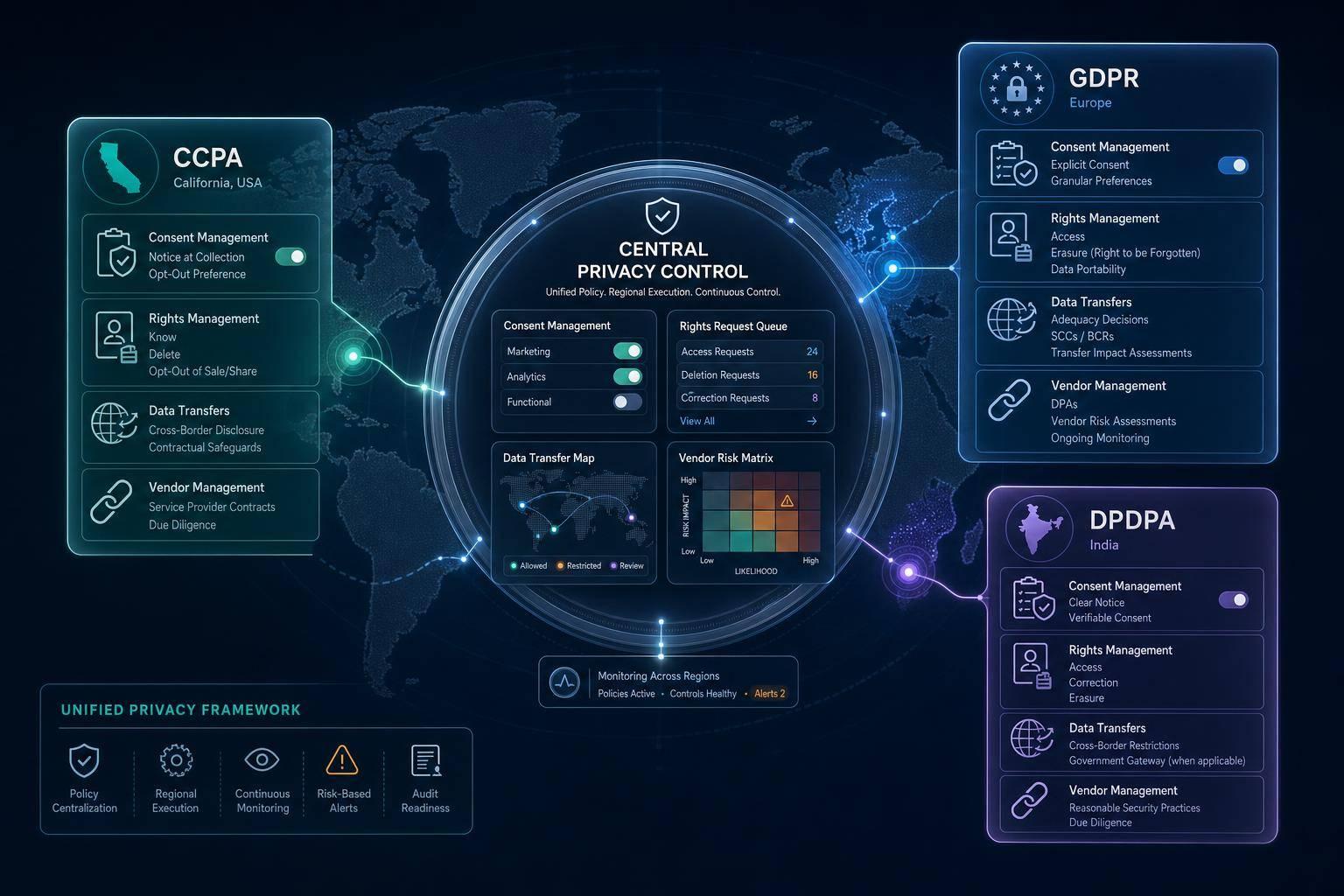
If I run one privacy programme the same way across GDPR, CCPA/CPRA, and India’s DPDPA, I create gaps. The fix is simple: keep one shared base for security, data mapping, vendors, retention, and incident response, then add region-specific branches for consent, rights, transfers, notices, and grievance handling.
Here’s the short answer:
- GDPR is about lawful basis, records, and accountability
- CCPA/CPRA is about notice, opt-out, and “Do Not Sell or Share”
- DPDPA is about affirmative consent, purpose-linked use, and grievance handling
That changes how I set up:
- consent flows
- rights intake and deadlines
- vendor reviews
- transfer checks
- deletion proof
- breach and complaint routes
A few points stand out fast:
- CCPA/CPRA includes a 45-day window for many consumer requests
- GDPR often needs SCCs or BCRs for cross-border data movement
- DPDPA pushes teams to keep clear consent records, multilingual notices, and an India-facing grievance process
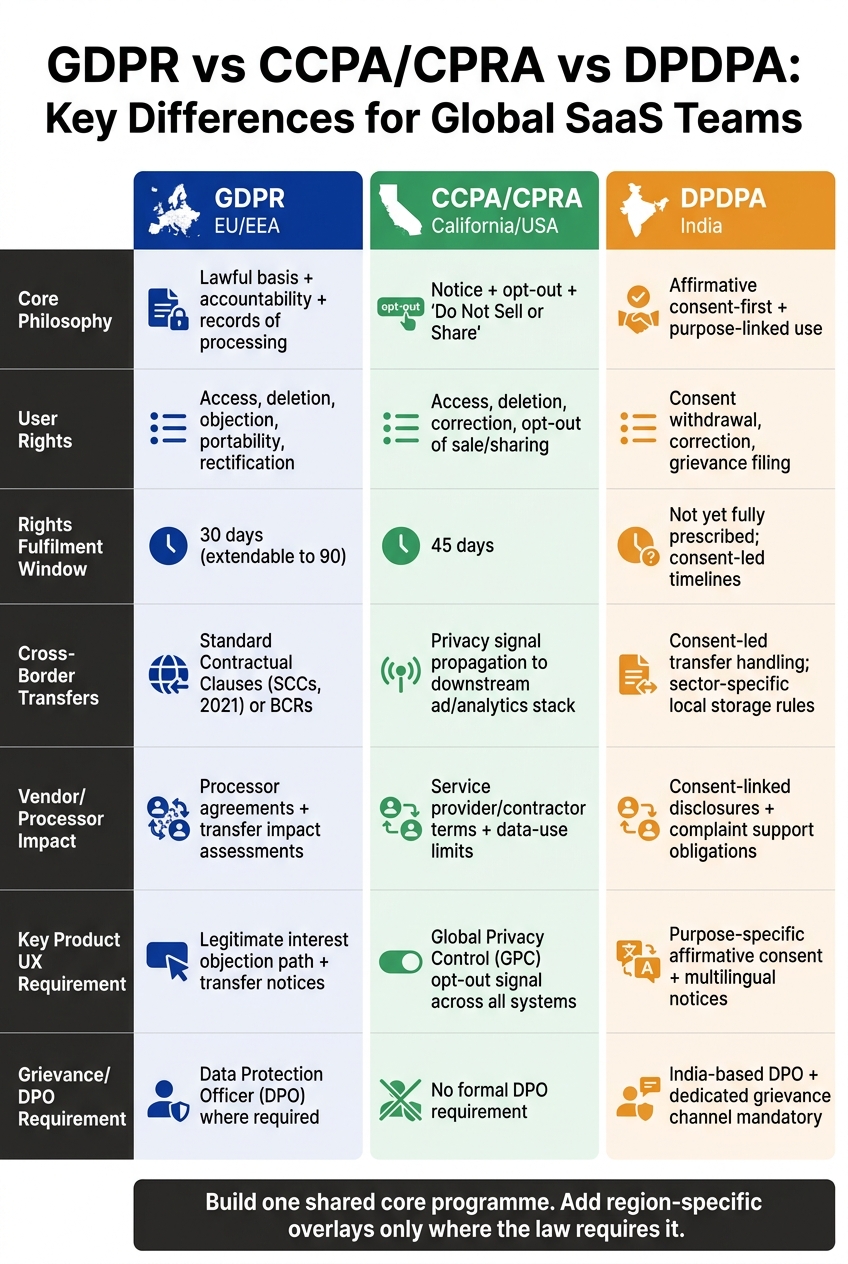
GDPR vs CCPA/CPRA vs DPDPA: Key Differences for Global SaaS Teams
Quick comparison
| Area | GDPR | CCPA/CPRA | DPDPA |
|---|---|---|---|
| Main rule style | Lawful basis + records | Notice + opt-out | Consent-first |
| What I must show | Why data is processed | Whether sale/sharing is disclosed and stopped on request | That valid consent was taken and managed |
| User control | Access, deletion, objection, more | Access, deletion, correction, opt-out | Consent withdrawal, correction, grievance |
| Product impact | Basis logic and objection path | GPC and opt-out signals across systems | Purpose-specific consent and preference control |
| Vendor impact | Processor terms and transfer checks | Service provider/contractor terms and data-use limits | Consent-linked disclosures and complaint support |
| Cross-border focus | SCCs/BCRs and transfer review | Signal flow to ad/analytics stack | Consent-led transfer handling |
My takeaway: I should not build three separate stacks. I should build one shared system that behaves differently when the law says it must.
CCPA vs GDPR vs DPDPA: Where SaaS Teams Must Operate Differently
These branches map straight into product UX, data operations, and vendor controls. Use this matrix to build workflow branches, not to give a high-level recap of the law.
| Dimension | GDPR | CCPA/CPRA | DPDPA |
|---|---|---|---|
| Consent | Support legitimate interest objections and branch for explicit consent where transfer notices require it | Honour Global Privacy Control signals across the stack | Use affirmative consent and granular preference handling in the CMP |
| Rights | Build single intake, tracked ownership, and deadline-based routing | Keep request intake and preference updates consistent across systems | Capture and update granular preferences as part of the consent and rights flow |
| Retention | Tie retention and deletion evidence to the processing activity | Keep deletion records aligned with privacy operations | Use automated purging to meet retention and deletion obligations |
| Transfers | Standard Contractual Clauses (2021 version) remain the baseline for many transfers | Make sure privacy signals flow into downstream systems | Keep transfer handling consent-led and aligned with regional transfer controls |
Consent, notices, and product UX
For product, legal, and GRC teams, consent handling splits in three different ways depending on the law. And each split hits a different part of the stack.
Under GDPR, workflows need to support legitimate interest as a processing basis, with a clear route for users to object. Cross-border transfer notices and transfer mechanisms should sit on their own path, instead of getting mixed into consent.
Under CCPA/CPRA, the big job is stack-wide opt-out propagation. If a user sends a GPC opt-out, that signal needs to move across product, analytics, and downstream systems. If it stops halfway, the workflow breaks.
DPDPA pushes teams towards consent-led design. That means purpose-specific affirmative consent, plus preference updates kept inside the CMP. For SaaS teams, the hard part isn’t only collecting consent. It’s being able to show that the right preference was applied to the right processing activity.
Rights fulfilment, retention, and breach workflows
The clearest difference here is retention and purging.
Automated purging of queries and data helps meet retention and deletion obligations at scale. It also cuts the mess that comes with manual clean-up across regions and data stores. Preserve objection, consent, and deletion history as part of the workflow, because teams need records they can trace later.
Rights fulfilment also needs clean routing. Intake, ownership, status tracking, and deadline handling can’t live in silos if the same request touches more than one system.
Transfers, vendors, and processor contracts
For global SaaS teams, transfer handling is often where one-size-fits-all privacy design starts to crack.
GDPR programmes often rely on Standard Contractual Clauses, and the 2021 version is still the baseline many teams use in practice. That has a direct effect on operations: vendor onboarding, transfer notices, and consent capture need to stay linked, not run as separate workflows.
If data crosses regions, controls need to branch before the data leaves the system. Feed transfer decisions into vendor onboarding and evidence logs. That same mapping should also feed the standard controls and automation described next.
How to Standardise the Core Programme Without Missing Local Requirements
Once you’ve mapped the law-specific splits, the next move is simple in theory but messy in practice: centralise what can stay common and split what has to change by region.
That means drawing a clean line between controls you can run once at a global level and workflows that need their own path in each market.
Controls you can standardise globally
Start with one data inventory and one RoPA-linked inventory map. Done well, this gives you a single place to see how data moves across systems. AI tools can map code, schemas, and infrastructure into one queryable source, which helps with continuous evidence capture.
The same idea applies to vendors and access controls. Instead of handling each request in a different way, set baseline vendor gates such as SOC 2 Type II and ZDR, then run everything through one vendor risk workflow. That way, approvals, attestations, and access reviews all sit in the same workflow.
Workflows that need region-specific handling
This is usually where spreadsheet-led compliance starts to fall apart. These workflows need separate automation branches, not one shared path.
Consent is a good example. You need to branch it by purpose, region, and processing basis. Consent records and revocation trails should stay separate from legitimate-interest handling.
Deletion needs the same kind of split. Standardise the workflow itself, but localise retention periods. You can use a compliance readiness tool to audit these requirements across different frameworks. And before a data source is removed from internal systems, require deletion evidence.
Use the shared core as the base layer for regional playbooks. That split becomes the operating model for the step-by-step blueprint below.
A Step-by-Step Blueprint for Global SaaS Privacy Operations
Turn the shared core into an operating model with the steps below.
Step 1: Map data flows, purposes, regions, and vendors
Start with a living data map. This is the thing that supports rights handling, transfer checks, and vendor decisions.
Tag each data flow with:
- the region where the data starts
- the processing purpose
- the third-party vendor involved
That tagging model is what makes rights requests and transfer assessments workable at scale, instead of turning them into one-off fire drills.
Use automated code, schema, and infrastructure parsing to surface hidden data paths.
Treat this map as the control plane for every downstream workflow.
Step 2: Build region-specific automation and evidence collection
Once the map is in place, connect region-specific automation to it. Consent management tools should collect and store granular permissions for each processing activity. Rights request handling should route into the correct regional workflow, with branches for GDPR, CCPA, and DPDPA, and evidence captured at each step.
Then feed retention, transfer, vendor, and incident records into one evidence trail.
When that evidence trail is in place, governance reviews can spend time on exceptions instead of manual follow-ups.
Step 3: Run governance reviews and track audit-readiness metrics
Governance reviews catch the issues automation can miss. Think vendor changes that slipped through, consent exceptions approved informally, or transfer exposure that grew as the product expanded.
Run these reviews on a fixed cadence, with ownership shared across the CISO, CTO, legal, and GRC leads.
Track a small set of leadership metrics to see if the programme is staying under control:
| Metric | What it signals |
|---|---|
| Unresolved rights requests | Rights-fulfilment backlogs |
| Vendor changes reviewed since the last cycle | Third-party risk and transfer exposure |
| Consent exceptions | Where the default workflow is breaking down |
| Open incidents and exceptions | Response and evidence gaps |
| Control gaps | Audit-readiness issues |
Review these metrics in each governance cycle and assign owners to any drift straight away. If the numbers start to move in the wrong direction, trigger remediation before the next audit cycle.
Conclusion: Build One Programme, Add Local Overlays Where the Law Requires It
Build the core once. Then add local overlays where the law says you must.
That’s the practical way to think about CCPA, GDPR, and DPDPA. The main question isn’t just what changes between them. It’s what you can standardise across all regions, and where you need a regional branch.
In day-to-day terms, this means separating global controls from local process overlays. Keep breach response, deletion, minimisation, encryption, and vendor governance inside the core programme.
The regional pieces need more than a line in a policy document. They have to sit inside product, legal, and vendor workflows.
For example:
- CCPA needs a “Do Not Sell or Share” opt-out mechanism and a 45-day rights fulfilment window.
- GDPR needs transfer mechanisms such as SCCs and BCRs for cross-border transfers.
- DPDPA needs multilingual consent notices, an India-based DPO and grievance channel, consent-manager integrations, and, in some sectors, local data storage requirements.
The risk isn’t only legal. It’s also the cost and confusion that come from running broken-up privacy workflows across teams and regions. One evidence trail, matched to many regional rules, helps global SaaS teams stay audit-ready without piling on manual work.
FAQs
How do I decide what stays global vs regional?
Keep a global baseline for core controls like encryption and data inventory mapping. But make consent handling, breach reporting timelines, and data subject rights region-aware.
Use regional metadata to trigger the right UX, and keep application logic separate from legal requirements. Also maintain a living RoPA that links data fields to purposes and legal bases. That way, you can centralise data inventory while regionalising compliance decisions.
What should I automate first across GDPR, CCPA/CPRA, and DPDPA?
Automate data subject request fulfilment first.
Set up one auditable workflow for access, correction, deletion/erasure, and export. That workflow should track each request from start to finish, with clear logs, approvals, and status changes. It also needs to handle jurisdiction-specific timing and routing, because the deadline and owner can change based on where the person is located.
Once DSRs are running end to end without gaps, add breach-notification timers and consent-record workflows. In plain terms: get the core request process working well first, then layer in the next set of privacy operations.
How do I prove compliance without adding manual work?
Move away from manual evidence collection and switch to automated, continuous compliance workflows. With an AI-native GRC platform like CISOGenie, you can bring policy management, audit logs, and DSR workflows into one central source of truth.
Focus first on:
- automated DSR workflows
- a living automated RoPA
- unified compliance monitoring
- API-driven vendor management
This approach makes compliance evidence a natural output of day-to-day work, instead of something teams scramble to assemble later. It also helps cut manual documentation gaps that often slow audits and create avoidable risk.