GRC Platform vs Spreadsheet: The Real Cost of Manual Compliance at Scale
-
 Shankar Jayaraman
 - 07 Aug, 2026

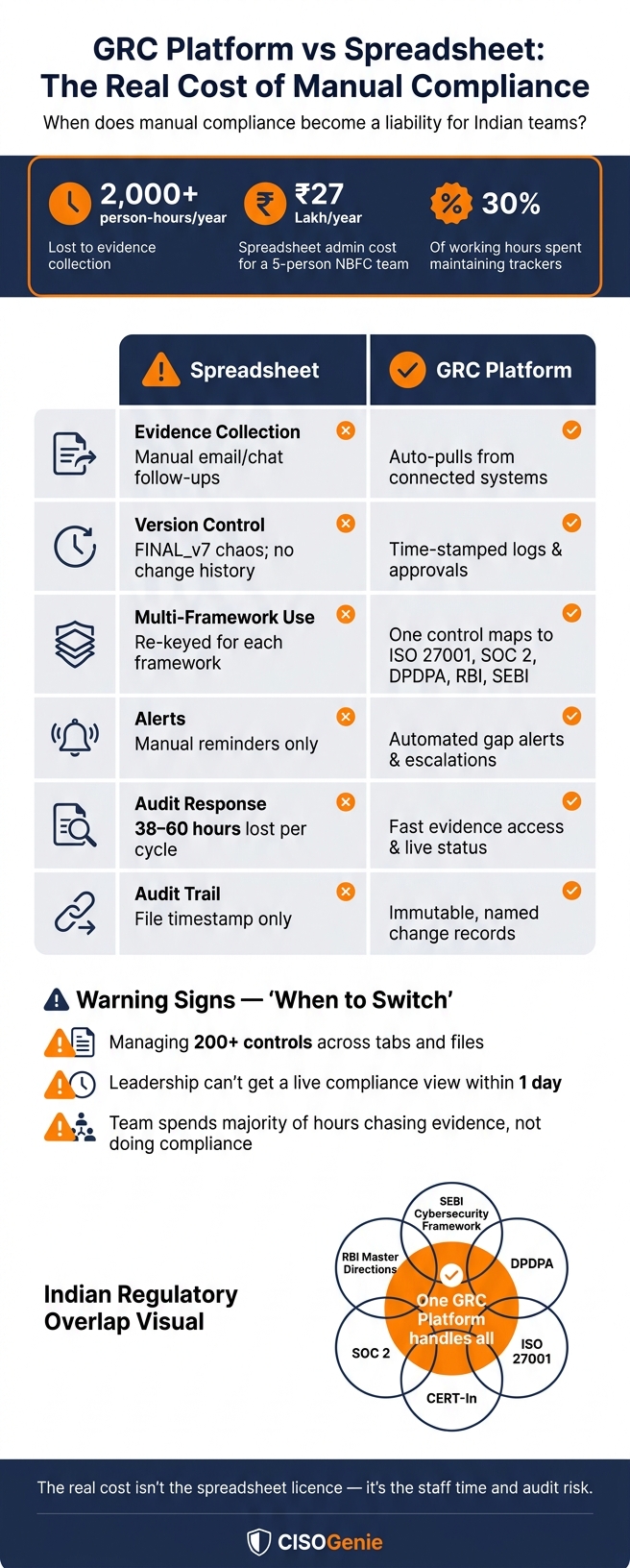
If you manage more than 3 regulations or 75–100 controls, spreadsheets start costing more than they seem. In many Indian teams, evidence collection alone can eat up 2,000+ person-hours a year, and a 5-person NBFC compliance team can spend about ₹27 lakh a year just maintaining trackers.
Here’s the short version:
- Spreadsheets work early on, when controls are few and the team is small.
- They start failing at scale through evidence chasing, version mix-ups, stale mappings, missed review dates, and slow audit responses.
- The main cost is staff time and risk, not the spreadsheet licence.
- A GRC platform puts controls, evidence, owners, alerts, and audit history in one place.
- The move usually makes sense when leadership cannot get a live status view in 1 day, or when the team is stuck doing admin instead of compliance work.
- For Indian firms, this matters more because RBI, SEBI, CERT-In, DPDPA, ISO 27001, and SOC 2 can overlap on the same team.
GRC Platform vs Spreadsheet: Real Cost of Manual Compliance in India
Quick Comparison
| Checkpoint | Spreadsheet | GRC platform |
|---|---|---|
| Evidence collection | Manual follow-ups on email, chat, and shared folders | Auto-pulls from connected systems |
| Version control | Many copies, file-name confusion, weak change history | Time-stamped change log and approvals |
| Multi-framework use | Same control entered again in many places | One control linked across many frameworks |
| Alerts | Manual reminders | Auto-reminders and gap alerts |
| Audit response | Slow, heavy manual prep | Faster status view and evidence access |
| Team effort | High admin load | Lower manual work at scale |
My takeaway is simple: once compliance work spreads across many frameworks, the choice is no longer tool preference. It becomes a question of whether you can stay audit-ready without burning team capacity.
The Hidden Compliance Costs of Spreadsheets
Spreadsheet programmes rarely break in one dramatic moment. They start slipping in quieter ways: evidence chasing, duplicate mapping, and missed alerts. And those cracks usually appear first in three areas: evidence, version control, and alerting.
Evidence Collection Delays, Version Problems, and Audit Bottlenecks
Every audit cycle pulls compliance teams into manual follow-ups. Compliance managers typically lose 38 to 60 hours per audit cycle just reconciling control IDs and chasing evidence owners. That’s admin work. It isn’t compliance.
Version control makes the mess worse. Spreadsheets only offer file-based versioning, so teams end up creating separate copies for audits, internal reviews, or board packs. Over time, those copies drift apart, and no one is fully sure which file is current.
In practice, this turns into FINAL_v7 chaos. You also lose any clean record of who changed a risk rating, when it changed, or why that change was made.
Once evidence becomes hard to collect, another problem shows up fast: you can’t reuse it cleanly across frameworks.
Duplicated Work Across ISO 27001, SOC 2, DPDPA, RBI, and SEBI
The same control often gets entered again and again for ISO 27001, SOC 2, and DPDPA instead of being documented once and reused. As regulatory requirements shift, crosswalks grow stale. Typically, 1 to 3 mappings go stale between versions without anyone noticing until audit preparation.
That duplicate effort turns into a steady maintenance burden. In Indian enterprises, compliance teams spend about 30% of their working hours maintaining trackers instead of doing actual compliance work. For a typical Indian NBFC, spreadsheet administration can cost roughly ₹27 lakh per year for a five-person team.
The same weak spot carries over into vendor oversight, where static trackers make it easy to miss expiries and review gaps.
Missed Alerts and Third-Party Risk Blind Spots
Spreadsheets are passive. They don’t tell teams when reviews expire, vendors lapse, or regulatory requirements change. At that stage, manual tracking is no longer just a workflow headache. It becomes a control failure.
Vendor inventories drift. Renewals slip. Risk ratings sit unchanged until an auditor asks for proof.
| Spreadsheet-led programme | Impact |
|---|---|
| Evidence collection | Manual requests via email or Slack; evidence disconnected from controls; 38–60 hours lost per audit cycle |
| Version control | File-based versioning only; FINAL_v7 naming chaos; no reliable record of who changed a rating or why |
| Multi-framework mapping | Manual re-keying for each framework; same control re-documented across ISO 27001, SOC 2, and DPDPA |
| Alerts and reminders | No automated escalation; missed deadlines for RBI/SEBI filings; last-minute audit rushes |
| Vendor risk | Stale risk posture; separate static files with no link to internal controls or contract dates |
| Audit trail | Only a file timestamp; no immutable change log |
That is where a modern GRC platform changes the operating model.
What a Modern GRC Platform Does Differently
Once manual tracking starts slowing things down, the bigger issue isn’t the checklist. It’s whether your system can still hold the process together.
A GRC platform moves compliance beyond file management and turns it into a managed workflow. Instead of relying on people to chase evidence, update control status, and prep audit files by hand, the platform handles much of that work in the background. This matters most when audit delays, evidence follow-ups, and duplicate work across frameworks are already dragging the team down.
A Single Source of Truth with a Full Audit History
A GRC platform gives each control one record with named owners, linked evidence, and an immutable, time-stamped log of every edit and approval. That matters when evidence, approvals, and alerts need to keep moving without constant follow-up by email or chat.
For RBI and SEBI engagements, this is a big deal. Clear evidence lineage isn’t a nice-to-have. It’s part of showing what changed, who approved it, and when it happened.
Automation for Evidence, Monitoring, and Continuous Compliance
A GRC platform can pull evidence on its own through integrations with cloud infrastructure, identity providers, HR systems, and ticketing tools like Jira. That means fewer screenshots, fewer reminders, and far less last-minute scrambling.
Automated evidence collection and live control checks cut down chase time and flag gaps before audit day arrives. So compliance stops being something teams rush through once or twice a year. It becomes continuous.
Control Reuse Across Frameworks and Business Units
One of the biggest gains is control reuse. Instead of documenting the same thing again and again for each audit, you map one control across many frameworks.
For example, a single access review control can map to ISO 27001, SOC 2, DPDPA, and sector-specific RBI or SEBI requirements at the same time. That’s where the gap becomes obvious: in a spreadsheet-led setup, the same control often gets copied, renamed, and tracked in different places. In a GRC platform, it stays linked to the same underlying record.
| Capability | Spreadsheet-led programme | Modern GRC platform |
|---|---|---|
| Evidence delays | Manual screenshots, email chasing, and broken links | Automated via API integrations with cloud, HR, and IT tools |
| Version control | Point-in-time only; no cell-level history | Immutable, time-stamped logs of every edit and approval |
| Framework reuse | Manual re-keying across multiple tabs or files | Single control maps to ISO 27001, SOC 2, DPDPA, and more |
| Missed alerts | No automated escalation; deadlines slip without notice | Real-time gap alerts with automated task reminders |
| Audit trail | File timestamp only; no record of who changed a rating or why | Full change history with named owners and approval records |
At that point, the question isn’t just what features the platform has. It’s whether the spreadsheet is still doing the job well enough to trust it.
When to Move from Spreadsheets to a GRC Platform
Signs That Spreadsheets Are Breaking Down
When evidence chasing, version drift, and alert misses become normal, this stops being an efficiency issue. It becomes a control failure.
Spreadsheets usually don’t collapse in one dramatic moment. They wear down bit by bit. First, manual updates become part of the day. Then evidence chasing eats into working hours. After that, reporting starts slipping.
A few signs tend to show up early:
- Your team is spending a big share of working hours chasing evidence instead of doing compliance work
- Leadership can’t get a live compliance view without days of manual aggregation
- You’re managing more than 200 controls across tabs and files
If leadership can’t get a current compliance view within a day, the process has already outgrown spreadsheets.
One signal is a warning. Two or more together means the spreadsheet is no longer just awkward to use - it’s a liability.
Once these symptoms show up, the next move is simple: put a ₹ figure on the operating cost and show leadership what the current setup is doing.
Building a Business Case for Leadership
The cost of staying on spreadsheets rarely sits in one neat line item. That’s why it often slips through without much pushback. The better way to present it is to translate spreadsheet overhead into annual staff time, delayed audits, and slower sales or procurement cycles. Delayed certifications and slow responses to security questionnaires can leave enterprise procurement stuck in limbo and stretch sales cycles.
For BFSI entities in India, this goes beyond internal inefficiency. Repeated audit observations about weak compliance infrastructure can affect an institution’s RBI risk rating, potentially leading to business restrictions. A spreadsheet won’t shield you from that.
When you present the case to leadership, keep it grounded. Put the numbers in ₹ terms. Tie the request to a clear regulatory deadline or the next audit window. And frame the platform as a capacity decision, not a software purchase.
A Low-Friction Path to Migration
The shift doesn’t need to be messy. A phased migration usually takes 4 to 8 weeks.
The path is fairly direct:
- Inventory all active frameworks
- Map overlapping controls
- Migrate high-friction workflows first; access reviews, vendor oversight, and incident evidence often create the most audit pressure
- Run one parallel audit cycle to verify data integrity
- Retire the spreadsheet from active compliance use
The goal is a controlled cutover, not a one-day overhaul.
How CISOGenie Fits This Shift and What Leaders Should Take Away
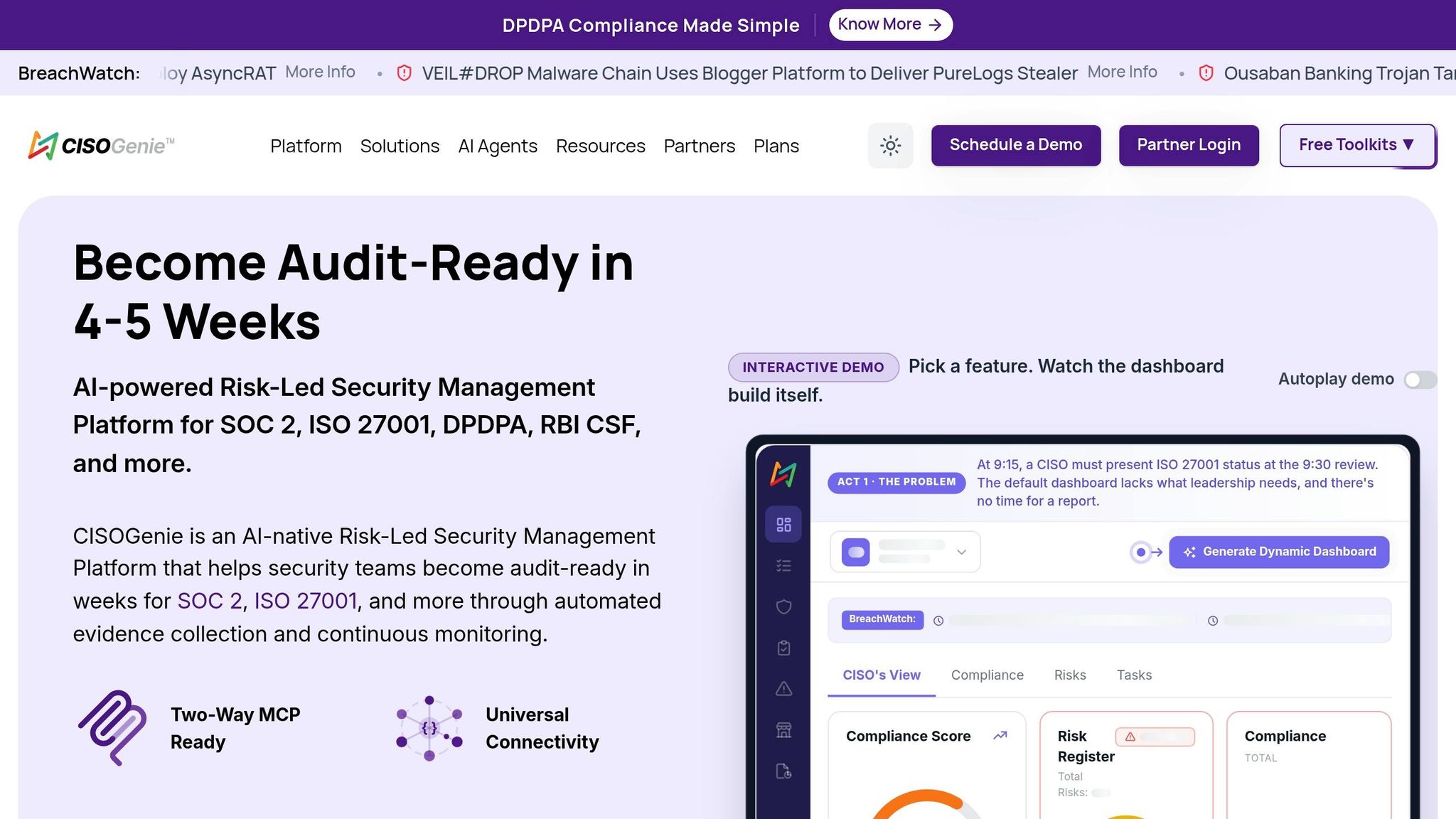
Once spreadsheets stop scaling, the next step is simple: pick the platform that cuts the most manual work with the least hassle.
How CISOGenie Addresses Manual Compliance Pain Points
CISOGenie uses AI agents to automate evidence collection, control mapping, and vendor risk workflows. For Indian enterprises dealing with overlapping mandates such as DPDPA, RBI Master Directions, SEBI cybersecurity frameworks, ISO 27001, and SOC 2, that has a direct day-to-day impact. One access review can support ISO 27001, SOC 2, DPDPA, and sector rules without duplicate entry.
CISOGenie’s immutable audit trail keeps every edit, attestation, and upload as tamper-evident records. That matters during RBI and SEBI inspections, and it’s something spreadsheets can’t provide in a dependable way. Its deployment model also supports India-focused data residency needs, which is especially relevant for BFSI organisations subject to DPDPA and RBI requirements.
That is the bar to use when judging any GRC platform: automation depth, auditability, and data residency.
Key Criteria to Evaluate Before Buying Any GRC Platform
Judge platforms by operational impact, not by how many boxes a demo appears to tick.
Framework coverage and control reuse: Check whether one control can map across ISO 27001, SOC 2, and DPDPA without duplicate setup. If a platform needs separate configuration for each framework, you’ve swapped one manual process for another.
Automation depth: Check whether native integrations with cloud infrastructure, identity providers, and ITSM tools make evidence collection actually automated instead of relying on manual uploads. Also check whether the platform alerts you when an automated test fails to run, not only when it fails.
Audit trail integrity, deployment flexibility, and data residency: Check whether the platform keeps tamper-evident change logs and supports local data handling. A global GRC tool that stores data outside India can create a compliance issue of its own.
Automatic propagation of regulatory changes: Check whether the platform updates linked controls automatically when a new RBI circular or CERT-In directive is issued, or if your team still has to handle that by hand.
These criteria help you see whether a platform cuts the compliance burden or just moves it from one place to another.
Conclusion: The Real Cost Is Not the Spreadsheet Licence
A spreadsheet licence costs ₹0. Running compliance on spreadsheets does not. In a typical Indian NBFC, a team of five can spend about ₹27 lakh per year in staff capacity on manual spreadsheet administration alone. That’s time going into work a platform can automate.
The table below shows the factors that tend to shape the decision most.
| Stay with spreadsheets | Adopt a conventional GRC platform | Adopt an AI-driven GRC platform such as CISOGenie | |
|---|---|---|---|
| Automation depth | Manual screenshots, email chasing, and broken links | Reduced manual effort; some configuration still required | AI-driven evidence collection and control mapping with automated gap detection |
| Audit trail integrity | File timestamp only; no record of who changed a rating or why | Centralised logs; manual updates when frameworks change | Immutable, time-stamped records of every edit, attestation, and approval |
| Data residency | No controls; data wherever the file is stored | Depends on vendor deployment model | Deployment model supports India-focused data residency needs |
The real test is whether the platform reduces manual compliance enough to scale without adding more headcount.
FAQs
How do I know when spreadsheets have stopped scaling for compliance?
Spreadsheets stop scaling when they go from a simple tracking tool to a liability. You can usually spot the shift pretty fast:
- Managing multiple frameworks gets messy and hard to maintain
- Audit prep turns into a days-long scramble for evidence and version history
- You can’t clearly track who changed a control, when they changed it, or why
- Leadership can’t get an immediate view of your compliance posture
At that point, the problem isn’t just inconvenience. It’s drag. If your team spends more time on manual updates and reconciling versions than on actual risk management, spreadsheets are no longer defensible.
What ROI should leaders expect from a GRC platform?
Leaders should view a GRC platform as an investment that moves compliance from reactive, manual work to a continuous part of day-to-day operations. For organisations handling multiple frameworks with dedicated compliance teams, ROI often shows up within 18 to 36 months.
The payoff usually comes from three areas:
- Staff time savings
- Lower audit and external costs
- Risk reduction through continuous monitoring and earlier remediation
How can a GRC platform simplify multi-framework compliance?
A GRC platform makes multi-framework compliance a lot easier by replacing repeated spreadsheet work with a shared control structure. Instead of tracking the same work again and again, teams can map one operational control to many requirements, including SOC 2, ISO 27001 and GDPR.
It also supports evidence reuse. You collect one artefact once, then use it across connected frameworks. Add automated evidence collection and continuous visibility, and teams can skip manual rework and those last-minute audit fire drills.