NIST CSF 2.0 for ISO 27001 Practitioners: A Practical Guide to What Changes, What Carries Over, and What to Do First
-
 Shankar Jayaraman
 - 01 Aug, 2026
If I already run ISO/IEC 27001:2022, I do not need a separate NIST CSF 2.0 programme. In most cases, I can reuse most of my ISMS, map existing controls, and fix only a few gap areas.
Here’s the short version:
- Most ISO 27001 work carries over
- asset inventory
- access control
- monitoring
- incident response
- recovery planning
- CSF 2.0 adds more focus on
- board-level governance
- documented risk appetite
- named accountability
- supply chain risk oversight
- Current vs Target Profiles for gap ranking
- What I should do first
- use the SoA as the base
- map in-scope ISO controls to CSF 2.0 outcomes
- identify gaps in Govern, third-party risk, and recovery proof
- build one control library and one evidence set for ISO, CSF 2.0, SOC 2, and local rules
- Why this matters
- CSF 2.0 now applies to organisations across sectors and countries
- it is showing up more often in RFPs, customer reviews, and cyber insurance forms
- with 70,000+ active ISO 27001 certifications and about 58% of organisations dealing with multiple audits each year, reuse matters
ISO 27001 as the Engine, NIST CSF 2.0 as the Dashboard
A Practical Operating Model
Quick comparison
| Area | ISO 27001:2022 | NIST CSF 2.0 |
|---|---|---|
| Core use | Certification and ISMS control | Risk communication and outcome tracking |
| Format | Clauses 4–10 + Annex A | 6 Functions, 22 Categories, 106 Subcategories |
| Progress view | Certified / not certified | Tiers 1–4 + Current / Target Profiles |
| Main gap for ISO teams | - | Governance, board reporting, supply chain oversight |
My takeaway: if I am already ISO 27001-mature, CSF 2.0 is mostly a mapping and reporting job, not a rebuild. The smart move is to reuse more, remediate selectively, and avoid duplicate evidence work.
What changes in NIST CSF 2.0 for ISO 27001-mature organisations
For ISO 27001:2022 teams, CSF 2.0 mostly tightens governance, accountability, and reporting.
If your ISO 27001 solution is already in good shape, the shift usually isn’t about missing policies. It’s about showing, in plain terms, who owns what, how risk is judged, and what reaches the board.
The new Govern function and stricter enterprise risk governance
For ISO 27001 teams, the main change is the amount of governance detail CSF 2.0 expects.
The gap is rarely that a policy doesn’t exist. More often, it’s around documented risk appetite, named accountability, and regular board reporting. That’s where ISO-mature teams often hit friction when they map their controls to CSF 2.0.
| CSF 2.0 Govern Category | ISO 27001:2022 Mapping | Where the Gap Often Sits |
|---|---|---|
| Organisational Context (GV.OC) | Clause 4.1, 4.2 | Alignment between security scope and business mission |
| Risk Management Strategy (GV.RS) | Clause 6.1, 6.2 | Formally documented and communicated risk appetite |
| Roles, Responsibilities, Authorities (GV.RR) | Clause 5.3 | Named accountability at leadership and board level |
| Oversight (GV.OV) | Clause 9.1, 9.3 | Regular board reporting and management review |
These are usually the first areas where ISO-to-CSF mapping gaps show up.
Supply chain and third-party risk get dedicated coverage
CSF 2.0 adds a dedicated supply chain risk category.
For ISO 27001 teams, the day-to-day gap often comes down to a few things:
- documented supplier criteria
- contract security clauses
- software supply chain checks
- offboarding
This goes further than Annex A controls 5.19 to 5.23. Those controls deal with supplier relationships, but they don’t ask for the same level of formal, governed supply chain risk strategy.
That makes supply chain controls a priority input to the ISO 27001 crosswalk.
Profiles, measurement, and continuous improvement become more actionable
CSF 2.0’s Current and Target Profiles change the conversation from “are we certified?” to “where are we now, where do we need to be, and what’s the priority path to get there?”
That’s a useful shift. Certification tells you one thing. A profile helps you decide what to fix first.
Use the Target Profile to rank gaps against contractual obligations and risk appetite. Then map only the ISO controls that need uplift.
Use this profile to separate true gaps from controls you already cover.
What carries over from ISO 27001 and where controls already align
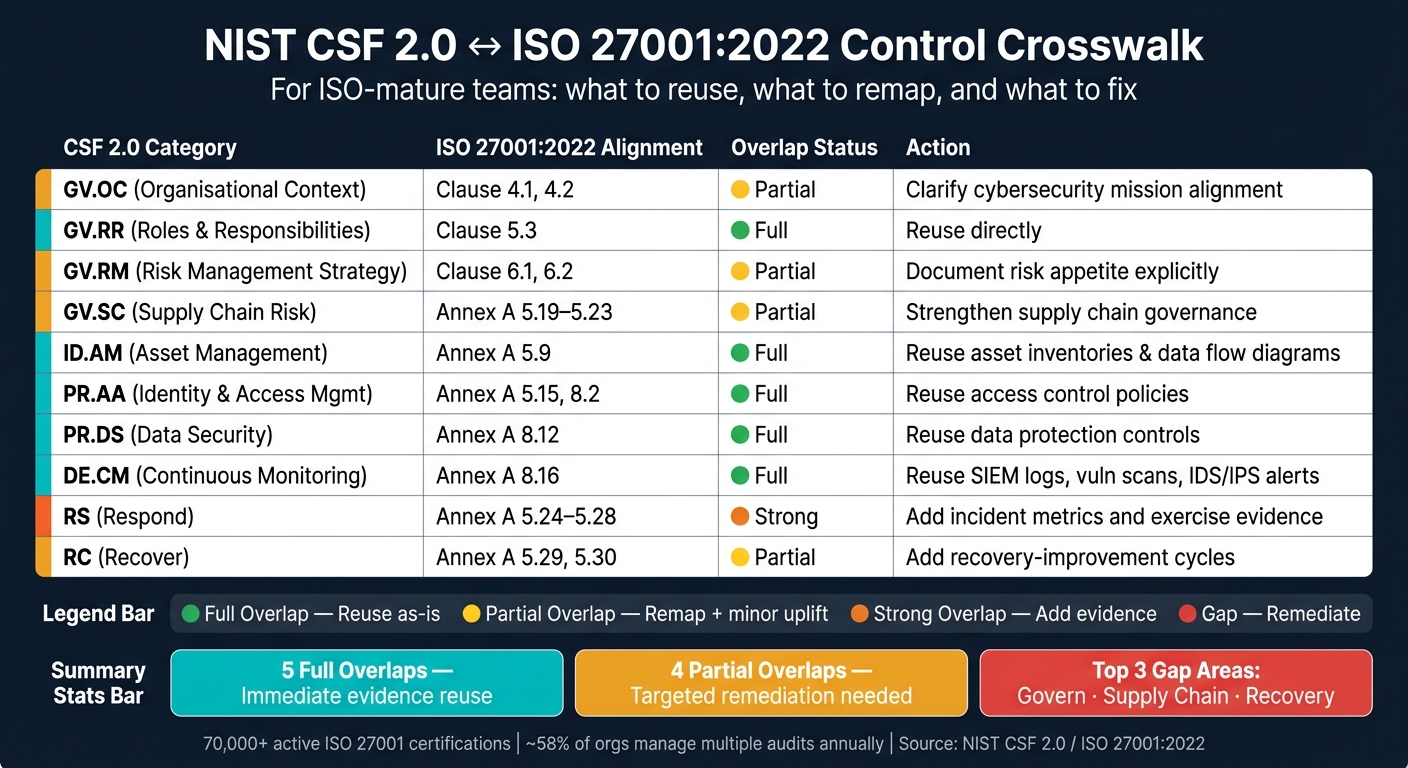
NIST CSF 2.0 vs ISO 27001:2022: Control Overlap & Gap Map for Security Teams
A mature ISO 27001 ISMS already covers a lot of CSF 2.0’s control intent. For ISO 27001 teams, CSF 2.0 mostly changes how you label, report, and rank work that already exists. You’re not starting from scratch. In most cases, you’re re-tagging what’s there and fixing a small set of clear gaps.
High-overlap areas across Identify, Protect, Detect, Respond, and Recover
The five operational CSF functions line up closely with ISO 27001’s management system and Annex A controls.
Your asset inventories (A.5.9) feed straight into Identify. Access control policies (A.5.15, A.8.2) line up with Protect outcomes tied to identity management. Monitoring controls (A.8.16) support Detect. Incident management controls (A.5.24 to A.5.28) cover Respond. And business continuity and recovery plans (A.5.29, A.5.30) support Recover.
Your existing risk register and Statement of Applicability (SoA) matter a lot here. Use the SoA first to split in-scope controls from exclusions before you map anything. That gives you a clean starting point for control consolidation and evidence reuse.
Where ISO 27001 evidence can be reused without rebuilding documentation
You can reuse ISO artefacts by re-tagging them to CSF 2.0 outcomes. In many cases, there’s no need to rewrite policies or rebuild audit packs.
For example, a single vulnerability scan can support both ISO A.8.8 and NIST DE.CM. Management review minutes, internal audit outputs, security policies, and risk management strategy documentation can support the new Govern function. Incident response playbooks built for ISO A.5.24 to A.5.28 can also be used to pilot NIST Respond drills.
The practical move is simple: re-tag existing evidence with NIST CSF category codes, such as GV.OC, ID.AM, or DE.CM, instead of producing separate documents for each framework. Vendor review records, supplier SOC 2 reports, and SLAs can also support GV.SC, though that’s one area where governance and risk oversight often need more work.
That gives you a clean base for control consolidation and evidence reuse.
Crosswalk table: CSF 2.0 categories mapped to ISO 27001 clauses and Annex A
Use this crosswalk to separate real gaps from controls you already evidence. Use full-overlap rows for immediate evidence reuse. Send partial overlaps into remediation.
| CSF 2.0 Function / Category | ISO 27001:2022 Alignment | Overlap | Notes |
|---|---|---|---|
| GV.OC (Organisational Context) | Clause 4.1, 4.2 | Partial | ISO covers context; CSF asks for clearer cybersecurity mission alignment. |
| GV.RR (Roles & Responsibilities) | Clause 5.3 | Full | Direct correlation; named accountability is already required. |
| GV.RM (Risk Management Strategy) | Clause 6.1, 6.2 | Partial | Make risk strategy explicit. |
| GV.SC (Supply Chain Risk) | Annex A 5.19–5.23 | Partial | Supply chain governance needs stronger oversight. |
| ID.AM (Asset Management) | Annex A 5.9 | Full | Asset inventories and data flow diagrams are directly reusable. |
| PR.AA (Identity & Access Management) | Annex A 5.15, 8.2 | Full | Access control policies and privileged access controls satisfy NIST outcomes. |
| PR.DS (Data Security) | Annex A 8.12 | Full | Reusable data protection controls. |
| DE.CM (Continuous Monitoring) | Annex A 8.16 | Full | SIEM logs, vulnerability scan reports, and IDS/IPS alerts are reusable. |
| RS (Respond) | Annex A 5.24–5.28 | Strong | Add incident metrics and exercise evidence. |
| RC (Recover) | Annex A 5.29, 5.30 | Partial | Add explicit recovery-improvement cycles. |
Use these overlaps to build one control library. Then send only the partial overlaps, especially GV.OC, GV.RM, GV.SC, and RC, into remediation. Reuse more, fix only where Govern, supply chain, or recovery maturity is weak, and avoid duplicate documentation.
How to avoid duplicated work and manage multi-framework compliance
Once the crosswalk is done, the next job is simple to describe and painful to ignore: stop treating each framework like its own project.
If you don’t have one shared way of working, every audit turns into a separate workflow. Teams end up repeating the same control checks, pulling the same files, and answering the same questions in slightly different formats. It’s busy work, plain and simple.
Build one control library and one evidence model for multiple frameworks
The fix is one operating model.
Start with ISO 27001 as the base for your control library. Then layer in CSF 2.0 outcomes, SOC 2 criteria, and any sector-specific regulatory needs that apply. After that, tag each control and each piece of evidence with the right framework references, such as the ISO clause, CSF category, and SOC 2 criterion. That way, one control test can support ISO, CSF, and SOC 2 at the same time.
That’s the heart of the map-once, report-many model.
A practical way to do this is to build a master control workbook with:
- rows for each internal control
- columns for ISO clause, CSF 2.0 category, SOC 2 criterion, and any sector regulation that applies
When a questionnaire lands in your inbox, you can filter by the needed framework and pull pre-tagged evidence instead of starting from scratch. It also helps to assign one Framework Owner to maintain the crosswalk and refresh it once a year.
This shared control model becomes the base for continuous evidence collection.
Use continuous compliance workflows instead of periodic audit sprints
Periodic audit sprints tend to fail in the same way every time. Evidence gets old between review cycles, control owners scramble at the last minute, and dashboards show a frozen picture instead of what’s happening now.
A better approach is continuous evidence generation. That means collecting items like vulnerability scans, access reviews, vendor assessments, and policy records as part of normal operations. In that setup, audit readiness becomes an ongoing state, not a six-week fire drill.
Automation helps, but only after the control model is unified.
An AI-native GRC platform like CISOGenie supports this approach by using automated workflows to collect evidence from connected systems, record the source, timestamp, and owner, and map that evidence to the right framework outcomes in real time. Centralised dashboards show control gaps early. Vendor risk tracking, policy management, and multi-framework reporting also run from the same platform.
Comparison table: manual framework management vs AI-driven compliance automation
| Area | Manual Framework Management | AI-Driven Compliance Automation |
|---|---|---|
| Audit preparation | 12–18 hours per questionnaire; manual evidence gathering | Automated mapping and evidence retrieval; real-time readiness |
| Evidence collection | Periodic sprints; manual artefact gathering | Continuous monitoring; automated technical evidence pulls |
| Control visibility | Static spreadsheets | Centralised dashboards with real-time status updates |
| Vendor risk tracking | Manual questionnaires and static reviews | Automated supply chain risk management (GV.SC) |
| Framework mapping | Duplicated effort for each new standard or regulation | Unified control library; map once, report many |
| Cost / effort | High manual effort | Reduced breach costs and audit overhead |
Automation shifts the team’s time away from chasing evidence and toward risk analysis. That sets up the gap-assessment work that comes next.
What to do first: a step-by-step adoption plan for ISO 27001 practitioners
Turn the crosswalk into a short remediation plan. Keep your ISO 27001 programme as it is, and add CSF 2.0 only where it changes scope, governance, or evidence. Then use the crosswalk to assign owners, deadlines, and evidence requests.
Steps 1 to 3: define scope, run a gap assessment, and build CSF profiles
Once the scope is fixed, start with your existing Statement of Applicability (SoA) as the baseline. Map each ISO 27001:2022 clause and Annex A control to the matching CSF 2.0 category. Only map controls that are in scope. If something is excluded, mark it as out of scope.
Next, build a Current Profile and a Target Profile. The gap between the two tells you where work is needed. Use that gap to rank remediation based on risk and contract impact. In the mapping rationale column, note why each control maps to each outcome. That way, every link is easier to defend if someone asks, “Why does this fit here?” Set target tiers by function, based on risk appetite and contract needs.
Steps 4 to 6: address Govern and supply chain gaps, update mappings, and automate evidence flows
After scope and profiles are in place, deal with the few spots where CSF 2.0 asks for clearer proof.
For Govern, review whether your ISO Clauses 4, 5, and 6 artefacts - context, leadership accountability, risk methodology, and policy - are documented in a way that maps cleanly to GV.OC, GV.RM, GV.RR, and GV.PO. Most ISO-mature organisations already have the substance. What’s often missing is more direct, outcome-level evidence. That makes the mapping easier to defend during audits.
For supply chain, ISO Annex A controls 5.19 to 5.23 give you a strong base, but CSF 2.0’s GV.SC category calls for updated vendor questionnaires, documented due diligence, and ongoing third-party reviews. Ownership should sit with Procurement or Legal, not only with the security team.
If you want to cut manual work, use an AI-native GRC platform like CISOGenie to automate evidence collection and keep mappings current across frameworks.
Then feed the revised mappings into the shared control library so one control can support both ISO 27001 and CSF 2.0.
Conclusion: reuse more, remediate selectively, and report risk more clearly
Reuse ISO controls, fix Govern and supply-chain gaps, and automate evidence collection.
FAQs
Do I need a separate NIST CSF 2.0 programme?
No. Running NIST CSF 2.0 as a separate programme usually leads to duplicate work and audit fatigue.
A better way is to fold it into one operating model. Map your existing ISO 27001 controls to NIST outcomes, use your current ISO 27001 management system to generate evidence for both, and put your effort into closing gaps, especially in the new Govern function.
Where do ISO 27001 teams usually find the biggest CSF 2.0 gaps?
The biggest gaps usually show up in Identify. That’s where 11 CSF 2.0 controls don’t map straight to ISO 27001.
Teams also tend to be weaker in Detect and Respond. On top of that, many run into gaps in the new Govern function when governance hasn’t been formally documented. Supply chain risk management is another area where shortfalls often appear.
How do I map ISO 27001 evidence to CSF 2.0 without duplicating work?
Use a crosswalk built on shared controls. Since about 77% of NIST CSF 2.0 controls line up with ISO 27001:2022, one artefact can often do the job for both frameworks.
Start with your Statement of Applicability. Map your current controls to CSF functions, categories, and subcategories, and note the reason behind each mapping. That way, you’re not just ticking boxes - you can show why a control fits where it fits.
Then reuse the same evidence for shared processes, such as vulnerability scanning and incident documentation. After that, focus only on the gaps instead of redoing work you’ve already done.