PCI DSS v4.0 for FinTechs: When Payment Security Becomes an Operational GRC Problem
-
 Shankar Jayaraman
 - 10 Aug, 2026
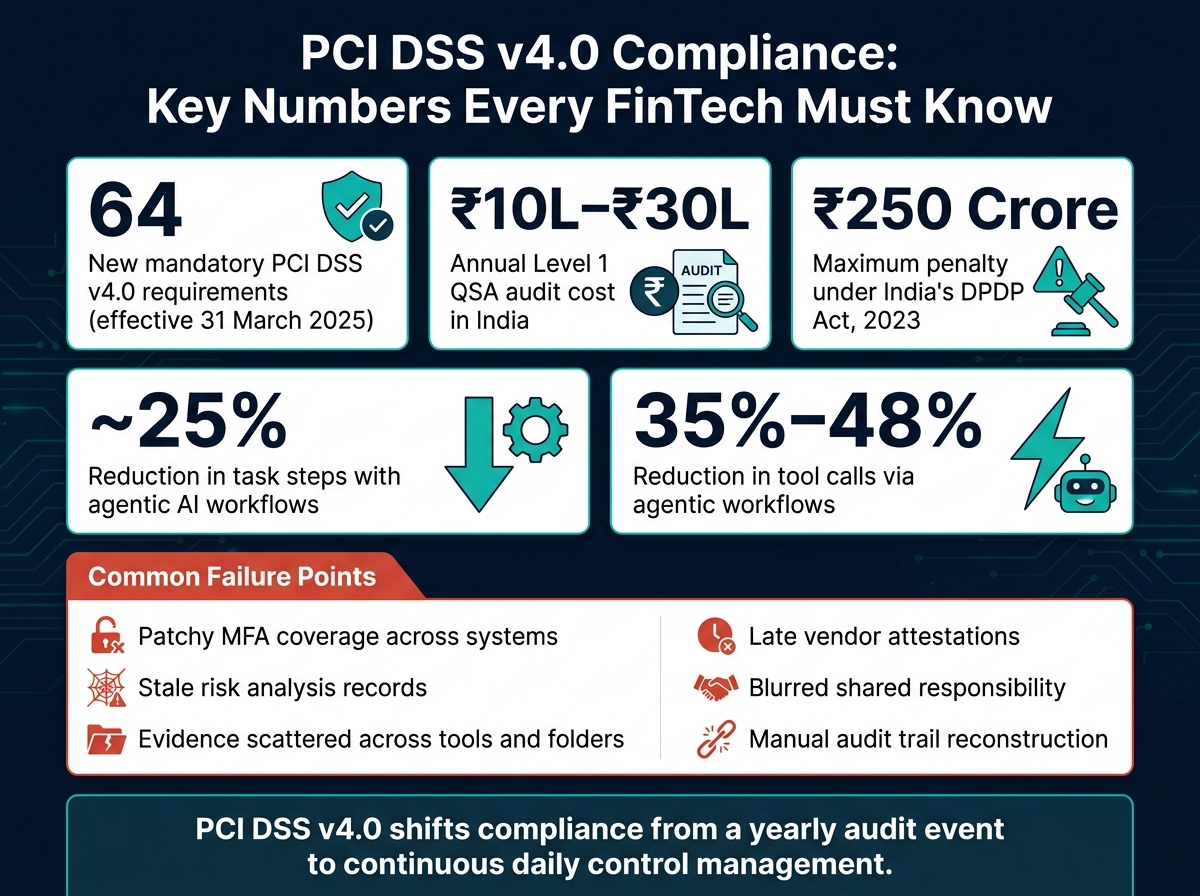
PCI DSS v4.0 is no longer just an audit task. It is day-to-day control work. Since 31 March 2025, 64 requirements that were earlier optional became mandatory. For FinTechs, that means one clear shift: you now have to show that controls worked throughout the review period, not just during audit week.
Key Takeaways:
- Continuous Proof Over Yearly Proof: PCI DSS has shifted from periodic audit snapshots to ongoing control verification.
- Shared Accountability: Engineering, security, compliance, and vendor owners must now share day-to-day control execution.
- Critical Operational Bottlenecks: Broader MFA coverage, targeted risk analyses (TRAs), continuous logging, and third-party dependencies create the biggest friction points.
- Regulatory Pressure in India: Indian FinTechs face compounding demands from RBI rules, PCI Level 1 mandates, and the DPDP Act, 2023 (with fines up to ₹250 crore).
- The Financial Impact: Annual Level 1 QSA audits in India typically cost between ₹10 lakh to ₹30 lakh.
Key Operational Challenges:
- Patchy MFA Coverage: Exceptions and broader access paths are hard to track and defend during audits.
- Stale Risk Analyses: Targeted Risk Analyses (TRAs) for custom controls drift out of sync as systems evolve.
- Fragmented Evidence: Control artifacts sit scattered across email threads, ticketing systems, and cloud folders.
- Delayed Vendor Attestations: Shared responsibility models blur boundaries and leave third-party blind spots.
My takeaway: PCI DSS v4.0 becomes hard when control proof is scattered and ownership is split. It becomes manageable when evidence collection, risk reviews, and vendor checks run continuously between audits.
Modernizing PCI DSS 4.0: From Compliance Burden to Competitive Advantage
PCI DSS v4.0 Compliance: Key Numbers Every FinTech Must Know
PCI DSS v4.0 Requirements That Create Day-to-Day Bottlenecks
These requirements turn PCI into day-to-day work for engineering, security, compliance, and vendor owners.
Broader MFA and Access Control Requirements
Under v4.0, MFA doesn’t stop at a small group of admin accounts. FinTechs now need stronger authentication across more of the sensitive access surface. In day-to-day terms, that means teams have to track MFA coverage and exceptions across more systems, more access paths, and more owners.
The hard part is proving it. Reviewers need to see where MFA is enforced, where exceptions sit, and who signed off on them. A single workflow for exceptions makes this much easier because it lets reviewers trace the approval, expiry, and justification without digging through scattered records.
There’s another snag here. If the access policy is too rigid, engineers will find workarounds. And when workarounds show up, that usually points to a gap between the policy and the actual risk.
As access policy grows, custom controls and exception records also get tougher to keep current.
Targeted Risk Analyses and Custom Controls
Custom controls can help when a prescriptive requirement doesn’t fit the environment. But there’s no free pass. Each one needs a targeted risk analysis.
That analysis should record:
- the threat
- the control rationale
- the review cadence
- the next review date
As infrastructure, releases, and vendors change, the analysis can drift unless someone reviews it on schedule. This is where many teams get stuck. PCI, SOC 2, and ISO 27001 reviews often run on separate tracks, which leads to duplicate work and inconsistent decisions.
Then those decisions need to stay current across logs, evidence, and control records. If one record says one thing and another says something else, review time gets messy fast.
Continuous Monitoring, Documentation, and Third-Party Dependencies
Continuous monitoring turns PCI into a live documentation and ownership problem. Teams need current logs, control records, and a clear view of what changed since the last review. Once evidence is collected manually from multiple systems, records go stale or conflict with each other far too easily.
Third-party dependencies add another layer of work. Shared responsibility doesn’t remove your side of the burden. You still need your own evidence, a named control owner, and a review cadence. With manual workflows, teams often spend more time reconciling ownership and scope than proving that a control is operating as expected.
Any tool used in the workflow also needs a close look. It must be checked for unintended storage of cardholder data in logs, attachments, or intermediate processing.
That’s where automation stops being nice to have and starts doing the heavy lifting.
Where FinTech Teams Struggle With PCI DSS in Practice
Fragmented Ownership Slows Remediation and Audit Readiness
PCI work often gets split across engineering, security, compliance, and outside vendors. On paper, that can look fine. In practice, it slows everything down.
MFA, monitoring, risk analyses, and vendor oversight end up sitting with different owners. Then each team waits for the next handoff. Remediation drags, and audit readiness starts to slip. By the time a QSA asks for proof, the evidence often has to be pieced back together from tickets, email, and chat. That kind of split ownership also masks control gaps until the audit is already underway.
That problem usually shows up first in evidence work.
Manual Evidence Collection Increases Effort and Errors
Manual evidence collection leans on spreadsheets, ad hoc searches, and repeated updates across different systems. It sounds simple enough, but it creates a mess fast.
Records drift over time. Versions clash. And the same evidence becomes much harder to reuse across SOC 2 and ISO 27001. The day-to-day cost is plain: more rework, slower QSA response, and a control view that never quite matches the current system state.
The same split also makes remediation tracking and control follow-up harder than it should be.
Monitoring Gaps and Third-Party Blind Spots Weaken Control Assurance
Continuous monitoring starts to fall apart when findings sit in disconnected tools and no one clearly owns the next step. Issues stay open. Owners are fuzzy. The audit trail stalls.
Third parties add another layer of trouble. Payment processors, cloud providers, and SaaS vendors hold key parts of the control environment, but their reports are often too shallow for continuous assurance. That weak vendor visibility leaves control gaps that internal teams can’t verify on their own.
These are the exact spots where automation and unified control workflows cut audit friction.
How to Make PCI DSS v4.0 Compliance Continuous and Scalable
The fix comes down to three things: a shared control model, automated evidence flow, and vendor processes that stay active between audits.
Build a Unified Control Model Across PCI DSS, SOC 2, ISO 27001, and DPDPA
You can cut compliance overhead by mapping overlapping controls once across frameworks. PCI DSS v4.0, SOC 2, ISO 27001, and India’s DPDPA all cover similar areas, including access management, logging, incident response, and vendor oversight. If you map those controls once into a unified control library, you avoid duplicate evidence requests and policy drift. Give each control one owner, one evidence source, and one review cadence.
Skip spreadsheets if you can. A linked control map works far better because a single control can support more than one framework at the same time. That shifts framework mapping from a one-off documentation task to day-to-day control ownership.
Automate Evidence Collection, Monitoring, and Risk Workflows
Manual evidence collection is where continuity usually falls apart. MFA status checks, access review logs, scan results, policy acknowledgements, and targeted risk analysis records all need to stay current, traceable, and organised, not thrown together in a panic before a QSA visit.
This is where agentic AI workflows make a clear difference. Autonomous agents can connect straight to IAM, cloud, ticketing, and security tools to collect, validate, and organise evidence on a continuous basis. They can also link findings to the right control, owner, and remediation ticket without manual hand-offs. Agentic workflows have been shown to reduce task steps by roughly 25% and tool calls by 35%–48%.
CISOGenie can pull evidence from live systems into a traceable, audit-ready repository with controlled access. Once that evidence is live, remediation can stay tied to the same control record instead of getting split across emails, tickets, and folders.
Standardise Vendor Risk and Audit Response Processes
Third-party dependencies are often the hardest part to run well in PCI DSS v4.0. Payment processors, cloud providers, and SaaS vendors each have their own attestation cycle, and manually chasing updated reports eats up time for compliance teams.
A structured vendor governance model helps here. That means:
- standard profiles for each vendor
- clear documentation of shared-responsibility boundaries
- automated attestation tracking
- contract obligation reviews that flag gaps before they turn into audit findings
When agentic workflows handle the follow-up, sending reminders, flagging overdue attestations, and surfacing changes in vendor risk posture, the compliance team spends less time chasing paperwork and more time fixing exceptions. It cuts audit back-and-forth and keeps third-party risk inside the same operating model as internal controls.
Conclusion: Treat PCI DSS v4.0 as an Operating Model, Not a Compliance Event
The main takeaway from the bottlenecks above is straightforward: PCI DSS v4.0 turns compliance into continuous control management.
For Indian FinTechs dealing with RBI mandates and DPDPA duties at the same time, the price of treating PCI DSS as a once-in-a-while task instead of a continuous function adds up fast.
The FinTechs that handle this well usually do three things. They align one control model across PCI DSS, SOC 2, ISO 27001, and DPDPA. They automate evidence collection inside engineering workflows. And they keep vendor governance running all the time.
That approach can cut audit effort in a meaningful way, especially when Level 1 QSA audits in India can cost between ₹10 lakh and ₹30 lakh.
This is the line between being ready for an audit and staying in continuous compliance. At its core, this is a structural operating issue, not a tooling issue. When ownership is clear and evidence moves on its own, PCI DSS becomes part of day-to-day operations, not a last-minute audit scramble.
FAQs
Does PCI DSS v4.0 apply to all FinTechs?
Yes. PCI DSS v4.0 applies to FinTechs that store, process, or transmit payment card data, no matter their size, transaction volume, or business model.
A lot of FinTechs are still in scope even when they outsource payment processing. Why? Because they may still touch cardholder data through APIs, webhooks, frontend scripts, or third-party SDKs. So even if a payment partner handles the heavy lifting, that doesn’t always take the FinTech out of the picture.
In India, there’s another layer to keep in mind. The RBI requires PCI DSS Level 1 certification for licensed Payment Aggregators and Payment Gateways.
What evidence do QSAs usually ask for?
Under PCI DSS v4.0, QSAs usually want proof that controls work all the time, not just a snapshot from one day.
That proof often includes TRA documents, monitoring and alert logs, architecture and data-flow diagrams, access logs with MFA proof, vulnerability and penetration test records, change management logs, secure configuration evidence, customised approach documentation, and automated compliance reports.
How can we manage PCI and DPDPA together?
Manage PCI DSS v4.0 and DPDPA with one risk-led approach. Start with data discovery to map cardholder data and personal data. Then use network segmentation and tokenisation to keep cardholder data inside a restricted environment and cut personal data exposure.
Use continuous monitoring to support day-to-day security and data protection. Keep evidence in one repository so teams aren’t scrambling during reviews. Platforms like CISOGenie can map controls to both frameworks and help improve audit readiness.