Security Questionnaire Fatigue: Why SaaS Teams Need a Better Way to Prove Trust
-
 Shankar Jayaraman
 - 23 Sep, 2026
If I had to sum this up in one line: SaaS teams do not have a questionnaire problem - they have a repeat work problem.
When I look at the numbers, the issue is plain:
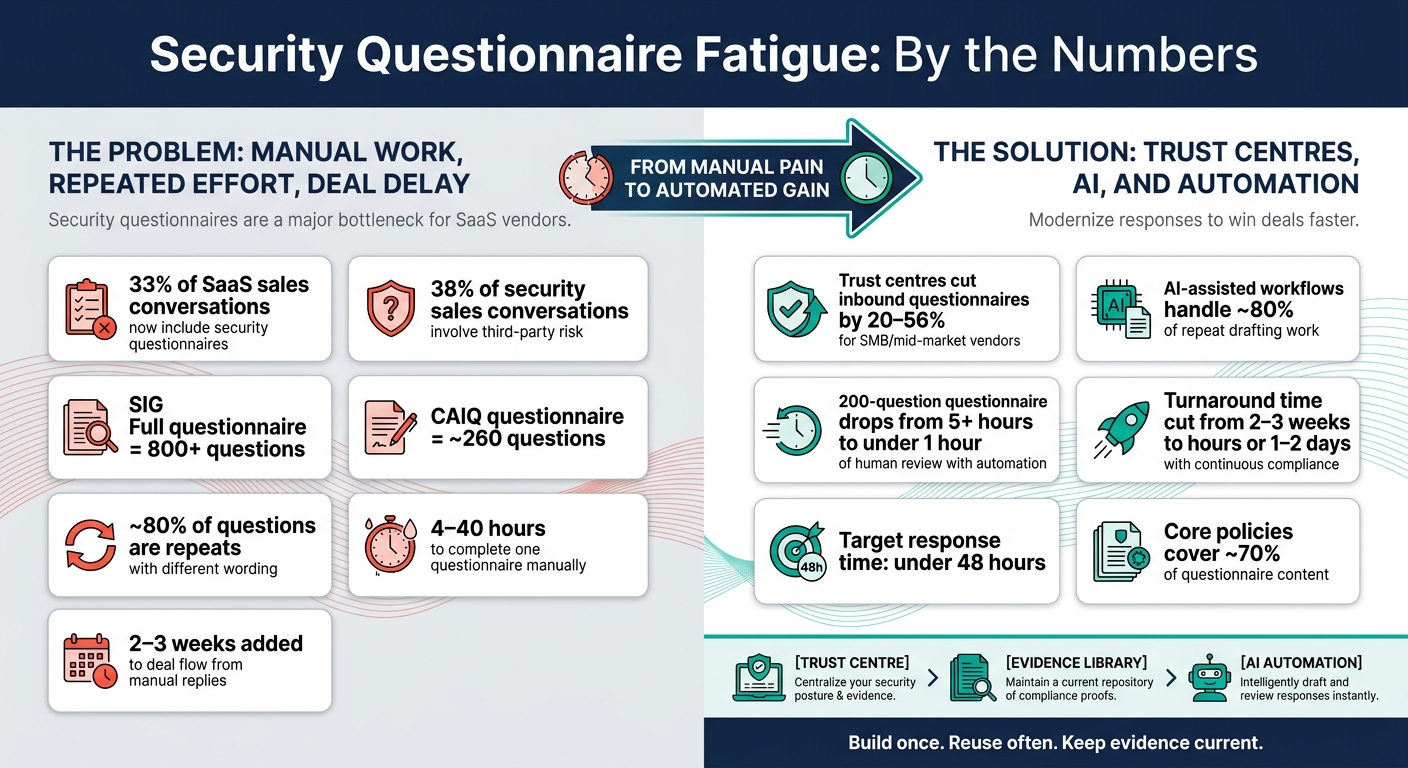
- Security questionnaires now appear in 33% of SaaS sales conversations
- Third-party risk shows up in 38% of security sales conversations
- A SIG Full can run past 800 questions
- A CAIQ sits at about 260 questions
- Around 80% of questions are repeats with different wording
- One questionnaire can take 4 to 8 hours, and in some cases 10 to 40 hours, by hand
- Manual replies often add 2 to 3 weeks to deal flow
So the answer is not “work harder”. It is to stop re-answering the same control in five different places.
If I were fixing this, I would keep it simple:
- Use a trust centre to answer common buyer asks early
- Keep one evidence library with approved answers and linked proof
- Use AI for first drafts and keep people in the review step
- Map one control set across SOC 2, ISO 27001, GDPR, DORA, DPDPA, and other buyer asks
- Tie answers to live control data so teams are not sending old screenshots and stale files
- Track response time and backlog and aim for under 48 hours
What stood out to me most is this: a trust centre can cut inbound questionnaires by 20% to 56% for many SMB and mid-market vendors, while AI-assisted workflows can handle about 80% of repeat drafting work. That means less spreadsheet chasing, fewer mixed answers, and less deal delay.
For SaaS leaders in India selling into global markets, this matters even more. Buyers now ask for proof on data handling, hosting, access control, and incident response - and they want the answers fast, in writing, and backed by source material.
The clearest path is to build once, reuse often, and keep evidence current.
Security Questionnaire Fatigue: Key Stats & The Smarter Way to Prove Trust
Why manual questionnaire workflows break as volume grows
Manual workflows start to crack when questionnaire volume goes up. The reason is simple: answers, evidence, and ownership end up spread across too many tools and too many people. A complex enterprise questionnaire can take 10 to 40 hours to complete by hand.
Fragmented answers, outdated files, and manual evidence chasing
The main issue is fragmented ownership across teams and systems. Security knowledge often sits across spreadsheets, email, Slack, Jira, and private docs, which makes it hard to know which response is the current one.
Sales teams often send custom spreadsheets through ticketing tools, which creates a messy ticket-to-spreadsheet loop. Then engineers and GRC teams go digging through Confluence or old files to find answers. When the next questionnaire lands, the same search starts all over again.
Once answers are split across places, the next problem shows up fast: inconsistency between security, compliance, and sales.
Inconsistent responses create risk for security, compliance, and sales
When different people answer from different sources, mismatched responses are almost unavoidable. Sales may describe roadmap items as if they already exist, while Security shares a different technical spec. Over time, answer drift sets in, especially when teams reuse answers from 18-month-old questionnaires without checking if policies, infrastructure, or certifications have changed.
Those gaps chip away at buyer trust and drag out deal cycles.
Managing multiple frameworks creates duplicate work
SOC 2 and ISO 27001 usually cover 60 to 80% of the questions found in standard security questionnaires. Even so, many teams still treat each framework as its own workstream. That means they answer the same questions about encryption, access control, and incident response again and again.
Then GDPR, DORA, or NIS2 gets added to the mix, and the duplicate work piles up fast. The same control gets documented, evidenced, and reviewed over and over, with no single owner and no single source of truth. At that point, the problem isn’t just extra work. It’s repeated proof for the same control across different buyers and frameworks.
Manual processes don’t scale. SaaS teams need reusable trust assets, not another spreadsheet. The way out is to centralise trust content, evidence, and controls, starting with trust centres, evidence libraries, and automated response workflows.
How to prove trust without repeating the same work
The fix isn’t typing faster. It’s building a system that answers most questions before the next questionnaire lands in your inbox.
That shift matters. Instead of replying deal by deal, you move to a proactive trust model built on three practical layers: a trust centre, a reusable evidence library, and automated response workflows.
Use a trust centre to answer common buyer questions earlier
A trust centre is a vendor-owned portal where buyers can self-serve the security documents they ask for most often - SOC 2 Type II reports (under NDA), ISO 27001 certificates, sub-processor lists, and penetration test executive summaries.
The point is simple: answer common buyer questions early, so fewer of them turn into inbound questionnaire requests.
In practice, trust centres can cut inbound questionnaire volume by 20% to 56% for vendors selling mainly to SMB and mid-market buyers. That drop is lower - around 10% to 15% - for vendors with major Fortune 500 or regulated-industry exposure. That makes sense. Buyers in regulated sectors such as banking, healthcare, and defence often still need a completed questionnaire because they require a documented, time-stamped record for their own compliance process. A signed questionnaire with an audit trail gives them that record. A trust centre link does not.
There’s one guardrail here: publish buyer-safe summaries, not raw internal artefacts. Specific tool names, internal IP ranges, network diagrams, and unfiltered penetration test payloads should stay internal. You’re trying to explain the control clearly, not hand over implementation details.
Use the trust centre to deflect common asks. Then let the evidence library handle the rest.
Build a reusable evidence library as a single source of truth
A governed evidence library should store six version-controlled core documents, supporting audit artefacts, and approved answer snippets. Every answer should point straight to a source - a policy section, an audit report page, or a configuration screenshot. That’s what makes a response defensible, not just fast.
Structure matters, but ownership matters just as much. Every high-value topic - encryption, sub-processors, access control - needs a named owner who keeps it current. A quarterly review cycle is the minimum if you want to stop stale responses from reaching buyers.
For teams handling SOC 2 and ISO 27001 at the same time, one mapped control set across both frameworks saves a lot of repeat effort. A single piece of evidence, like an access control policy, can support multiple audits and questionnaires.
Once the library is clean, versioned, and tied to approved sources, AI can draft responses against that material.
Automate questionnaire responses with AI and workflow controls
From there, you can automate drafting without removing human approval. AI-assisted response generation matches incoming questions by meaning, not just keywords, against approved content. In practice, that handles roughly 80% of the repetitive drafting work, leaving teams to review and approve instead of writing every answer from scratch.
A five-layer setup works well in practice:
- a policy foundation
- a structured knowledge base
- an AI matching engine
- a human review step
- a feedback loop that updates the library based on reviewer edits
The human review layer is non-negotiable. AI should draft, not decide. Novel questions, legal commitments, and scope-sensitive items still need subject-matter review.
The time savings can be sharp. A standard 200-question questionnaire that takes more than five hours manually can drop to under one hour of human review with a well-configured automated system. And unlike a shared spreadsheet, automated systems produce signed, time-stamped responses with source citations. That gives you an audit-ready artefact that a trust centre link simply cannot replace.
How continuous compliance cuts questionnaire fatigue at the source
Once your trust-centre content and re-usable evidence are set up, the next step is simple: keep every answer current. Faster responses help, but they don’t fix the root issue. Continuous compliance ties questionnaire answers to live control status, not old files sitting in a folder.
Map one control set across SOC 2, ISO 27001, and other frameworks
Most SaaS teams still handle each framework like its own mini-project. SOC 2 sits in one lane, ISO 27001 in another, and DPDPA readiness gets pushed somewhere else. That leads to duplicate work and scattered evidence.
A better way is to use one control set across frameworks. Build a centralised set of controls for access control, data protection, incident response, and similar areas. Then map that same set across SOC 2, ISO 27001, GDPR, and any other framework your buyers care about. One control set, backed by one evidence base, can support many questionnaires and audit requests. It also keeps each answer linked to the same control record.
But mapping controls isn’t enough on its own. The evidence behind those controls has to stay up to date.
Replace screenshot collection with live evidence and control monitoring
Manual evidence collection - screenshots, exports, and static reports - is slow and easy to break.
Continuous compliance systems pull live evidence straight from cloud environments, IAM tools, endpoint management platforms, and ticketing systems. That evidence is timestamped and tied to the control it supports. If a control changes or fails, the related answer gets flagged before a buyer spots the gap.
That changes the whole rhythm of the process. Instead of a last-minute scramble before every review, teams can cut questionnaire turnaround from 2–3 weeks to hours or 1–2 days. That means shorter deal cycles and less back-and-forth between security, compliance, and sales.
Where CISOGenie fits in for AI-native GRC operations
CISOGenie is an AI-native GRC platform that uses autonomous AI agents to handle evidence collection, policy management, vendor risk workflows, and continuous control monitoring across 35+ global frameworks, including SOC 2, ISO 27001, GDPR, and India’s Digital Personal Data Protection Act (DPDPA). When a questionnaire comes in - through a TPRM portal or straight from procurement - the answers come from live, verified control data.
“Questionnaires are becoming source-of-truth queries. When a buyer’s portal pulls the same three answers from your SOC 2 report, your trust center, and your security page, they want consistency.” - Nate Lee, CEO, TrustMind
That makes rollout easier. Start with one control area, then extend monitoring and response coverage.
A practical rollout plan for SaaS leaders
Start by measuring volume, response time, and evidence gaps
Once the trust model is set, the next move is simple: measure the backlog first, then roll out fixes based on impact.
Before you buy a tool or publish a trust centre, get a plain view of where things stand today. Look at the last 12–18 months and count how many questionnaires came in each quarter, how long each one took, and which teams - Security, Engineering, Legal - had to step in each time. Then sort the most repeated question groups and the evidence used to answer them.
A few metrics matter most here:
- sales-cycle days added
- response time
- share of answers pulled from approved content
This baseline shows which changes are most likely to cut response time first. Set a clear goal: respond in under 48 hours.
“A questionnaire sitting in a queue is a buying decision cooling off, and the vendor who answers in a day frames the security conversation for everyone who answers after them.” - Stas Bojoukha, Founder, Compyl
Phase in trust content, automation, and continuous compliance
Once you have the baseline, roll out changes in stages. Trying to fix everything in one go usually creates more mess than progress.
Start with the core policies: security, data protection, incident response, access control, business continuity, and acceptable use. These usually account for 70% of questionnaire content, so putting them into a version-controlled, centralised repository is the best first step. After that, build a knowledge base of standard answers from past responses and map each one to the right policy or evidence document.
Next, publish a trust centre. For SMB and mid-market SaaS vendors, this can deflect 20% to 56% of inbound questionnaires. In a 2025 case study, Nutrient reported a 56% year-on-year drop in inbound questionnaires after putting in a trust centre powered by Conveyor. Even when buyers still sent a questionnaire, 75% checked the SOC 2 report through the trust centre first.
The last layer is AI-assisted automation linked to live controls. At that stage, the team stops spending most of its time drafting replies and starts focusing on exceptions instead. Manual handling can take weeks. Trust centres reduce the common asks. Continuous compliance brings many exceptions down to hours or 1–2 days.
The order matters here:
- If you’re getting fewer than 30 questionnaires per quarter, start with the trust centre.
- If you’re above 80 per quarter, put AI automation ahead of the trust centre.
Conclusion: Proving trust should not depend on spreadsheet-heavy processes
With the process in place, the next job is keeping evidence current.
Questionnaire fatigue is a scale issue. Fix the evidence base, automate responses, and keep controls live. That turns questionnaires from a bottleneck into proof that your team can answer fast and back it up.
FAQs
When should a SaaS team move beyond spreadsheets for security questionnaires?
Move past spreadsheets when the manual work starts slowing deal cycles or getting tough to handle. That usually happens once inbound volume goes past 30 questionnaires per quarter.
At that stage, teams usually need a centralised, version-controlled knowledge base. It helps cut inconsistent answers, old evidence, and the same bottlenecks popping up again and again. It also keeps teams audit-ready across questionnaires and frameworks such as SOC 2 and ISO 27001.
How do trust centres and continuous compliance work together?
Trust centres and continuous compliance work hand in hand to make trust proof simpler and more consistent.
A trust centre gives customers a self-serve place to review certifications and security documents. That means fewer repeat due diligence requests landing on your team’s desk.
At the same time, continuous compliance keeps control mappings and evidence up to date. So the content in the trust centre - and the answers your team gives in questionnaires - stay in sync.
The result is fewer mismatches, less back-and-forth, and faster responses backed by current evidence.
What is the best first step to reduce questionnaire turnaround time?
Start by pulling your common sources of truth into one searchable knowledge base. That includes old spreadsheets, policy documents, and audit reports. Get this base in place before you bring in automation tools.
Next, set clear ownership for each topic and use AI to draft responses from that verified library. This shifts the work from an ad hoc manual task to a repeatable, scalable workflow.