SOC 2 Continuous Monitoring: Moving from Annual Evidence Sprints to Always-On Control Tracking
-
 Shankar Jayaraman
 - 16 Sep, 2026
If I had to sum this up in one line: SOC 2 Type II is not about building proof at the end of the year; it is about showing that controls worked across the full 6–12 month review period.
If you still run a 4–8 week audit rush before the assessor arrives, you are spending too much time on screenshots, logs, approvals, and follow-ups. I’d look at this another way: connect cloud, identity, code, HR, ticketing, and vendor systems so evidence flows in every day, control drift is flagged fast, and fixes are logged with timestamps. That is how teams cut prep time from 4–8 weeks to 2–5 days and avoid wasting 500+ internal hours a year on manual work.
Here’s the plain-English version of what matters:
- Annual evidence sprints fail because they show end-stage assembly, not control performance across the year.
- Continuous monitoring works when tools like AWS, Okta, GitHub, HRIS, SIEM, and CSPM feed evidence into one system through APIs.
- Not every control needs live checks. I’d focus first on:
- access and MFA
- deprovisioning
- privileged roles
- production changes
- cloud misconfigurations
- backup jobs and restore tests
- vendor report expiry
- policy and training completion
- The best model is simple: real-time alerts for severe failures, weekly reviews for exceptions, monthly health checks, and quarterly certifications.
- The goal is not just passing the audit. It is reducing drift, fixing issues faster, and staying ready for buyers, assessors, and internal reviews all year.
A short comparison makes the shift clear:
| Area | Annual sprint model | Continuous monitoring model |
|---|---|---|
| Evidence collection | Manual, near audit time | Automated, daily |
| Issue detection | Late in the cycle | Near real time |
| Audit prep effort | 4–8 weeks | 2–5 days |
| Control drift | Found late | Flagged early |
| Ownership | Split and reactive | Clear with SLA-based follow-up |
| Multi-framework use | Duplicate work | Same evidence reused across SOC 2, ISO 27001, and DPDPA |
If I were building this from scratch, I would start with high-change controls, wire them to source systems, set fix-time SLAs, and treat SOC 2 as a year-round control programme instead of a once-a-year project.
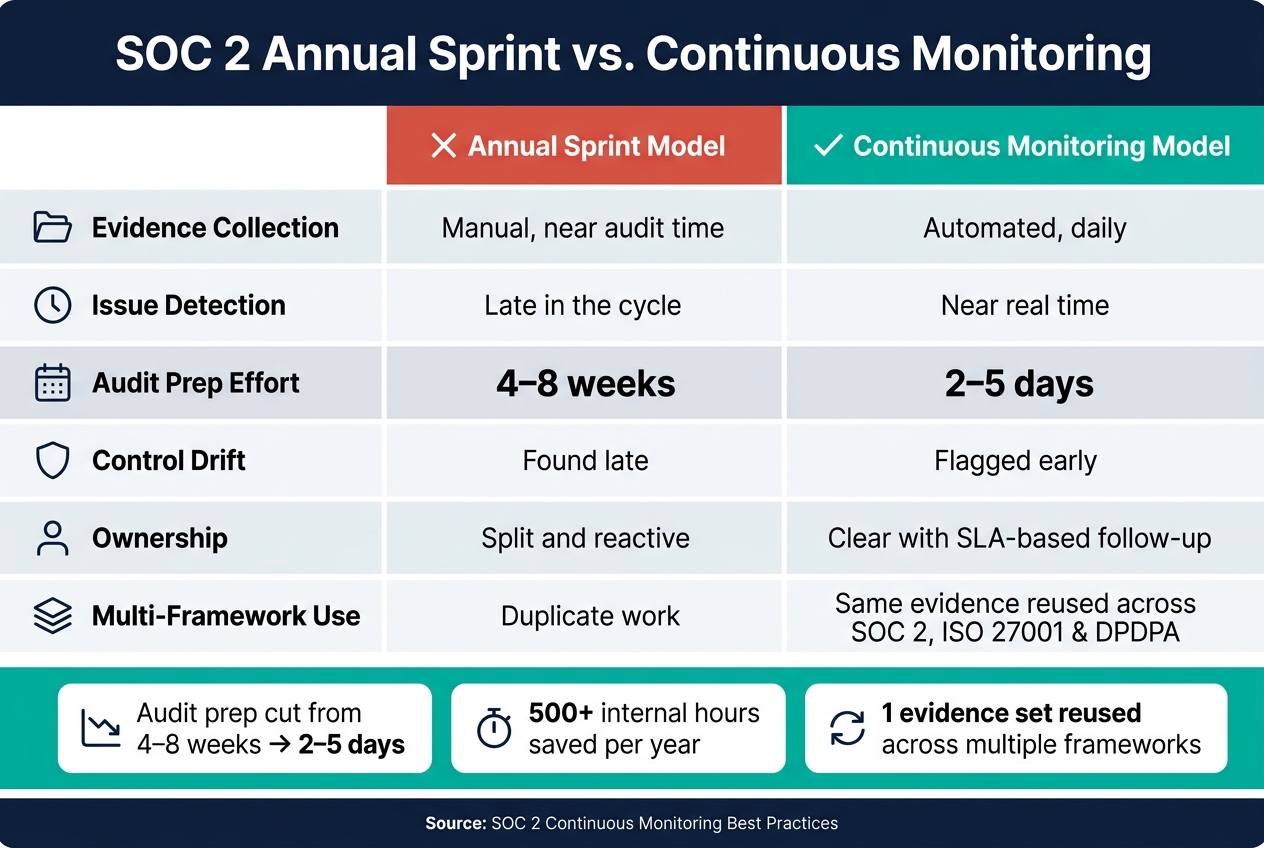
SOC 2 Annual Sprint vs. Continuous Monitoring: Key Differences
Where Traditional SOC 2 Programmes Break Down
Manual Evidence Collection Creates Delays and Weak Audit Trails
The annual-sprint model tends to fall apart for one simple reason: teams collect evidence at the end of the review period instead of gathering it as work happens.
That creates a mess fast. Logs, screenshots, tickets, and approvals end up spread across cloud consoles, HR tools, ticketing systems, shared drives, Slack, and email. When that happens, proving that a control worked across the full audit window becomes much harder. That’s the gap continuous monitoring is meant to close.
And once evidence is scattered, another problem shows up right behind it: ownership. If no one is watching for drift in real time, small issues sit quietly until they become audit problems.
Fragmented Ownership Slows Remediation and Increases Control Drift
The deeper problem is what happens between review cycles.
Without continuous tracking, controls can drift without anyone noticing. A contractor leaves, but their account stays active. A cloud resource gets misconfigured. An access review cycle is missed, and that missed step turns into a control failure for that period.
By the time someone spots the issue, the audit window may already be close to shutting. That means rework, more auditor questions, and in some cases, a qualified opinion.
When ownership is split across teams and no one has a clear line of sight, fixes take longer and audit gaps stick around longer than they should.
Why Annual Audit Preparation Costs More Than Teams Expect
Most GRC leaders plan for the auditor’s fee. What often gets missed is everything around it.
An automated SOC 2 solution can reduce the burden of a fully manual programme can take more than 500 internal hours a year. That’s a big drain on time. And the cost doesn’t stop at labour. Teams also pay for control gaps that sit undetected for months, plus the engineering time pulled away from product work every time the audit cycle starts all over again.
That’s why SOC 2 programmes need live tracking for the controls that matter most. The practical next step is to decide which SOC 2 controls need continuous monitoring and which ones can stay on a periodic review cycle.
Which SOC 2 Controls to Monitor Continuously
The next step is picking the controls that change often and leave the weakest paper trail. Not every SOC 2 control needs live monitoring. Focus on the ones that shift often, fail quietly, and create the most audit evidence work.
Access, Identity, and Policy Compliance
Access controls are where many audit surprises show up. A contractor account wasn’t deprovisioned. An admin role got approved for a one-off task and stayed in place. An MFA exemption quietly turned into a permanent exception.
Continuous monitoring turns this from a quarterly scramble into a daily automated check. Identity providers like Okta or Microsoft Entra ID can export MFA status, privileged access assignments, and role changes every day. When that data is tied to an HRIS like BambooHR, the system can flag a terminated employee account that stays active past the 24-hour deprovisioning SLA. That timestamp becomes the control record.
Policy acknowledgement tracking works in much the same way. Instead of chasing employees for signatures before the audit window closes, teams can monitor completion rates for security awareness training and policy acknowledgements every week or month. If someone falls out of compliance, the alert goes out automatically.
After identity and access, the next set to watch is production change and cloud configuration.
Logging, Change Management, and Infrastructure Configuration
Logging and change records are the hardest to rebuild later. If they’re missing, you usually feel it during audit prep.
Always-on logging means your SIEM or XDR timestamps events and flags unusual activity as it happens. For change management, CI/CD telemetry from tools like GitHub or GitLab can flag every production deployment that skipped peer review or happened outside the approved change window. That gives you a continuous, ticket-linked record of what changed, who approved it, and when.
On the infrastructure side, CSPM tools tied to AWS Config, Security Hub, or Azure Policy can flag drift in real time: a public S3 bucket, an unencrypted database, or an open security group. Each alert becomes evidence that configuration controls operated throughout the year.
Then there are resilience and third-party controls, where evidence goes stale fast and manual checks tend to lag.
Backups, Vendor Risk, and Operational Resilience
Backup monitoring is one of the most underestimated gaps in SOC 2 programmes. Most teams can prove backup jobs ran. Fewer can prove restores worked. That’s the difference between activity and proof.
Always-on backup monitoring means tracking daily job success logs and scheduling automated restore tests with documented outcomes. Tools like AWS Backup, paired with uptime monitoring from Datadog or PagerDuty, give you a continuous record of operational resilience.
Vendor risk follows the same pattern. Third-party SOC 2 reports expire. Security ratings change. Sub-processor lists get updated without notice. Continuous monitoring here means automated tracking of vendor report expiry dates, plus periodic checks of security ratings and sub-processor lists, so the evidence is current before the audit starts.
Use this as the baseline set for continuous monitoring.
| Control Area | What to Monitor Continuously | Key Evidence Sources |
|---|---|---|
| Access & Identity | MFA status, deprovisioning SLAs, privileged access changes | Okta, Entra ID, BambooHR |
| Cloud Configuration | Public bucket exposure, encryption drift, open ports | AWS Config, Security Hub, Azure Policy |
| Change Management | Peer review bypass, unapproved production deployments | GitHub, GitLab, Jira, ServiceNow |
| Backups & Resilience | Backup job success, restore test records, uptime | AWS Backup, Datadog, PagerDuty |
| Vendor Risk | SOC 2 report expiry, security rating changes | Vendor registers, GRC platforms |
| Policy Compliance | Training completion rates, policy acknowledgement status | HRIS, LMS, GRC platforms |
How to Build an Always-On SOC 2 Operating Model
An always-on SOC 2 operating model turns compliance into routine control work instead of a last-minute scramble once a year. That’s how teams shift from annual evidence sprints to steady, day-to-day control tracking.
The first move is simple: map the same control to every framework it supports.
Map Controls Once Across SOC 2, ISO 27001, DPDPA, and Internal Risk Priorities
Don’t run SOC 2, ISO 27001, and DPDPA as separate programmes. In practice, all three often point back to the same technical question: who can access what, and is that access still appropriate?
Build a cross-framework control map that links each technical configuration - MFA enforcement, encryption settings, access provisioning workflows - to the requirements across all active frameworks. Map shared controls once, then reuse the same evidence across frameworks. Use that map as the live control baseline for monitoring and evidence collection.
Prioritise controls based on business risk, not framework order. Systems that handle sensitive data like PII or PHI need real-time monitoring and tighter thresholds. Lower-risk internal systems can run on longer review intervals.
Once the control map is in place, connect source systems so evidence can start flowing on its own.
Connect Source Systems and Automate Evidence Collection
Start with cloud, identity, and code systems because they cover most technical controls. Then bring in HRIS, ticketing, endpoint management, and vulnerability scanning tools to extend coverage across employee lifecycle events, change management, device compliance, and remediation tracking. Each integration should produce timestamped evidence stored in one tamper-evident repository.
When a control fails, auto-create a Jira ticket, notify Slack, attach evidence, and start the SLA clock. That ticket becomes the remediation record. Auditors can then see the failure, the response, and the resolution in one place.
Automation cuts down collection work. After that, the next job is setting review frequency and response time.
Set Review Cadences, Remediation SLAs, and Internal Readiness Checks
Use automation for detection and people for review. A simple cadence works well:
| Review Type | Focus | Frequency |
|---|---|---|
| Continuous alerts | Critical failures - public data exposure, root login, MFA disabled | Real-time |
| Weekly review | Exception handling and alert trends | Weekly |
| Monthly health check | Evidence completeness and SLA compliance | Monthly |
| Quarterly certification | Access reviews and vendor risk updates | Quarterly |
Pair this with clear remediation SLAs. Critical issues such as a public database should be resolved within 24 hours. High-severity findings like disabled MFA should be fixed within one week. Medium findings should be closed within 30 days.
Track a small set of core metrics:
- Open exceptions
- Remediation timeliness by severity
- Evidence completeness
These metrics show whether SOC 2 is running as expected or starting to drift. Teams using this model cut audit prep from 4–8 weeks to 2–5 days.
Using AI-Native GRC Platforms to Sustain Continuous Compliance
Once SLAs and review cadences are set, the next step is simple: can your tooling keep up? Continuous monitoring isn’t just a reporting add-on. It’s the system that produces evidence every single day.
What to Look for in a Continuous Compliance Platform
The features that matter in daily compliance work are pretty specific. Automated, API-driven evidence collection is non-negotiable. The platform should connect to source systems and vendors through read-only APIs and pull timestamped records each day without manual effort. Most SOC 2 evidence can be auto-collected this way. That’s what makes moving from a 4–8 week audit sprint to a 2–5 day close-out possible.
Collection alone isn’t enough. You also need real-time drift detection so control failures show up as soon as they happen. Add cross-framework mapping, and the same MFA or encryption check can support SOC 2, ISO 27001, and DPDPA at the same time. On top of that, the platform should verify that policies match live controls, send integrated alerts, and provide a live compliance dashboard so leadership can see current posture at a glance. The evidence repository also needs to be tamper-evident, so auditors can trace each record back to its source.
That is where an AI-native GRC platform starts acting like the control layer, not just a place to store evidence.
How CISOGenie Fits a Risk-Led SOC 2 and Multi-Framework Programme
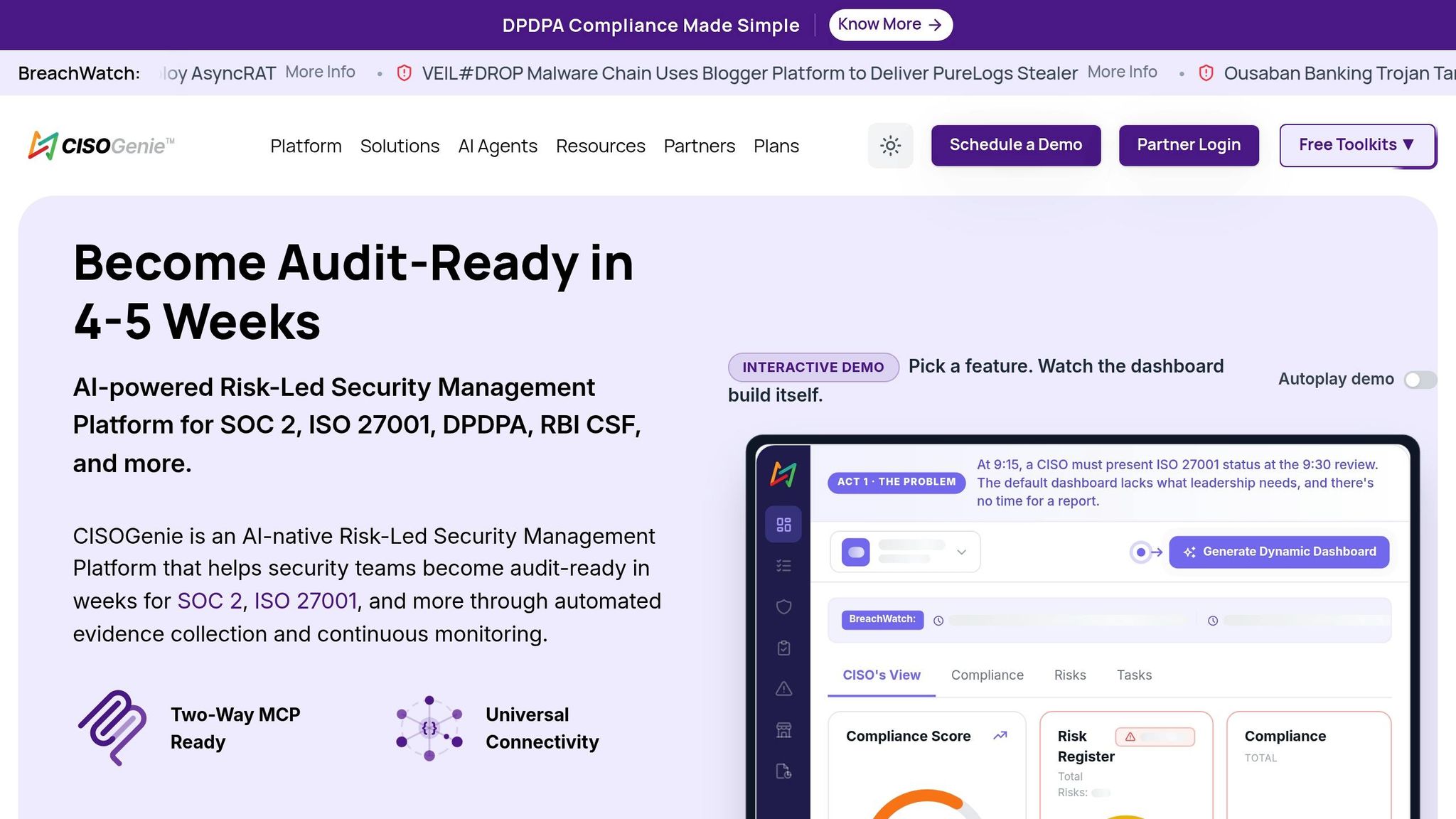
CISOGenie is an AI-native GRC platform that automates evidence collection, risk triage, and third-party risk workflows. In day-to-day use, it maps controls across frameworks, sends exceptions to the right owners, and keeps a clear evidence trail through the year. The same evidence can map across SOC 2, ISO 27001, and DPDPA without duplicate manual effort.
CISOGenie fits a risk-led programme because it helps teams focus on what needs attention first. Issues are tied to remediation SLAs, so critical drifts are handled first and logged clearly for auditors. Its vendor risk workflows also track SOC 2 report expiry dates and changes in security posture automatically. That way, a third-party certification lapse doesn’t sit unnoticed until the next annual review.
When the platform, controls, and owners stay connected, compliance stops revolving around audit season.
Conclusion: The Practical Gains from Always-On Control Tracking
Continuous SOC 2 monitoring is an operating model shift, not just a software buy. Teams that work this way cut audit prep time, reduce manual evidence work, and stay audit-ready through the year. Cleaner evidence trails and faster remediation come from connected systems, automated collection, and clear SLAs, because controls are already being tracked, reviewed, and fixed as part of normal operations.
FAQs
How do we start SOC 2 continuous monitoring without overcomplicating it?
Start with a phased, risk-led approach. Focus first on high-impact controls that already generate data, such as identity management, cloud configuration, and change management. Then connect your main tools so they can automate audit-ready evidence collection.
Assign clear control owners and set simple remediation SLAs. Review gaps every month instead of waiting for the annual audit. Continuous monitoring still needs hands-on management of alerts and exceptions.
Which SOC 2 controls should we automate first?
Start with the controls that usually trigger the most auditor follow-ups and the most manual work: identity and access management, cloud configuration, and change management. In most teams, these three areas cut audit prep time the fastest.
- Access management: MFA, user provisioning/deprovisioning, access reviews
- Cloud configuration: security baselines, encryption drift, public storage, open security groups
- Change management: branch protection and pull request approvals
What evidence will auditors expect from continuous monitoring?
Auditors will expect a continuous, timestamped, structured evidence trail that shows your controls worked across the full 12-month observation period, not just on the day of the audit.
That trail should map back to each control and SOC 2 criterion. In plain terms, you need clear proof for access governance, change management, cloud configuration, vulnerability management, and vendor risk. Keep logs, review records, scan results, remediation notes, and incident evidence in one central place, with timestamps, system identifiers, and control owner details attached to each item.