Vendor Risk Assessment Without Spreadsheet Chaos: A Better Way to Review Third-Party Risk
-
 Balachandran Sivakumar
 - 20 Jun, 2026
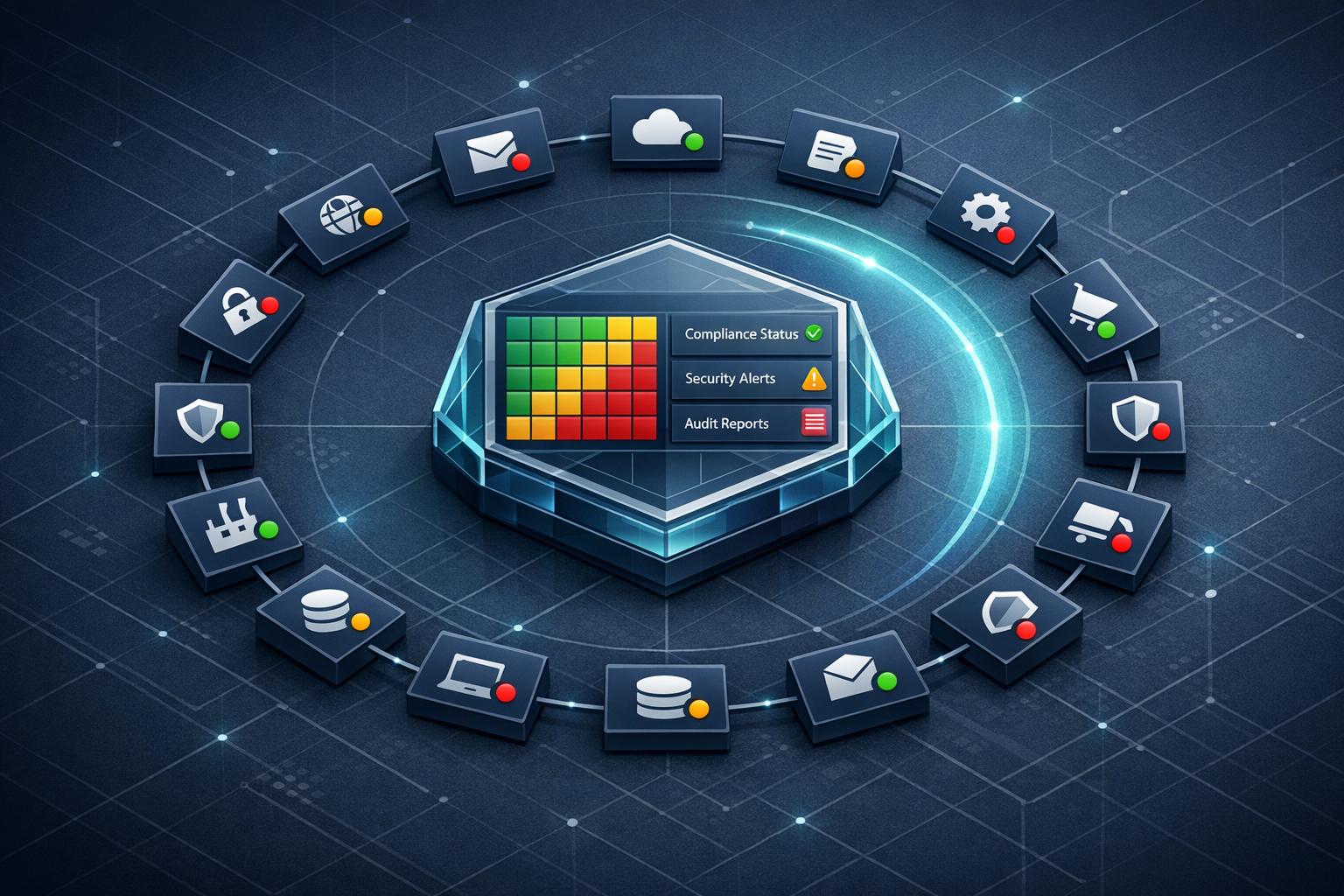
Managing vendor risks with spreadsheets is outdated, inefficient, and costly. As businesses grow, handling hundreds or thousands of vendors introduces complexity that spreadsheets can’t manage. Here’s why automated systems are the smarter choice:
- Spreadsheets lead to inefficiencies: Manual processes result in incomplete data, missed deadlines, and low questionnaire completion rates (50–60%).
- High costs of manual processes: ₹17.5 crore annually on average, with third-party breaches costing ₹40.7 crore.
- Lack of real-time monitoring: Static reviews fail to detect risks like breaches or policy changes, which occur frequently.
The solution? Automated vendor risk management tools. These systems centralise vendor data, streamline assessments, and enable continuous monitoring. For example, AI-driven platforms like CISOGenie reduce assessment time, improve response rates (85%+), and ensure compliance across frameworks like ISO 27001, SOC 2, and India’s DPDPA Act.
Key Benefits of Automation
- Efficiency: Assessments in days instead of weeks.
- Accuracy: AI validates evidence and flags risks.
- Scalability: Manage thousands of vendors seamlessly.
- Compliance: Meet multiple standards with a single system.
Switching to automation transforms vendor risk management from a chaotic paperwork exercise into a streamlined, proactive process. For Indian organisations, this shift is critical to meeting regulatory requirements and protecting against costly breaches.
Building a Risk-Based Vendor Inventory and Classification Model
Creating a thorough vendor inventory is the first and most important step - yet it’s often overlooked. Organisations, on average, maintain 2,643 third-party relationships, with 61% lacking a complete data-access inventory. This makes proper mapping a non-negotiable task.
Grouping Vendors by Service Type and Criticality
Start by building a centralised inventory. This should be a detailed record covering each vendor’s role, their access to data, system connectivity, and their importance to your operations. Go a step further by cross-referencing internal records and logs to identify any unauthorised vendor relationships.
Once your inventory is ready, categorise vendors by service type - cloud infrastructure, payroll, payment processors, CRM, HR tools, and so on. This categorisation allows you to use standardised assessment templates, saving time and effort. After grouping by service, evaluate criticality: Would a vendor’s failure disrupt revenue-generating operations, cause service delays exceeding 24 hours, or just be a minor inconvenience? This distinction influences all subsequent decisions.
Two key factors should guide vendor classification: data sensitivity (does the vendor handle personal, financial, or health data?) and system integration depth (do they connect to your production environment via VPN, API, or SSO?). For example, a marketing analytics tool with limited, read-only access to anonymised data presents a far lower risk than a cloud infrastructure provider with root-level access to your systems.
“Effective programs start with a complete vendor inventory, apply risk-based tiering, and use structured assessments rather than annual questionnaires.” - Tyson Martin, CISO
With vendors grouped by service type and criticality, the next step involves defining risk tiers and assigning clear ownership.
Defining Risk Tiers and Assigning Ownership
After categorisation, assign vendors to risk tiers based on their inherent risk - the risk they pose before evaluating their controls. A four-tier model is practical and effective:
| Tier | Profile | Assessment Depth | Monitoring Frequency |
|---|---|---|---|
| Tier 1 – Critical | Handles regulated data; failure disrupts operations | Full questionnaire + SOC 2 Type II + Pen test evidence | Continuous + Quarterly review |
| Tier 2 – High | Access to sensitive data; integrates with critical systems | Full questionnaire + SOC 2 Type II | Continuous + Semi-annual review |
| Tier 3 – Medium | Limited access to non-sensitive data | Abbreviated questionnaire + certification check | Annual reassessment |
| Tier 4 – Low | No access to sensitive data or internal systems | Basic due diligence + insurance verification | Biennial or trigger-based |
This tiering system not only determines the depth of assessments but also sets the frequency of ongoing monitoring. For instance, Tier 1 vendors require extensive measures like on-site audits and penetration test evidence, while Tier 4 vendors may only need basic onboarding checks.
Ownership assignment is equally critical. Every vendor relationship should have a named internal owner, ensuring accountability. Without this, vendors can easily slip through the cracks, especially during contract renewals, personnel changes, or acquisitions. Assigning a business owner - beyond just IT or procurement teams - ensures someone is responsible for managing the relationship. Using a RACI matrix can further clarify roles and responsibilities throughout the vendor lifecycle, making accountability both clear and auditable.
A well-organised inventory, paired with clear risk tiers and ownership, sets the stage for advanced tools like AI-driven monitoring and compliance automation.
Centralising Due Diligence with AI-Driven Tools
Once you’ve established a tiered inventory and clear ownership, the next logical step is simplifying due diligence processes with AI-powered tools. Many organisations still depend on outdated methods like email threads, shared drives, and manually updated spreadsheets. This patchwork system often leads to misplaced evidence, unanswered questionnaires, and confusion about vendor statuses.
Standardising Vendor Questionnaires and Evidence Collection
Custom questionnaires often lead to inconsistency - different reviewers tend to ask different questions and apply varying levels of scrutiny. A better solution is to standardise using widely accepted templates such as SIG Lite or CAIQ. These templates can save significant time by providing a consistent and reliable baseline for assessments.
AI-driven platforms take this a step further by making these questionnaires dynamic. For example, when a vendor submits a SOC 2 Type II report, natural language processing tools can extract relevant controls and automatically remove unnecessary questions. This can shrink a 280-question SIG to about 90 questions, saving time and effort. Additionally, AI tools can flag missing documents and expired certifications, reducing the time required for Tier 1 assessments from eight weeks to just seven days.
By adopting these tools, organisations can create a more streamlined and efficient process while building a dependable repository of vendor data.
Creating a Single Source of Truth for Vendor Data
Streamlined questionnaires are only part of the puzzle. Consolidating all evidence into a single, secure location is equally crucial for quick and effective audit responses. Disorganised storage - where certifications are in one inbox, contracts in another folder, and risk scores in yet another spreadsheet - can make it nearly impossible to respond promptly to regulatory inquiries. A centralised evidence vault solves this issue by keeping all documents in one place. Each file is hashed, timestamped, and versioned, ensuring clarity about what was reviewed and when.
For Indian organisations, compliance requirements from RBI and SEBI demand thorough oversight of third-party relationships. A platform that maps vendor evidence across multiple frameworks - such as ISO 27001, SOC 2, GDPR, and India’s DPDPA - can help organisations meet multiple compliance standards with a single set of vendor data. This eliminates the need for manual cross-referencing and minimises errors.
As Gabriel Few-Wiegratz from SureCloud explains:
“Third party risk management is not a questionnaire problem. It is an information problem.” – Gabriel Few-Wiegratz, SureCloud
The aim of centralisation is to provide immediate, actionable insights for every vendor in your network. Tools like CISOGenie consolidate vendor risk data, evidence artefacts, and compliance mappings into a single dashboard. This gives GRC teams real-time visibility without the hassle of manual follow-ups. By centralising due diligence and automating routine tasks, organisations can more effectively manage risk and maintain compliance across multiple frameworks, all while supporting a proactive, risk-driven approach.
Moving from Point-in-Time Assessments to Continuous Monitoring
Even with centralised tools, detecting risks in a timely manner remains a major challenge. While centralised data and risk-based tiering are important, continuous monitoring offers a level of oversight that static, one-time assessments simply cannot achieve. Here’s why: a vendor might pass your assessment in January but could face breaches, lose critical staff, or change their sub-processor list by March - and you wouldn’t know until the next scheduled review. This highlights the limitations of point-in-time assessments. In fact, third-party involvement in breaches has doubled from 15% to 30%, and supply chain attacks take an average of 267 days to detect and contain. Clearly, the need for dynamic monitoring over static assessments has never been more pressing.
Tracking Vendor Risk After Onboarding
A study monitoring over 1,100 sub-processor pages revealed that 67% experienced changes within 90 days, and 62% of vendor trust centres underwent material updates in the same timeframe. This rate of change is far too rapid for annual reviews to keep up. A smarter approach is to tie reassessments to specific events - such as scope changes, incident reports, contract renewals, or certification expirations - rather than relying solely on fixed timelines.
For Tier 1 vendors, this means combining annual reviews with continuous monitoring, while lower-risk vendors might only require reviews during contract renewals. However, even for lower-risk vendors, basic change detection for critical documents like Data Processing Agreements (DPAs) and privacy policies is beneficial.
“The biggest shift we’ve made is moving from viewing vendor assessment as a procurement gate to treating it as an ongoing relationship. The initial evaluation is just the beginning of continuous risk management.” – Security Leader
It’s crucial to establish clear escalation workflows. For instance, if a vendor’s risk profile changes - say, due to an expired ISO 27001 certification or a disclosed breach - there should be a predefined process for alerting the right team, outlining remediation timelines, and determining next steps if the vendor doesn’t respond.
Automated tools can play a key role here by turning detected changes into actionable tasks, ensuring nothing falls through the cracks.
Automating Issue Tracking and Risk Alerts
Manual tracking simply doesn’t scale. Organisations that use automated monitoring tools detect critical vendor incidents 60–80% faster than those relying on periodic assessments alone. This not only speeds up detection but also allows for quicker, proactive risk management.
AI-powered GRC platforms like CISOGenie monitor vendors across multiple risk areas, including:
- Cybersecurity indicators: Certificate expirations, credential leaks, etc.
- Operational changes: Departure of key personnel.
- Regulatory triggers: Sanctions or enforcement actions.
When a signal crosses a set threshold, the platform raises an alert and assigns a remediation task, ensuring the issue is addressed promptly.
For Indian businesses, maintaining an automated, auditable trail is vital - not just during onboarding but throughout the vendor lifecycle. This demonstrates ongoing due diligence, which is essential for compliance and risk management.
Managing Multi-Framework Compliance with AI-Native GRC Platforms
Continuous monitoring helps with timely risk detection, but GRC teams face another major challenge: juggling compliance requirements for multiple frameworks at the same time. Most organisations don’t just focus on ISO 27001 - they also need to meet standards like SOC 2, DPDP, and PCI DSS. Using disconnected tools to manage these frameworks separately often leads to duplicated work and inefficiency.
Aligning Vendor Oversight Across Multiple Compliance Standards
Centralising oversight across frameworks can significantly reduce redundant efforts, much like the concept of a unified evidence vault. A common problem with traditional GRC methods is treating each framework as an isolated project. For example, a vendor’s access control policy might meet the requirements of ISO 27001 Annex A.9, SOC 2 CC6, and NIS2 Article 21. Without a unified approach to control mapping, teams end up gathering the same evidence multiple times for different frameworks.
Modern AI-driven GRC platforms simplify this with a “map once, comply many” strategy. By defining controls once, these platforms automatically reuse evidence across multiple frameworks, cutting down on repetitive work. For Indian businesses balancing global standards like ISO 27001 alongside domestic regulations like DPDPA, this centralised approach is especially useful. Managing all compliance obligations from a single dashboard not only saves time but also lays the groundwork for adopting AI tools that simplify multi-framework compliance.
Automated tools can reduce audit cycles from three months to just three days and cut evidence collection efforts by as much as 80% by reusing data across frameworks. For lean GRC teams, which are common in mid-sized Indian companies, this efficiency can mean the difference between keeping up with audits and falling behind.
How CISOGenie Supports Risk-Led Compliance
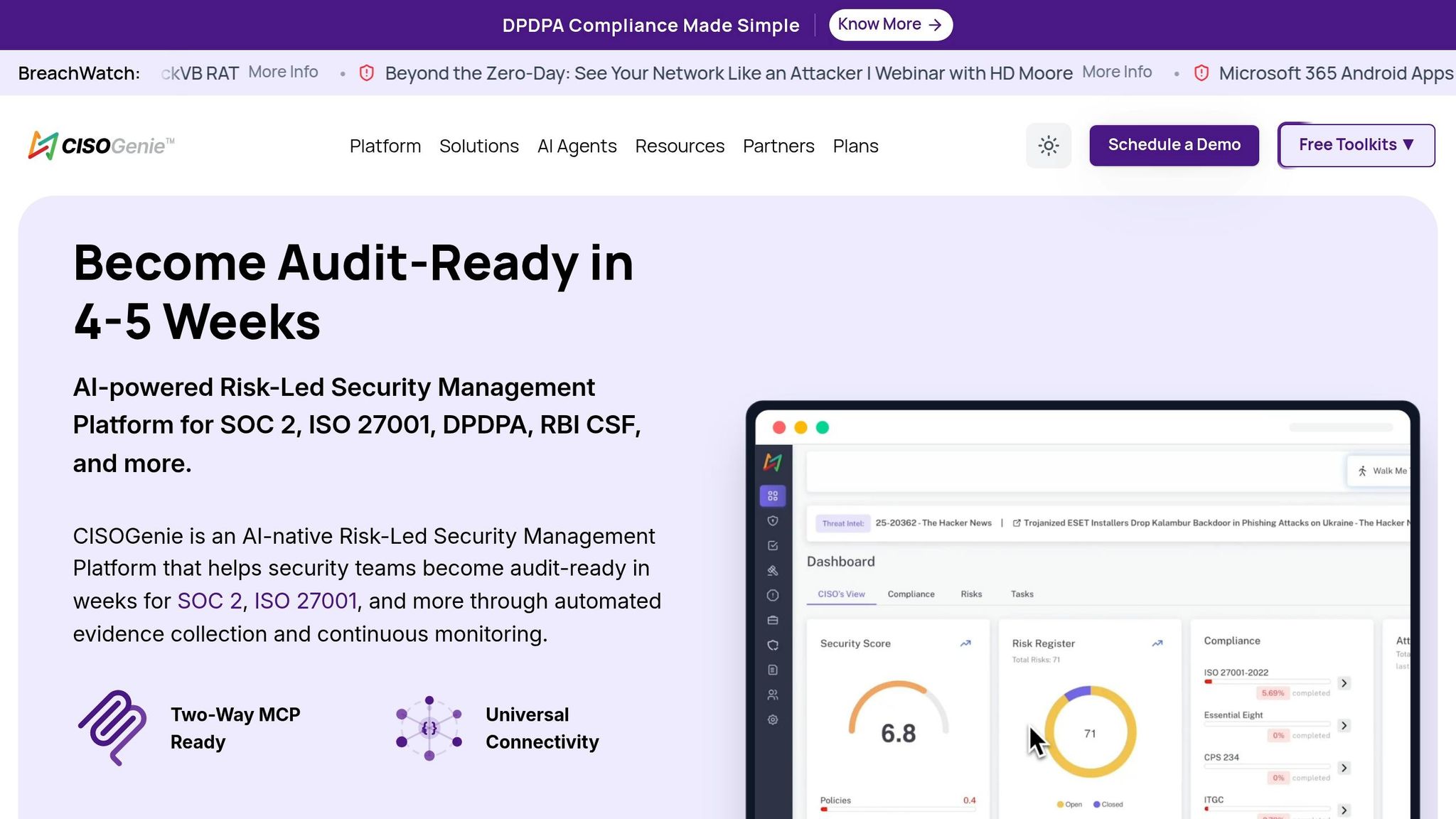
CISOGenie takes these efficiencies a step further by focusing on aligning compliance with an organisation’s actual security posture, rather than treating it as a periodic checkbox exercise.
“Traditional GRC tools are systems of record. They store what you tell them. An AI-powered GRC platform like CISOGenie is a system of action. It goes and finds out for itself.” - CISOGenie Team
CISOGenie’s Autonomous AI agents connect to cloud platforms, SaaS tools, and security scanners to pull evidence in real time, cutting down manual effort. Even in cases where APIs aren’t available, browser agents can navigate vendor portals to gather data. This creates a continuously updated, fully auditable evidence trail.
Take the example of a fintech company in May 2026: with just a two-person security team, they used CISOGenie to prepare for ISO 27001 and DPDPA audits simultaneously in just 28 days - without hiring additional staff.
CISOGenie supports over 35 global compliance frameworks, including SOC 2, ISO 27001, NIST CSF, GDPR, HIPAA, PCI DSS, DORA, and India’s DPDP. For vendor risk management, this means third-party oversight is fully integrated into broader compliance processes, providing CISOs and GRC leaders with a single, defensible record across all frameworks they operate under.
How to Move from Spreadsheets to Automated Vendor Risk Management
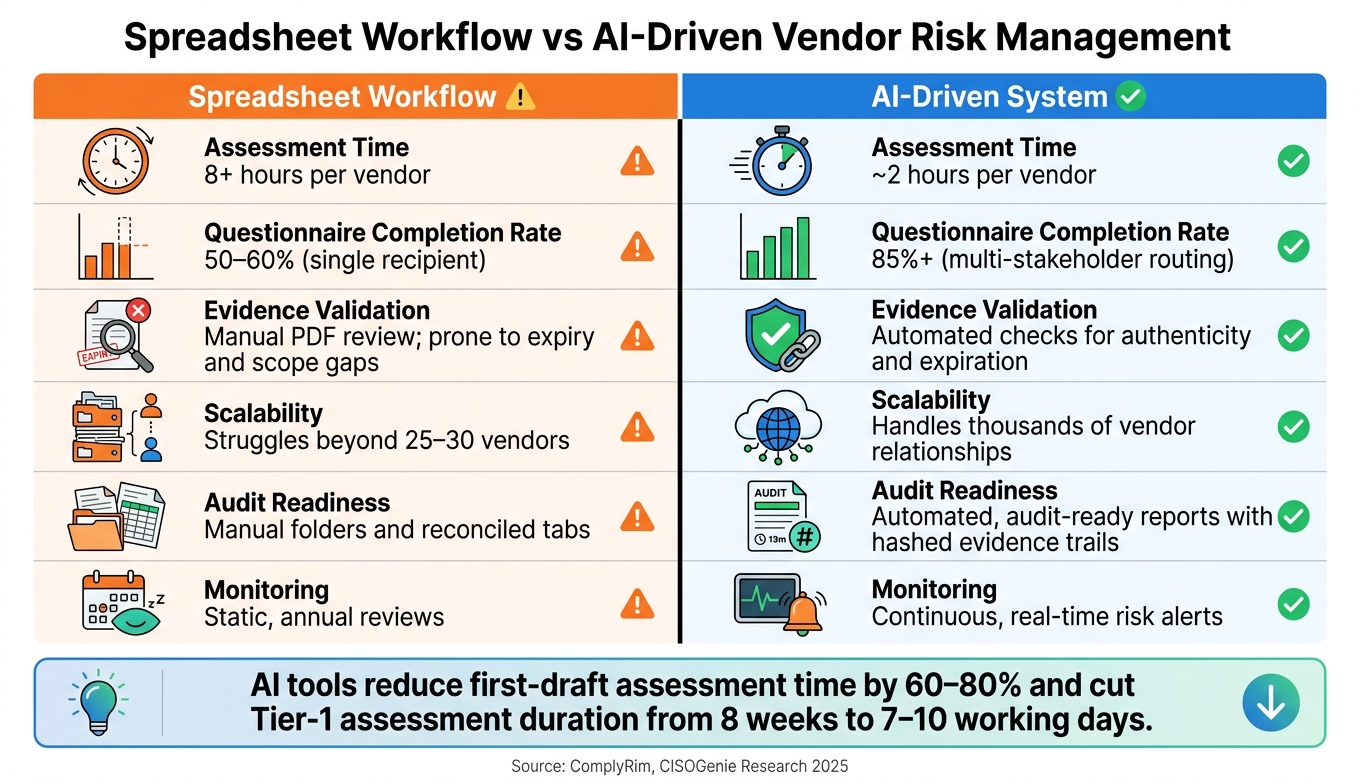
Spreadsheet vs AI-Driven Vendor Risk Management: Key Metrics Compared
Transitioning from spreadsheets to an automated vendor risk management system is a logical step for organisations aiming for continuous, risk-based monitoring. The process doesn’t need to be overwhelming. A phased approach ensures you keep risks manageable while maintaining steady progress.
A Step-by-Step Implementation Plan
One common misstep organisations make is rushing into a new system without first organising their existing data. The first step is to clean up your vendor inventory. This means standardising vendor names, removing duplicates, and confirming ownership and renewal dates. Skipping this step can lead to importing disorganised data into the new platform, creating more problems than solutions.
Once your inventory is ready, categorise vendors into defined risk tiers. This helps tailor the depth of assessments, avoiding unnecessary efforts like sending exhaustive surveys to low-risk vendors, such as stationery suppliers.
| Step | Action | Goal |
|---|---|---|
| 1. Inventory Cleanup | Standardise vendor names, eliminate duplicates, verify owners | Create a clean foundation for migration |
| 2. Risk Tiering | Apply risk-based categories | Match assessment depth to vendor risk levels |
| 3. Tool Selection | Choose a platform aligned with compliance needs | Ensure the tool fits your organisation’s maturity |
| 4. Pilot Programme | Test with 5–10 Tier 1 vendors | Fine-tune workflows and processes before full rollout |
| 5. Full Migration | Move historical data and records to the new system | Centralise vendor data into one source of truth |
| 6. Continuous Enrolment | Link vendors to real-time monitoring feeds | Transition from annual reviews to ongoing risk tracking |
To save time, leverage industry-standard templates like SIG Lite or CAIQ instead of creating custom questionnaires. This approach not only reduces back-and-forth communication with vendors but also ensures a consistent baseline for assessments. Begin with a pilot programme involving 5–10 Tier 1 vendors. Use this phase to test workflows, validate evidence, and automate follow-up reminders.
From there, you can explore how AI-driven systems outperform traditional spreadsheet workflows.
Comparing Spreadsheet Workflows with AI-Driven Systems
Manual workflows for vendor assessments are time-consuming and inefficient. On average, they take 8+ analyst hours per vendor and result in questionnaire completion rates of just 50–60%. In contrast, AI-driven tools cut assessment time to approximately 2 hours and boost completion rates to over 85%, reducing first-draft time by 60–80%. This efficiency becomes critical as organisations face growing workloads, managing an average of 347 vendor security questionnaires annually by 2025 - a 40% jump since 2023.
“The spreadsheet starts breaking down at the 25-vendor mark - not because the data won’t fit, but because the multi-stakeholder routing and evidence-expiry tracking become unmanageable.” - ComplyRim Team
| Feature | Spreadsheet Workflow | AI-Driven System |
|---|---|---|
| Assessment Time | 8+ hours per vendor | ~2 hours per vendor |
| Questionnaire Completion Rate | 50–60% (single recipient) | 85%+ (multi-stakeholder routing) |
| Evidence Validation | Manual PDF review; prone to expiry and scope gaps | Automated checks for authenticity and expiration |
| Scalability | Struggles beyond 25–30 vendors | Handles thousands of vendor relationships |
| Audit Readiness | Manual folders and reconciled tabs | Automated, audit-ready reports with hashed evidence trails |
| Monitoring | Static, annual reviews | Continuous, real-time risk alerts |
The difference in completion rates is particularly striking. When vendors receive lengthy questionnaires via spreadsheets, responses tend to stall. AI tools, however, route specific questions - like security queries to the CISO or privacy concerns to the DPO - dramatically improving response rates from 50–60% to over 85%. For Indian companies managing third-party relationships under frameworks like DPDP, ISO 27001, or PCI DSS, this improvement means fewer compliance gaps, quicker onboarding, and stronger ongoing risk management.
Conclusion: What Better Vendor Risk Management Looks Like
Switching from spreadsheets to AI-driven vendor risk management can completely change how organisations handle third-party risks. When vendor data is scattered across files and emails, you’re not managing risk effectively - you’re just juggling paperwork.
Adopting AI-native platforms brings clear benefits. For instance, the median time for Tier-1 assessments drops from 8 weeks to just 7–10 working days. Vendor onboarding becomes 3–5 times faster, and teams can shift their focus from chasing evidence to making impactful risk decisions.
These outcomes reflect a broader change in risk management practices.
“The biggest shift we’ve made is moving from viewing vendor assessment as a procurement gate to treating it as an ongoing relationship. The initial evaluation is just the beginning of continuous risk management.” - Security Leader, Abnormal AI Webinar
For Indian organisations, the stakes are even higher due to regulations like the DPDPA, RBI IT Outsourcing guidelines, SEBI CSCRF, and IRDAI frameworks. A single Tier-1 vendor breach could result in direct remediation and regulatory costs ranging from ₹15–60 crore. Annual spreadsheet reviews simply aren’t equipped to handle such risks.
Key Takeaways for Decision-Makers
Here’s what decision-makers should focus on:
- Speed: What once took weeks can now be done in days.
- Accuracy: AI validates evidence rather than relying on self-attested claims.
- Scale: Manage hundreds of vendor relationships without increasing team size.
- Continuous intelligence: 24/7 monitoring identifies real-time changes in vendor risk, replacing outdated static reviews that lose relevance within 90 days.
Platforms like CISOGenie bring all these capabilities together in a single AI-native GRC system. They support compliance with over 35 frameworks, automate evidence collection, and provide centralised dashboards to keep your organisation audit-ready. This shift transforms vendor risk management from a compliance hassle into a strategic tool that protects revenue, accelerates onboarding, and helps leaders make smarter decisions.
FAQs
When should we stop using spreadsheets for vendor risk?
When managing more than 10–20 vendors or dealing with manual workflows that increase audit risks, it’s time to move beyond spreadsheets. Spreadsheets often create headaches like version control issues, outdated data, and a lack of scalability.
For CISOs and GRC leaders, the need to upgrade becomes even more pressing when transitioning to continuous risk management or facing challenges with audit preparedness. Free compliance readiness tools can help benchmark gaps before migration, and an AI-powered platform such as CISOGenie provides automated monitoring, evidence mapping, and scalable vendor risk management that’s always ready for audits.
How do we tier vendors by risk in a practical way?
To categorise vendors effectively, focus on two key factors: data access and service criticality. A three-tier model works well for this:
- Tier 1 (Critical): Vendors with access to sensitive data or core infrastructure. These require thorough, annual assessments to ensure compliance and security.
- Tier 2 (Significant/High): Vendors with access to internal systems or operations. Regular periodic reviews are necessary here to monitor risks.
- Tier 3 (Low): Vendors without access to sensitive data. For these, basic due diligence is sufficient.
This approach helps prioritise resources based on risk levels, ensuring compliance with auditor expectations.
What should we continuously monitor after vendor onboarding?
After bringing a vendor onboard, it’s crucial to keep an eye on any significant changes in their security measures and overall operations. Pay close attention to areas like public vulnerability reports, security breaches, incident notifications, and even their financial stability.
You should also monitor their infrastructure - this includes keeping tabs on certificates and domains. Regularly verify their security certifications, such as SOC 2 or ISO 27001. Additionally, stay alert to any updates regarding their sub-processors or compliance requirements, as these could directly impact your risk exposure.