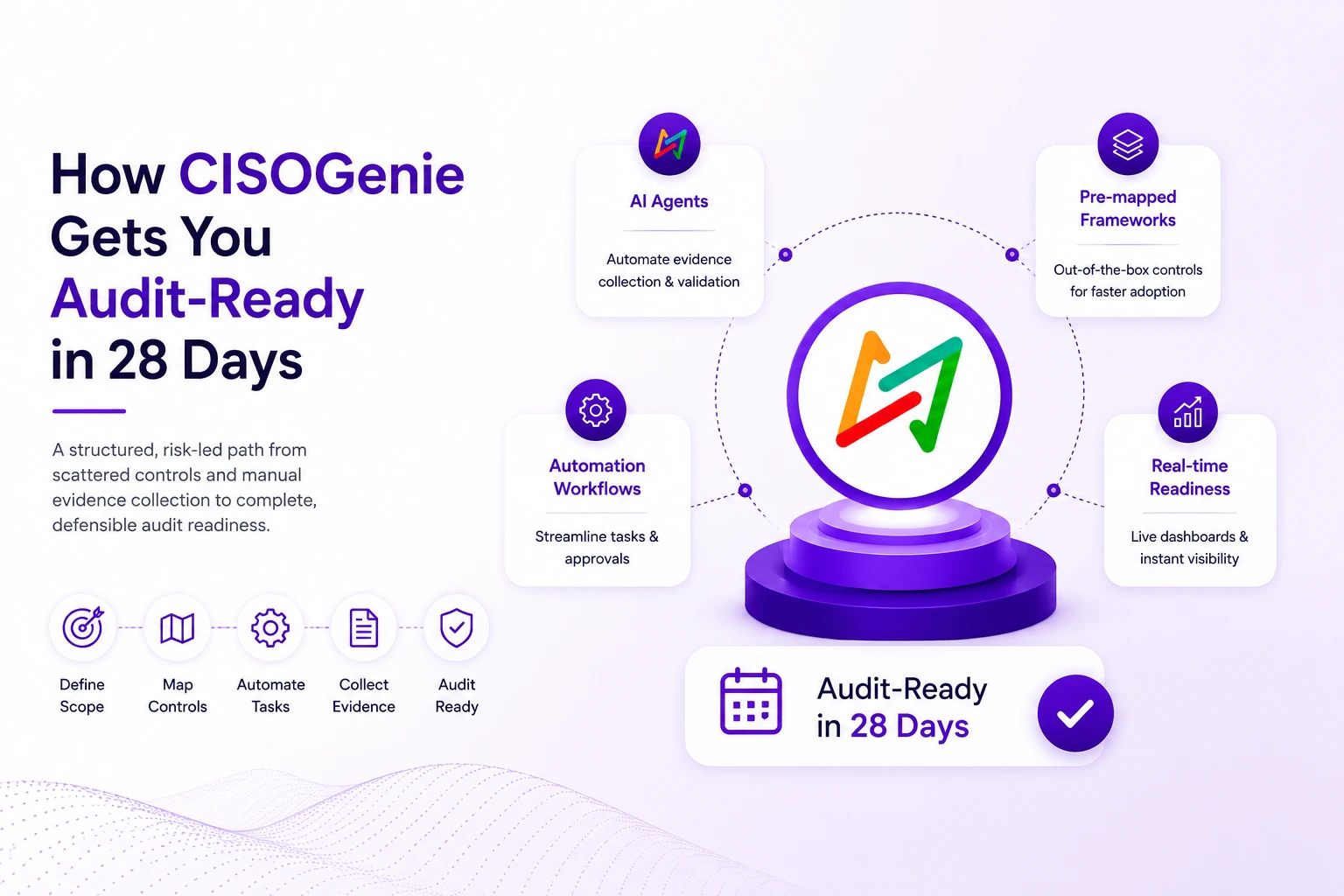
A structured, risk-led path from scattered controls and manual evidence collection to a complete, defensible audit readiness package — in as little as 28 days.
✍️ CISOGenie Team📅 May 2026🕐 14 min read🏷️ Audit Readiness · Compliance Automation
For defined-scope environments and focused audit readiness programs. Broader scope takes longer — the platform tells you exactly where you stand. See how teams compress timelines in our 3–4 week compliance readiness guide.
40+
Frameworks Supported
28
Days to Audit Readiness
6
Structured Phases
ISO 27001SOC 2GDPRDPDPARBI CSFSEBI CSCRFDORAIEC 62443ISO 42001CCPAEssential EightCPS 234Saudi PDPL+ more
Audit readiness isn't hard because your team is unprepared. It's hard because the process is structurally broken.
Most compliance struggles aren't capability problems. They're architecture problems — the wrong tools, the wrong sequence, and no single view of where things actually stand. Control-first programmes often break down in risk management even when individual controls look fine on paper.
📋
Evidence Lives Everywhere
Policies in Google Drive, screenshots in email, logs in a ticketing system, risk items on a sticky note. When an auditor asks, the scramble begins. The evidence collection gap is the most common cause of delayed audits.
🗺️
No Clear Audit Path
Teams know they need to be audit-ready. What they lack is a structured workflow that tells them what to do first — and what "done" actually looks like within a defined audit scope.
📊
Spreadsheet-Driven Compliance
Tracking controls in a spreadsheet works until it doesn't. Version conflicts, manual updates, no audit trail. The moment the sheet is stale, compliance readiness visibility disappears entirely.
🏗️
Controls Without Context
Checking boxes without understanding which controls are tied to which risks. That's control-first compliance — and it's the main reason teams get surprised during audits even when they've worked hard on risk management.
"Most teams underestimate how much time disappears in pre-audit coordination. The controls exist. The documentation doesn't."
Where Audit Preparation Time Actually Goes
The hours disappear before the real work begins.
Audit preparation rarely fails on compliance knowledge. It fails on operational friction — the time spent chasing, rebuilding, and coordinating instead of executing. That's the pattern we break down in manual audit prep vs. CISOGenie.
Week 1
Chasing Screenshots and Access Records
Someone needs to confirm MFA enforcement is active. Another person needs to pull access logs. A third needs to find the vulnerability assessment that was run six months ago. Each request generates a Slack thread, three follow-ups, and an uncertain outcome.
↑ 3–5 days lost
Week 2
Rebuilding the Risk Register From Scratch
The last version was a spreadsheet. It has seventeen tabs, unclear ownership, and the risk ratings haven't been reviewed in eight months. Starting over — again — because there was no continuous risk register between audit cycles.
↑ 4–7 days lost
Week 3
Discovering Policies Were Never Acknowledged
The Acceptable Use Policy exists. The Information Classification Policy exists. Neither has tracked acknowledgment. The auditor will ask for evidence of policy adoption. There isn't any. Everything needs to be re-sent, re-acknowledged, and documented in a hurry.
↑ 3–5 days lost
Week 4
The Pre-Audit Panic Review
A late-stage review surfaces gaps that should have been found in week one. Remediation items are logged for the first time. Some get fixed; others get marked as accepted risk without documentation. The evidence pack is incomplete. The auditor is booked. That sounds minor at first. It usually isn't.
↑ 5–8 days lost
Week 2 is where a stale spreadsheet becomes a full rebuild — exactly the problem a live risk register is meant to prevent.
Why Audit Preparation Stalls
What slows down audit preparation — and why it keeps happening.
These aren't one-off failures. They're predictable friction points that appear in nearly every audit preparation cycle, across teams of every size and every level of GRC maturity.
1
No Baseline Assessment
Teams start implementing controls without first understanding their current gap against the target framework. That sounds minor at first. It usually isn't — it leads to overbuilding in some areas and missing critical requirements entirely in others. A structured gap assessment changes the entire trajectory of the program.
2
Undefined Audit Scope
A SOC 2 audit readiness program can cover one system or twenty. An ISO 27001 scope can be narrow or enterprise-wide. When scope isn't fixed early, effort spreads across everything — and the audit never converges.
3
Policy Without Adoption
Policies get written and uploaded. Then they sit. Without tracked acknowledgment and linked evidence, a policy document is not a control — it's a file. Auditors know the difference. Policy adoption tracking is one of the most commonly missed audit readiness requirements.
4
Manual Evidence Collection
The single highest time-cost in audit preparation. When evidence — access reviews, MFA enforcement records, encryption at rest confirmations, vulnerability assessment reports — has to be gathered by hand, two weeks disappear before anything substantive is reviewed. Automated evidence collection is the most impactful compression lever.
5
No Internal Audit Before the External One
Teams hand over evidence to an external auditor without running an internal audit first. Gaps that could have been remediated in a week instead become audit findings — with all the rework, delay, and cost that follows. Architecturally, this is not a small distinction.
6
Consultant Dependency Without Capability Transfer
External GRC consultants can accelerate early stages. But when the knowledge stays external, every audit cycle starts from near-zero. The goal of a sound agentic GRC platform is to build internal capability — not permanent dependency.
The fastest way to get audit-ready is to follow a sequenced workflow where each phase produces outputs that feed directly into the next. CISOGenie is built around that sequence — not around a list of controls to tick off. This is what separates end-to-end compliance execution from a compliance document library — and what risk-led security platform management makes sustainable cycle after cycle.
28
days to readiness
for defined-scope environments
Phase 0
Onboarding
Day 1
Set Up Your Compliance Environment
Configure your organisation profile, define the audit scope, select your target framework — ISO 27001, SOC 2, or any of 40+ supported standards — and connect your asset register. This is where scope becomes a concrete boundary, not a vague intention. Scope defined here governs everything that follows.
Run a structured gap assessment against your selected framework. CISOGenie maps your current controls against framework requirements, surfaces gaps, and produces a compliance readiness score — so the team works from facts, not assumptions. Most teams underestimate how many partially-implemented controls won't survive auditor scrutiny.
Build or import your policy library, complete your risk assessment, and map controls to risks — not just to framework requirements. This is what separates a risk-led approach from control-first compliance. A control exists because it reduces a risk. CISOGenie keeps that chain visible and traceable throughout the entire compliance lifecycle.
This is where CISOGenie's agentic AI capabilities deliver the most visible time saving. Evidence against controls — access control reviews, MFA enforcement confirmation, encryption at rest documentation, audit logs, vulnerability assessment outputs — is collected, tagged, and linked to controls automatically wherever integrations are in place. What remains requires human judgment; the platform tells you exactly what that is and who owns it.
Review your evidence pack, validate control effectiveness, and work through open remediation items. The compliance dashboard gives the full picture in real time — what's closed, what's in progress, what's outstanding. No status meeting required to understand current readiness state.
CISOGenie generates a structured internal audit report against your selected framework through audit assist workflows and audit management. This is the step most teams skip — and the step that most frequently determines whether the external audit is a formality or a fire drill. Find the gaps yourself. Fix them. Then face the auditor. It's a basic sequencing principle that makes an outsized difference to outcomes.
Export a complete evidence pack, generate your Statement of Applicability or equivalent documentation, and confirm your compliance readiness score is in the range your auditor will expect. Everything in one place. Everything traceable. Your team has owned this process — not just received it from a consultant — and that matters well beyond day 28.
"Audit-ready and certified are not the same thing. Audit-ready means your documentation, evidence, and controls are in a defensible state for review. That's the achievable goal — and it's the only goal this workflow pursues."
Not every team preparing for an audit has a GRC background. CISOGenie is designed to meet teams where they are — whether that's a first-time startup founder navigating startup audit readiness for the first time, or an experienced security team that wants the platform to move as fast as they do.
🧭 Founder Mode
For teams who are new to GRC — and don't want to feel that way.
GRC jargon is hidden. The platform speaks in tasks and outcomes, not framework clauses. The only question on screen is: what do I do next?
→Task-driven workflow — "do this now" replaces compliance theory
→GRC terminology surfaced only when it's directly actionable
→Plain-language explanations of why each step matters
→No assumed prior knowledge of ISO, SOC 2, or any framework
→Guided gap assessment — questions, not clauses
→Built for founders, engineering leads, and first-time compliance owners
⚡ Autopilot Mode
For teams who know what they're doing and want it done fast.
Pre-filled risk acceptance decisions, automatic policy adoption routing, evidence mapping on autopilot. The platform handles the routine; your team handles the judgments.
→Pre-filled risk acceptance and treatment recommendations
→Automatic policy adoption workflows — send, track, close
→Evidence mapped to controls as integrations pull data
→Remediation items auto-assigned based on asset and control owner
→Internal audit report generated without manual compilation
→Built for experienced CISOs, compliance leads, and security teams
"The best compliance systems reduce the distance between knowing what to do and actually doing it. Founder Mode and Autopilot Mode are both trying to close that gap — from opposite starting points."
Compliance Dashboard
One view of your entire audit readiness state.
The CISOGenie dashboard is designed around one question: what does my auditor need, and do I have it? Continuous compliance monitoring means readiness is a standing state — not a pre-audit sprint that resets after every cycle.
🎯
Compliance Readiness Score
A live readiness score against your selected framework, updated as controls are implemented and evidence is collected. Not a vanity metric — a working signal for where effort needs to go next.
🔗
Connected Evidence & Controls
Every piece of evidence is linked to the control it supports, which is linked to the risk it mitigates, which is linked to the framework requirement. The chain is always visible. No orphaned documents, no unattributed screenshots.
📈
Remediation Tracking
Open items, assigned owners, due dates, and closure status — all tracked in the platform. The team knows what's outstanding. The CISO knows what's at risk. No coordination overhead.
📂
Risk Register & Asset Register
Maintained continuously, not rebuilt for each audit. Risk assessments stay current as assets and environments change — so scope stays accurate throughout the year, not just in audit season.
🤖
Agentic AI Workflows
CISOGenie is MCP-ready, enabling connected agentic AI workflows across assets, risks, controls, evidence, audits, and remediation. Routine collection and linkage happens automatically; judgment stays with your team.
🏢
Multi-Tenant Architecture
Purpose-built for security teams managing compliance across multiple entities, clients, or business units. Each tenant has its own clean compliance environment with shared platform governance and no data bleed.
Dashboard workflows tie into agentic GRC execution and MSSP multi-tenant programmes without rebuilding evidence every cycle.
Risk-led compliance versus control-first compliance
The distinction sounds architectural. It is. And it determines whether your compliance program survives contact with an experienced auditor — or looks like a checklist exercise that happened to produce documents. We cover the full philosophy in risk-led security management.
Control-First Approach
CISOGenie — Risk-Led Approach
Start from a framework's control list and work through it
✓Risk assessment drives control selection and prioritisation
Evidence collected per control, without risk context
✓Each control is traceable to a specific risk and framework requirement
Risk register created separately, often after the fact
✓Evidence is collected against controls with documented rationale
Gaps discovered during auditor review, not before
✓Internal audit catches gaps before the external auditor does
Readiness score reflects implementation, not risk reduction
✓Readiness score reflects actual risk posture, not task completion
Each audit cycle starts from scratch or a stale spreadsheet
✓Continuous compliance tracking — no audit-season scramble
Consultant dependency for sequencing and prioritisation
✓Team capability builds with every cycle — not consultant dependency
"A 35-year GRC practitioner will tell you: the auditor's first question is rarely about your controls. It's about your risk assessment. Start there."
What You Get
The complete set of audit-defensible deliverables.
At the end of 28 days — or earlier, depending on your scope — you have a documented, traceable, audit-defensible set of outputs. Not a status update. A complete evidence pack your auditor can review. For a line-by-line view of automation boundaries, see what CISOGenie automates vs. what your team completes.
🗂️
Complete Evidence Pack
All evidence, linked to controls, linked to risks, linked to framework requirements. Ready for external review without last-minute assembly.
📋
Internal Audit Report
A structured report against your target framework, with nonconformities, corrective actions, and closure status — generated by the platform, not compiled manually.
⚖️
Risk Register
A maintained, audit-ready risk register with treatment decisions, owners, and residual risk documentation. Current — not a version from last cycle.
🔒
Policy Library with Adoption Tracking
Policies in force, with acknowledgment records. Not a folder of PDFs — a documented compliance artefact with a traceable adoption history.
🗺️
Asset Register
In-scope assets, classified and mapped to controls. Scope stays defined and current — not assumed from memory or a spreadsheet last updated eight months ago.
📊
Compliance Readiness Score
A defensible readiness score your team can present to leadership, the board, or an auditor — with full backing documentation and traceability.
🔄
Remediation Log
Every open item, assigned, tracked, and closed — with an audit trail. Demonstrates operational compliance, not just documentation compliance.
📄
Statement of Applicability (or Equivalent)
For ISO 27001 and equivalent frameworks — a documented, justified SoA that reflects your actual risk decisions, not a template with blanks filled in.
Designed for startups and lean security teamsBuilt for multi-framework compliance environmentsUsed for audit preparation across regulated sectorsReduces consultant dependency with every cycleMCP-ready agentic GRC for connected workflows
Honest Expectations
Things worth knowing before you start.
Audit-ready means your documentation, evidence, and controls are in a defensible state for auditor review — not that certification is guaranteed. Scope, auditor, and external dependencies all matter.
28 days is achievable for focused scope engagements — a single system, a defined service perimeter, or a startup with a contained infrastructure environment. Broader scope takes longer. The platform tells you.
Some controls genuinely require human judgment: access control decisions, supplier due diligence assessments, executive risk acceptance. CISOGenie flags them clearly; your team owns them.
Evidence automation works where integrations are in place. Where they aren't, the platform guides what's needed and from whom — it doesn't pretend the gap doesn't exist.
Continuous compliance tracking means you're not rebuilding from scratch each cycle. The second audit is materially faster than the first. That compounding effect is where the platform's value becomes most visible.
You don't need a dedicated GRC team to use CISOGenie. You need one person with ownership and a few hours a week during initial phases. Most startup security teams have exactly that.
The platform supports 40+ frameworks. You don't have to be working toward ISO 27001 or SOC 2 specifically. DPDPA, RBI CSF, DORA, Essential Eight, and others follow the same structured workflow.
MCP-ready architecture means CISOGenie connects to your existing security tooling through integrations — not a reason to rip and replace your stack to adopt the platform.
Ready to see the 28-day path for your specific framework?
Book a live walkthrough of CISOGenie with your target framework, your scope, and your timeline. Not a generic demo — a conversation about your actual audit readiness situation.