Breach Notification Compliance Guide: Mapping Incident Response to DPDPA, GDPR, HIPAA, and CCPA
Use one incident record, one time-of-awareness stamp, and one decision trail split by law to handle DPDPA, GDPR, HIPAA, and CCPA together.
Breach Notification Compliance Guide: Mapping Incident Response to DPDPA, GDPR, HIPAA, and CCPA
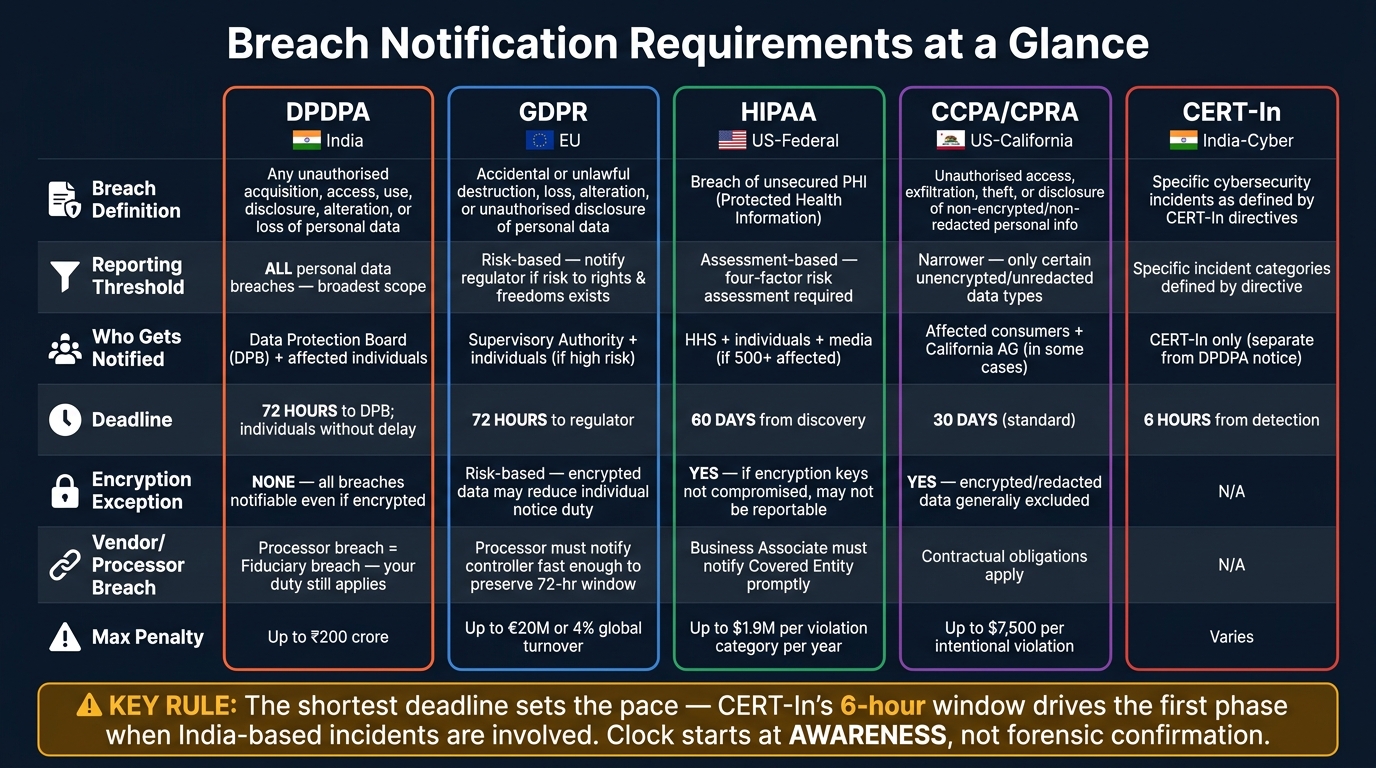
One breach can start three different clocks at once: CERT-In in 6 hours, DPDPA and GDPR in 72 hours, and HIPAA in 60 days. If your team waits for full forensic proof, you can miss the deadline before the facts are even lined up.
I'd sum up the article like this: use one incident record, one time-of-awareness stamp, and one decision trail that is split by law. That is the cleanest way to handle DPDPA, GDPR, HIPAA, and CCPA together. It also helps when the same event hits India, the EU, and the US at the same time.
Here's the full takeaway in simple terms:
- DPDPA is broad: if personal data is breached, notice is expected. Penalties can go up to ₹200 crore.
- GDPR is risk-based: regulator notice depends on risk to people's rights and freedoms; people get notice if risk is high.
- HIPAA is assessment-based: the four-factor test decides if unsecured PHI was compromised.
- CCPA/CPRA is narrower: it focuses on certain personal information, mainly where data is not encrypted or redacted.
- CERT-In is separate: for India-based incidents, a cyber incident may need reporting within 6 hours, and that does not replace DPDPA notice.
- Encryption does not solve everything: under HIPAA it may remove notice duty in some cases; under DPDPA it does not.
- Vendor breach still becomes your problem: if your processor or service provider is hit, your own notice duties may still start.
- Non-reportable events still need records: if you decide not to notify, write down why.
Quick Comparison
| Framework | What starts notice review | Who may need notice | Main deadline |
|---|---|---|---|
| DPDPA | Personal data breach | DPB and affected individuals | 72 hours to DPB; individuals without delay |
| GDPR | Personal data breach with risk | Supervisory authority; individuals if high risk | 72 hours |
| HIPAA | Breach of unsecured PHI | HHS, individuals, media in some cases | 60 days from discovery |
| CCPA/CPRA | Certain personal information exposed | Consumers; AG in some cases | Often 30 days |
| CERT-In | Certain cyber incidents | CERT-In | 6 hours from detection |
If I were turning this into a working rule for a response team, it would be this: treat awareness time as day zero, map every incident to every law at once, and keep separate written reasons for each notification call. That is the main point of the article, without repeating all of its detail.
Breach Notification Rules Under DPDPA, GDPR, HIPAA, and CCPA
The same incident can trigger very different notice duties depending on the law in play. That's the part that often trips teams up. One set of facts may look like a security issue at first, then quickly become a privacy, legal, or compliance call.
What Counts as a Notifiable Breach Under Each Framework
DPDPA takes the broadest route here. It treats any unauthorised acquisition, access, use, disclosure, alteration, or loss of personal data as reportable. And the Data Fiduciary still carries the duty even if the breach happened at a processor.
GDPR covers accidental or unlawful destruction, loss, alteration, or unauthorised disclosure of personal data. But not every breach leads to the same notice duty. You notify the supervisory authority when the breach is likely to create risk to people's rights and freedoms. You notify individuals when that risk is high.
HIPAA applies to breaches of unsecured PHI. Here, the key step is the four-factor risk assessment. That assessment is used to decide whether there is a low probability that PHI was compromised. Business Associates must notify covered entities promptly.
CCPA/CPRA is narrower in scope. It covers unauthorised access, exfiltration, theft, or disclosure of non-encrypted and non-redacted personal information.
Notification Triggers, Recipients, and Deadlines
Once you know the breach definition, the next job is simple in theory and messy in practice: who gets notified, and how fast? The table below maps that out.
| Framework | Definition of Breach | Reporting Threshold | Recipients | Timeline |
|---|---|---|---|---|
| DPDPA (India) | Unauthorised acquisition, access, use, disclosure, alteration, or loss of personal data | All personal data breaches | Data Protection Board (DPB) and affected Data Principals | 72 hours for detailed report to DPB; without delay to affected Data Principals |
| GDPR (EU) | Accidental or unlawful destruction, loss, alteration, or unauthorised disclosure of personal data | Risk to rights and freedoms for regulator; high risk for individuals | Supervisory Authority; individuals if high risk | 72 hours to regulator |
| HIPAA (US) | Breach of unsecured PHI | Low probability of compromise assessment | HHS, individuals, and media if more than 500 affected | 60 days from discovery; annually for fewer than 500 records |
| CCPA/CPRA (CA) | Unauthorised access, exfiltration, theft, or disclosure of non-encrypted and non-redacted personal information | Unauthorised access, exfiltration, theft, or disclosure | Affected consumers; California Attorney General in some cases | 30 days standard |
One point matters more than teams sometimes admit: the clock starts at awareness. Under DPDPA and GDPR, that means the earliest point when a responsible person has enough information to reasonably conclude that a breach occurred. You do not need forensic certainty before that clock begins.
That's why incident logs matter so much in the first few hours. If facts come in late, the notice timeline doesn't magically slow down.
Where CERT-In Fits for India-Based Response Teams
For India-based teams, there's another layer on top of privacy notice duties. Specific cybersecurity incidents must be reported to CERT-In within 6 hours of detection.
That filing is not the same thing as a DPDPA privacy notice. It goes to a different recipient, asks for different content, and runs on its own timeline. In plain terms, don't treat one as a substitute for the other.
Run CERT-In reporting in parallel with the DPDPA notice flow. In those first few hours, that usually shapes triage, logging, and legal review more than anything else.
Mapping the Incident Lifecycle to Breach Notification Obligations
Knowing the rules is one thing. Running a clean response when the pressure is on is something else. Most teams don't stumble because they don't know the law. They stumble because of messy hand-offs, unclear timestamps, and missing records.
The aim here is simple: turn the framework rules from the previous section into a workflow your team can use in practice. Use it as the base path for ransomware, vendor compromise, lost-device, and accidental-disclosure cases.
Detection, Triage, and Initial Logging in the First Few Hours
The moment the organisation has enough facts to reasonably suspect a breach, the regulatory clock starts. Open the incident record within 2 hours. It should capture the IST timestamp of first awareness, the alert source, affected assets, and an early view of whether personal data is involved.
That one record becomes the base document for every notification call that follows. It feeds DPDPA, GDPR, HIPAA, CCPA, and CERT-In duties at the same time.
Early classification matters more than many teams think. A ransomware event can trigger DPDPA, GDPR, and CERT-In at once, depending on the data set and the places involved. A lost laptop with encrypted drives may take a different route if the encryption keys were also exposed. Get the data category and jurisdiction right in the first few hours, and the rest of the response becomes far easier to manage.
Legal Assessment and Threshold Determination
Once containment is in motion, the DPO and legal counsel need to make a clear call: is this reportable, and under which frameworks?
This is where teams often lose precious time. The assessment should record:
- the categories of data affected
- the estimated volume of records
- the jurisdictions of affected data principals
- the exact trigger being used, such as "unauthorised access" under DPDPA or "risk to rights and freedoms" under GDPR
Just as important, record the reasoning even when you decide not to notify. A breach register entry that says "assessed as non-reportable because data was fully encrypted and keys were not compromised" is audit evidence. An empty record, on the other hand, can come back to haunt you.
The table below turns this into a repeatable hand-off from SOC to legal.
| Phase | Timeframe | Primary Owner | Required Artefacts | Key Decision/Approval Record |
|---|---|---|---|---|
| Detection & Triage | 0–2 Hours | SOC / IT Security | Incident log, IST awareness timestamp, alert source, preliminary data scope | Initial triage: Is personal data exposure plausible? |
| Containment | 2–6 Hours | IR Team / Engineering | Containment report, credential revocation log, evidence chain of custody | Containment scope sign-off; evidence preservation confirmed |
| Legal Assessment | 6–24 Hours | DPO / Legal / CISO | Breach assessment report, data category map, jurisdiction matrix, reportability rationale | Severity classification; rationale for reportability |
| Regulator Notification | Within applicable deadline | DPO / Legal / Compliance | Regulator submission, submission proof, draft notices | Approval of notification content by Executive/DPO |
| Individual Notification | Without delay | Communications / Privacy | Principal notice copies, delivery logs, support team FAQ | Final decision log for individual notice |
| Post-Incident Review | 2–4 Weeks | CISO / DPO / IR Team | Root cause analysis, updated IR playbook, forensic summary, lessons learned | Lessons learned; remediation sign-off |
When more than one framework applies at the same time, the shortest deadline sets the pace for the whole response. If an incident triggers both CERT-In (6 hours) and DPDPA (72 hours), the 6-hour window drives the first phase.
Notification Execution and Post-Incident Documentation
Don't write notices from scratch inside the notification window. Teams that handle this well usually have pre-approved templates ready for regulators and individuals, with blank fields for incident-specific details.
If some facts are still unclear when the deadline hits, send an initial report to the regulator and then provide phased updates as the forensic work continues.
And once the notices are out, the paperwork isn't over. Keep:
- forensic summaries
- internal approval records
- vendor statements in third-party compromise cases
- copies of all communications sent
- the final decision log
Under DPDPA, these records, along with proof of reasonable security safeguards, should be kept for a minimum of 3 years to support regulatory inquiries.
Post-incident review closes the loop. Update the IR playbook, fix evidence gaps, and write down lessons learned while the details are still fresh. Keep the incident record, approval trail, and communications log. The next section applies this workflow to ransomware, vendor compromise, and lost-device scenarios.
Framework-Specific Mapping for Common Breach Scenarios
Now bring the lifecycle into day-to-day breach patterns. These scenarios show the real test: can one incident record support separate decisions under each framework? The point isn't to repeat the rules. It's to show how the same facts can lead to different notice outcomes depending on the framework in play.
Use each scenario to check whether your incident record can support separate decisions under each framework.
Ransomware, Access by Unauthorised Parties, and Data Exfiltration
Do not wait for proof of exfiltration before you start the notification analysis.
Ransomware can trigger notification even when exfiltration has not been confirmed. Under DPDPA and GDPR, loss of access alone is enough to start the analysis, while HIPAA turns on breach presumptions and the four-factor assessment.
Under HIPAA, the encryption exception does exist, but it is narrow. If the attacker did not obtain the encryption keys, breaches of secured PHI are not reportable. Under DPDPA, there is no such exception. All personal data breaches must be reported, even if the data was encrypted.
So what should responders collect before making the call? Move fast. Capture logs, memory captures, and disk images at once. Then document:
- the nature and extent of the data involved
- who accessed it
- whether it was actually acquired or viewed
- whether encryption keys were obtained
- what mitigation has already been completed
Under HIPAA, that record supports the four-factor assessment. Under DPDPA and GDPR, it shapes what goes into the notices.
| Framework | Loss of Access (No Exfiltration) | Encryption Exception | Evidence That Changes the Analysis |
|---|---|---|---|
| DPDPA | Reportable | None - all breaches notifiable | Nature of breach, categories of data, steps taken |
| GDPR | Reportable | None specific - risk assessment may affect individual notice | Risk to rights and freedoms of individuals |
| HIPAA | Fact-specific | Yes - if keys were not obtained | Four-factor risk assessment documentation |
| CCPA | Consumer notice under state law; regulator reporting generally not mandatory unless specific sensitive data types are involved | Depends on the category of data | Specific sensitive data categories involved |
Third-party incidents bring the same pressure, but usually with less sight into the facts.
Vendor Compromise and Third-Party Processor Incidents
Your duties start as soon as the vendor confirms a breach affecting your data.
Under DPDPA, processor breach equals fiduciary breach. Under GDPR, processor notice must come quickly enough to preserve the 72-hour regulator deadline. Under HIPAA and CCPA, vendor notice should be contractually faster than the statutory clock.
The fix here is mostly contractual and procedural. Vendor agreements should set notification timelines that are tighter than the regulatory deadlines, not just matched to them. It also helps to build a notice matrix into your third-party risk programme. For each critical vendor, map:
- which frameworks apply
- who the regulator is
- what the deadline is
- who internally owns the notification decision
When a vendor breach lands late on a Friday, that matrix should tell the on-call team what to do straight away, without wasting time on basic orientation.
The same pattern shows up in low-volume incidents. They may look minor on the surface, but the notice analysis can still split across frameworks.
Lost Devices and Accidental Disclosure Incidents
These incidents are often underestimated because the volume is low and the cause sounds ordinary: a laptop left in a taxi, an email sent to the wrong address. But low-volume does not mean low-effort. The decision log still needs to be complete.
Across all frameworks, the key variable is encryption status. Under HIPAA, a lost device containing encrypted PHI is not reportable if the encryption key was not compromised. Under DPDPA, that exception does not exist. Any loss of personal data triggers dual notification to the Data Protection Board and affected individuals. Under GDPR, the test is risk-based, so an encrypted lost device with no key exposure may fall below the notification threshold.
For misdirected emails, the analysis shifts again. Under DPDPA, sending personal data to the wrong recipient counts as misdirected disclosure or unauthorised disclosure and is always notifiable. Under HIPAA, there is a narrow exception: if the entity can show a good-faith belief that the recipient could not retain the information, it may not be a reportable breach. That reasoning needs to be written down clearly and separately for each framework. It should not be collapsed into one vague note saying “assessed as low risk”.
That's exactly why a single decision memo falls short. The same lost laptop can be non-reportable under HIPAA, need a risk-based review under GDPR, and be plainly reportable under DPDPA. Your breach register entry should show the reasoning for each framework on its own. Not one shared conclusion, but a separate decision trail.
These scenario rules should flow straight into your templates, matrices, and breach register fields.
Building a Repeatable Breach Notification Programme
The Minimum Set of Artefacts Every Programme Needs
Those scenario patterns only work if the programme has a standard set of artefacts behind them. Without that base, every incident turns into a brand-new fire drill. That's the last thing any team wants when a 72-hour clock is already ticking.
Every programme needs a breach requirements tracker that maps jurisdictions, triggers, deadlines, and recipients. It also needs an incident-to-obligation matrix that converts legal duties into day-to-day operational questions, an escalation matrix with live paths to the DPO, Legal, and executives, legal-approved notice templates, a decision register, and a forensic readiness policy for log preservation and chain of custody.
You should also keep a breach register for all incidents, including non-reportable ones. And when teams make threshold calls, they need to record the basis for each one. That means writing the framework-specific rationale, not a vague, one-line conclusion.
Once these artefacts are in place, automation can help keep them current during a live incident.
Where Compliance Automation Helps Most
When the control set is already in place, automation does its best work in the first response window. That's where most teams slip, and it usually happens in three places.
First, automate evidence collection from SIEM, EDR, and cloud tools. This shrinks the collection window and gives teams usable audit evidence early enough to support the 72-hour window.
Second, automate obligation mapping across overlapping jurisdictions. This helps teams spot the shortest deadline and see which notices are needed under each regime.
Third, centralise deadline tracking from the point of awareness, not from the point of forensic confirmation.
An AI-native GRC platform such as CISOGenie can centralise these workflows across vendor risk, contract analysis, and continuous compliance for DPDPA, GDPR, HIPAA, CCPA, ISO 27001, and SOC 2. Its autonomous agents pull evidence from connected security tools and keep compliance work moving across third-party and internal workflows during an active event.
Conclusion: Key Decisions Teams Must Standardise
The main job here is simple: standardise the decisions that change from one framework to another. Teams that do this well don't make it up on the fly. They've already worked through the tough calls before the incident starts.
There are five areas to lock down:
- Define reportable breach thresholds for each framework in writing before an incident occurs.
- Map every new incident to all applicable regimes during initial triage, not after containment.
- Track all deadlines from a single source that starts at awareness.
- Preserve a defensible evidence record with separate reasoning for each framework.
- Rehearse the notification workflow, including the escalation chain, decision gates, and template approval process, at least twice a year using multi-jurisdiction tabletop scenarios.
Only 20% of organisations have actually tested their detection-to-notification pipeline end-to-end. That's where missed deadlines and inconsistent notices usually begin.
The difference is rarely raw effort. It's process. Teams with repeatable, risk-led workflows handle breach notification with far less chaos. The frameworks are messy enough already; the programme shouldn't be.
Frequently Asked Questions
Frequently Asked Questions
Ready to Centralise Breach Notification Across Every Framework?
See how CISOGenie maps evidence, deadlines, and notification obligations across DPDPA, GDPR, HIPAA, and CCPA from one platform.