ISO 42001 Readiness Checklist: Before AIMS Certification
A practical checklist for scoping your AI Management System, assigning roles, embedding lifecycle controls, and collecting audit-ready evidence.
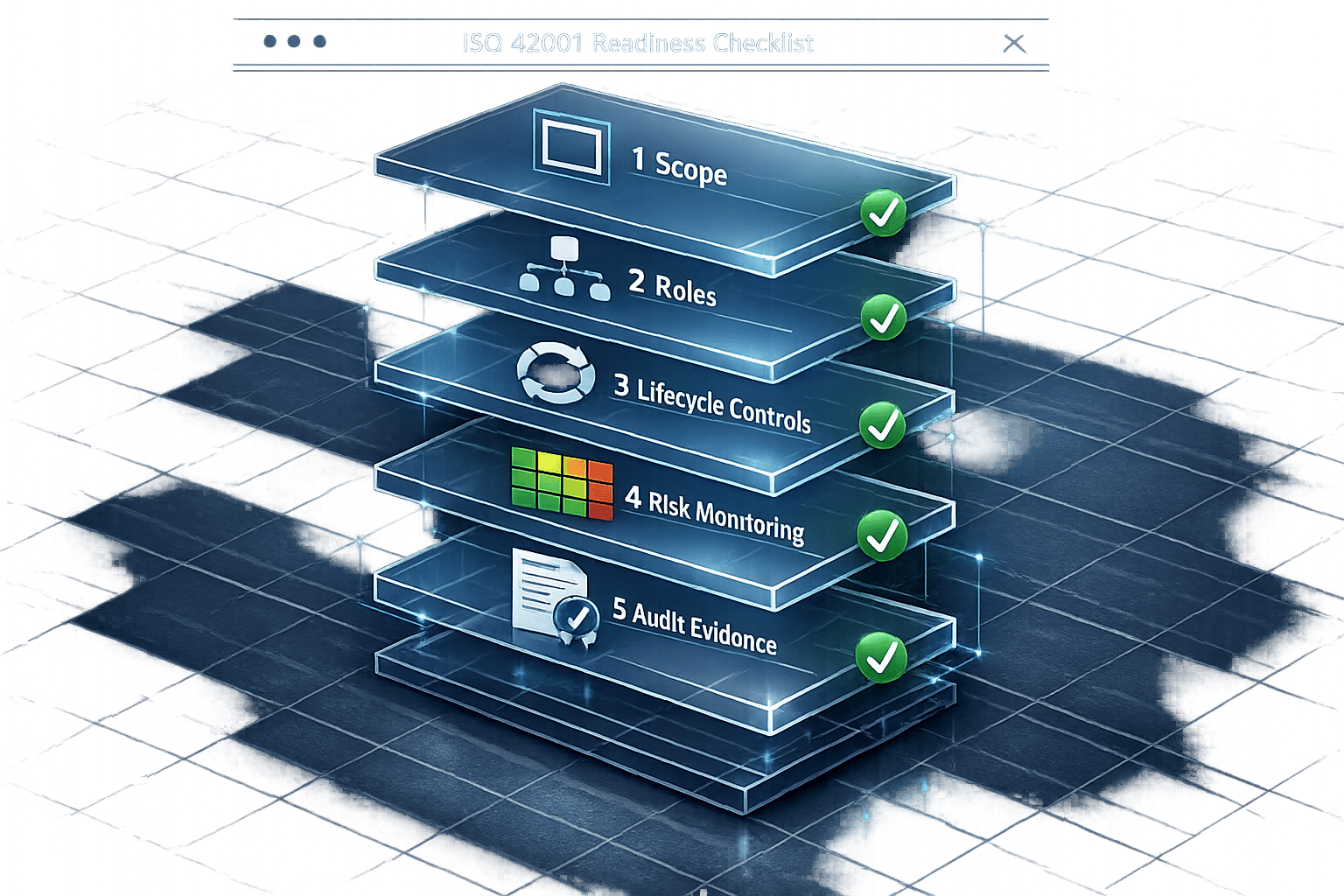
ISO 42001 Readiness Checklist: What to Assess Before AI Management System Certification
ISO 42001:2023 is the first global standard for Artificial Intelligence Management Systems (AIMS). It helps organisations govern AI responsibly, focusing on processes, controls, and accountability rather than specific AI models. For Indian organisations, it aligns with frameworks like the Digital Personal Data Protection Act (DPDPA) and sector-specific rules from RBI and SEBI.
Who Needs This?
Companies using AI in regulated sectors like BFSI, healthcare, or SaaS exports.
What's Required
Clear AI policies, risk assessments, lifecycle controls, and stakeholder roles.
Timeline
4–6 months for ISO 27001-certified firms; 9–15 months otherwise.
Cost in India: ₹7,20,000–₹16,20,000 for initial certification; ₹3,60,000–₹8,10,000 annually for surveillance audits.
Define your AI scope
Maintain an updated system inventory.
Assign roles with clear authority
Designate AI System Owners with halt authority.
Document policies, risks, and lifecycle processes
Use AI-driven GRC platforms
Streamline evidence collection with autonomous AI agents and ISO 42001 compliance automation.
Start with a half-day workshop to identify gaps and focus on top priorities. Engage a certification body once 60–70% prepared to avoid delays. Certification signals your commitment to responsible AI and builds trust in regulated markets.
ISO 42001 on CISOGenieScoping and Stakeholder Alignment for AIMS
Defining Scope and Organisational Context
Your AIMS scope document should clearly outline which AI systems, processes, and locations fall under its governance. A broad and vague scope like "all AI we use" is often rejected by auditors. Instead, focus on a specific, manageable area — such as a credit-scoring model or a customer-facing chatbot.
When defining the scope, consider both internal elements (policies, infrastructure, team capabilities) and external regulations (India's DPDPA, RBI/SEBI guidelines, or the EU AI Act for exports). Exclusions must also be justified — clearly document the reasoning behind exclusions, not just inclusions.
Maintain a living AI system inventory that tracks each system's purpose, model type, data sources, outputs, and the decisions it influences. This register should be updated continuously, not hastily compiled before an audit.
Stakeholder Roles and Responsibilities
The AI system owner must have the authority to halt a system. Evidence: documented role descriptions with authority levels. Verbal authority structures fail audits.
| Role | Primary Responsibility | Key Audit Evidence |
|---|---|---|
| Top Management (CEO/MD) | Approve AI policy, allocate resources | Signed policy, board or management review minutes |
| AI Governance Lead / AIMS Coordinator | Maintain AIMS, coordinate cross-functional reviews | Internal audit reports, management review records |
| AI System Owner | Operational oversight, authority to halt systems | Role description with explicit authority levels |
| Data Scientists / AI Practitioners | Model validation, bias testing, drift monitoring | Validation reports, testing logs |
| Compliance / Legal Officer | Regulatory mapping (DPDPA, EU AI Act, RBI/SEBI) | Context register, legal requirements list |
| InfoSec Team | AI access controls, incident response | IAM policies, incident playbooks |
Once scope and roles are defined, you can automate ISO 42001 compliance to streamline the creation of documentation for every control and decision.
Documentation and Evidence Readiness
If your controls live only in policy documents, you do not have an AIMS. You have a slide deck.
- AIMS Scope Statement (Clause 4.3)
- Interested Parties Register (Clause 4.2)
- AI Policy (Clause 5.2)
- Role Assignment Matrix (Annex A.3.1)
Each document must be version-controlled, signed, and traceable. One commonly overlooked document is the Statement of Applicability (SoA), which outlines which of the 38 Annex A controls apply and the rationale for any exclusions. If your organisation already has an ISO 27001 programme, you can reuse 40–60% of your existing management system infrastructure.
Leadership, Governance, and AI Policy Framework
Leadership Commitment and Governance Structures
Auditors don't just look for a signed AI policy — they want clear evidence of leadership's active involvement, including references to AI governance in board meeting minutes, proof of resource allocation, and documented AI risk reviews.
Lack of executive sponsorship leads to audit failures. You need a C-level champion who removes blockers and allocates resources.
Set up an AIMS Steering Committee that meets monthly to track progress, resolve disputes, and oversee AI objectives. Implement a RACI matrix that assigns specific names — not just job titles — to governance responsibilities.
AI Policy and Principles
An AI policy should stand alone, not be tacked onto an existing information security policy. Core principles to include are fairness, explainability, human oversight, safety, and data privacy. Define clear escalation paths for AI-related incidents with specific notification timelines and authority levels.
The standard is not satisfied by writing policy documents; it is satisfied by operating the policy long enough that an auditor can see the wear marks.
Aligning AI Governance with GRC Frameworks
ISO 42001 is designed to integrate with existing standards like ISO 27001 rather than replace them. The key is to extend, not duplicate — update your risk register for AI-specific risks, expand supplier assessments for third-party AI vendors, and add AI literacy requirements to training records.
| ISO 42001 Control Area | ISO 27001 Equivalent | Action Required |
|---|---|---|
| Data access controls (A.7.3) | A.9 (Access Control) | Extend existing controls |
| Audit trail / logging (A.6.2) | A.12.4 (Logging) | Extend existing controls |
| Third-party AI assessment (A.10) | A.15 (Supplier Relationships) | Extend existing controls |
| AI roles and responsibilities (A.3) | A.6.1 (Security Roles) | Extend with explicit AI authorities |
| Human oversight mechanisms (A.8) | No equivalent | Build from scratch |
| AI lifecycle management (A.6) | No equivalent | Build from scratch |
AI Risk Management and Lifecycle Controls
Risk Assessment and Treatment
When assessing risks for AI systems, focus on AI-specific behaviours: discriminatory outputs, data poisoning, adversarial inputs, and model failures. For organisations in India, risk scenarios must also address DPDPA requirements and sector-specific guidelines from SEBI or RBI.
| AI Lifecycle Stage | Key Risk Activity | ISO 42001 Reference |
|---|---|---|
| Inception/Design | AI System Impact Assessment (ASIA) | Clause 6.1.2, Annex A.6 |
| Development | Bias and Fairness Evaluation | Annex A.9, Annex A.7 |
| Validation | Pre-deployment Review Gate | Annex A.7.3 |
| Operation | Model Drift and Performance Monitoring | Clause 9.1, Annex A.7.4 |
| Retirement | Data Disposal and Impact Review | Annex A.7.5 |
Lifecycle Controls for AI Systems
At the design stage, start with a formal AI System Impact Assessment (ASIA) defining intended use, potential misuse, and out-of-scope conditions. During development, document training data provenance and conduct bias evaluations. For validation, implement a pre-deployment review gate requiring formal sign-off from the AI System Owner and risk owners.
The lifecycle isn't overhead — it's the structure that makes trustworthy AI possible at scale.
Continuous Monitoring and Incident Response
ISO 42001 Clause 9.1 mandates that monitoring results be reviewed by top management. Organisations without formal AI monitoring programmes face AI-related incidents at a rate 3.2 times higher than those with documented plans.
- Tracking model drift (both data drift and concept drift)
- Monitoring performance deviations from established baselines
- Keeping immutable, timestamped logs of inputs, outputs, and decisions
Integrate AI-specific incident categories — prompt injection attacks, model drift, or hallucinations — into your existing corporate incident management processes. Aim to populate your CAPA log with 8–15 entries before your certification audit.
Data, Model, and Audit Evidence Management
Data Integrity and Privacy Safeguards
Maintain detailed records of each dataset's source, format, volume, and classification per ISO 42001 Annex A.7. In India, training data involving personal information must comply with the Digital Personal Data Protection Act, 2023. Implement immutable, timestamped logs that record inputs, outputs, and decisions.
Model Transparency and Accountability
Model Cards act as both a guide and a record of accountability, outlining purpose, architecture, training data, performance metrics, and known failure modes. For high-stakes decisions, Annex A.8 requires human-in-the-loop mechanisms with documented authority for output review and approval.
Audit Evidence Consolidation
ISO 42001 mandates 19 required documents — 14 tied to specific clauses and up to 5 linked to Annex A controls. For a Stage 1 audit, organisations typically need 20–25 artefacts; Stage 2 may require 50–75. Map each piece to its corresponding clause using a Statement of Applicability (SoA).
Platforms like CISOGenie centralise evidence mapping, enforce version control, and maintain a transparent audit trail — with automated evidence collection across 35+ compliance frameworks.
Using AI-Driven Compliance Automation for ISO 42001 Readiness
Identifying Manual Workflows and Tool Fragmentation
ISO 42001 evidence often resides across disconnected systems — engineering logs, HR records, legal files — creating bottlenecks and blind spots. Shadow AI, where teams deploy experimental models without oversight, compounds the problem. Poor KPIs often trace back to manual workflows rather than lack of effort.
How AI-Driven GRC Platforms Help
AI-native GRC platforms create a unified AI system registry, automate evidence collection via integrations, and enable continuous control monitoring. For organisations already experienced with ISO 27001, this approach can shorten ISO 42001 certification to 4–6 months compared to 9–15 months with manual methods.
ISO 42001 certification has nothing to do with headcount or how long a company has been in business. The audit focuses on how AI risks are governed, whether controls are effective and repeatable, and whether you can demonstrate responsible AI use continuously through operational evidence.
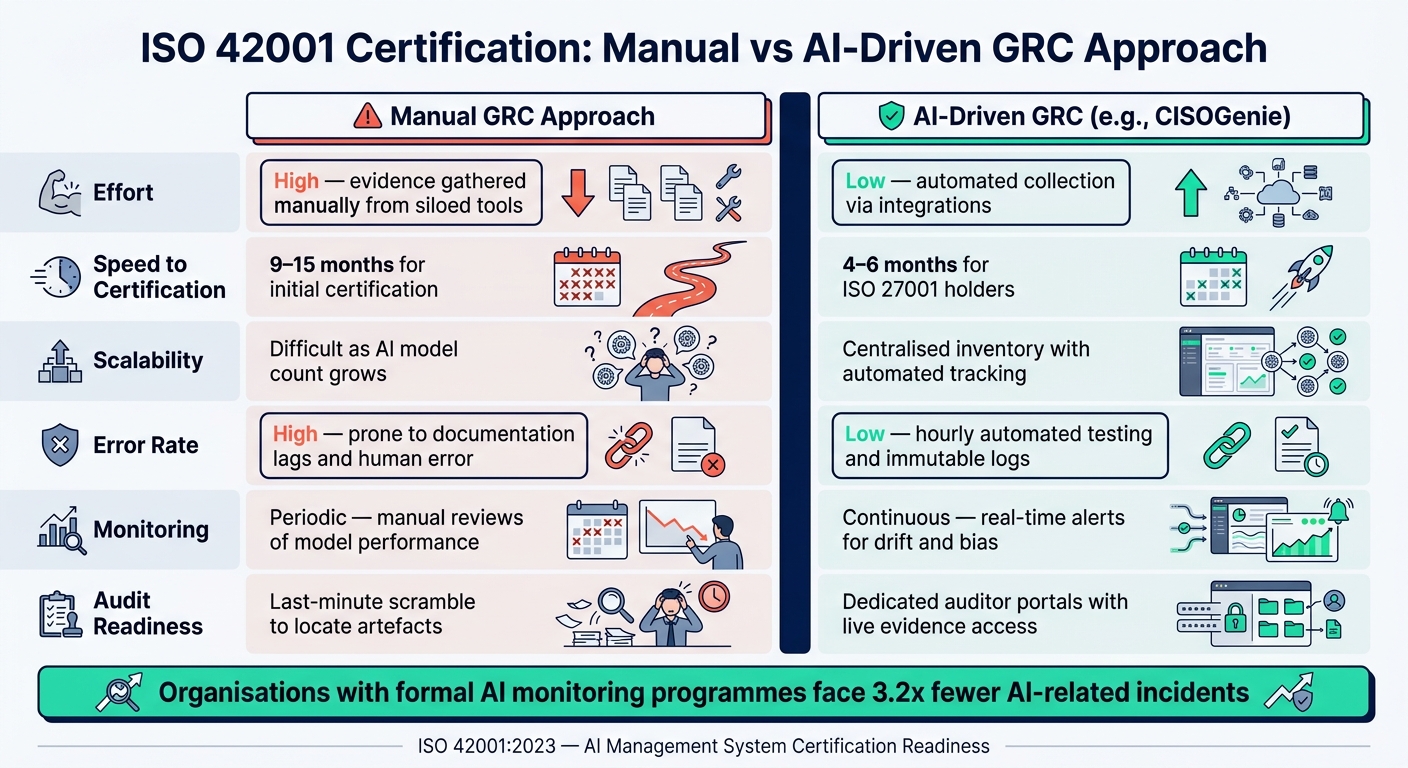
Manual vs AI-Driven GRC: A Side-by-Side Comparison
| Dimension | Manual GRC Approach | AI-Driven GRC (e.g., CISOGenie) |
|---|---|---|
| Effort | High; evidence gathered manually from siloed tools | Low; automated collection via integrations |
| Speed to Certification | 9–15 months for initial certification | 4–6 months for ISO 27001 holders |
| Scalability | Difficult as AI model count grows | Centralised inventory with automated tracking |
| Error Rate | High; prone to documentation lags | Low; hourly automated testing and immutable logs |
| Monitoring | Periodic; manual reviews | Continuous; real-time alerts for drift and bias |
| Audit Readiness | Last-minute scramble to locate artefacts | Dedicated auditor portals with live evidence access |
Conclusion: ISO 42001 Readiness Checklist Summary
| Readiness Area | Key Leadership Review Items | Typical Evidence Required |
|---|---|---|
| Governance | AI Policy approval, assigned roles | Signed AI Policy, RACI matrix, AI Objectives document |
| Risk | Impact assessments, risk treatment decisions | AI Risk Register, Impact Assessments, SoA |
| Lifecycle | Validation results, deployment gates | Design specs, bias reports, decommissioning playbook |
| Operations | Incident response, supplier vetting | Incident playbooks, change logs, vendor risk assessments |
| Monitoring | Internal audit results, KPI performance | Audit reports, management review minutes, dashboards |
A practical way to kickstart this is by hosting a half-day workshop with your AI governance, security, and engineering leads. Use a Met, Partial, or Missing rating system to evaluate each readiness area and prioritise the top three gaps each quarter.
| Readiness Rating | Stage | Next Priority |
|---|---|---|
| 0–30% | Early Stage | Establish AI Policy and begin AI system inventory |
| 31–60% | Foundation in Place | Complete formal AI system mapping and impact assessments |
| 61–80% | Strong Foundations | Implement Annex A controls, focusing on transparency and human oversight |
| 81–100% | Audit-Ready | Complete internal audit and management review; contact your registrar |
ISO/IEC 42001 will enable certification, increase consumer confidence in AI systems, and enable broad responsible adoption of AI.
Engage your certification body when you're around 60–70% prepared. One frequently overlooked item is the decommissioning playbook. Tackling this early, along with a thorough management review of the AIMS, can help avoid common pitfalls during the Stage 2 audit. See audit-ready in 28 days for a compressed readiness path.
Frequently Asked Questions
Ready to assess your ISO 42001 readiness?
See how CISOGenie helps you scope your AIMS, map controls, automate evidence collection, and monitor AI risks for certification readiness.