01 / 04
Legal
revisits the interpretation
Reopens the original applicability memo. Flags assumptions.
For global technology teams, DPDPA applicability risk often starts inside day-to-day product, support, and analytics workflows. The real challenge is not only deciding applicability, but proving that decision with defensible evidence when scrutiny arrives.
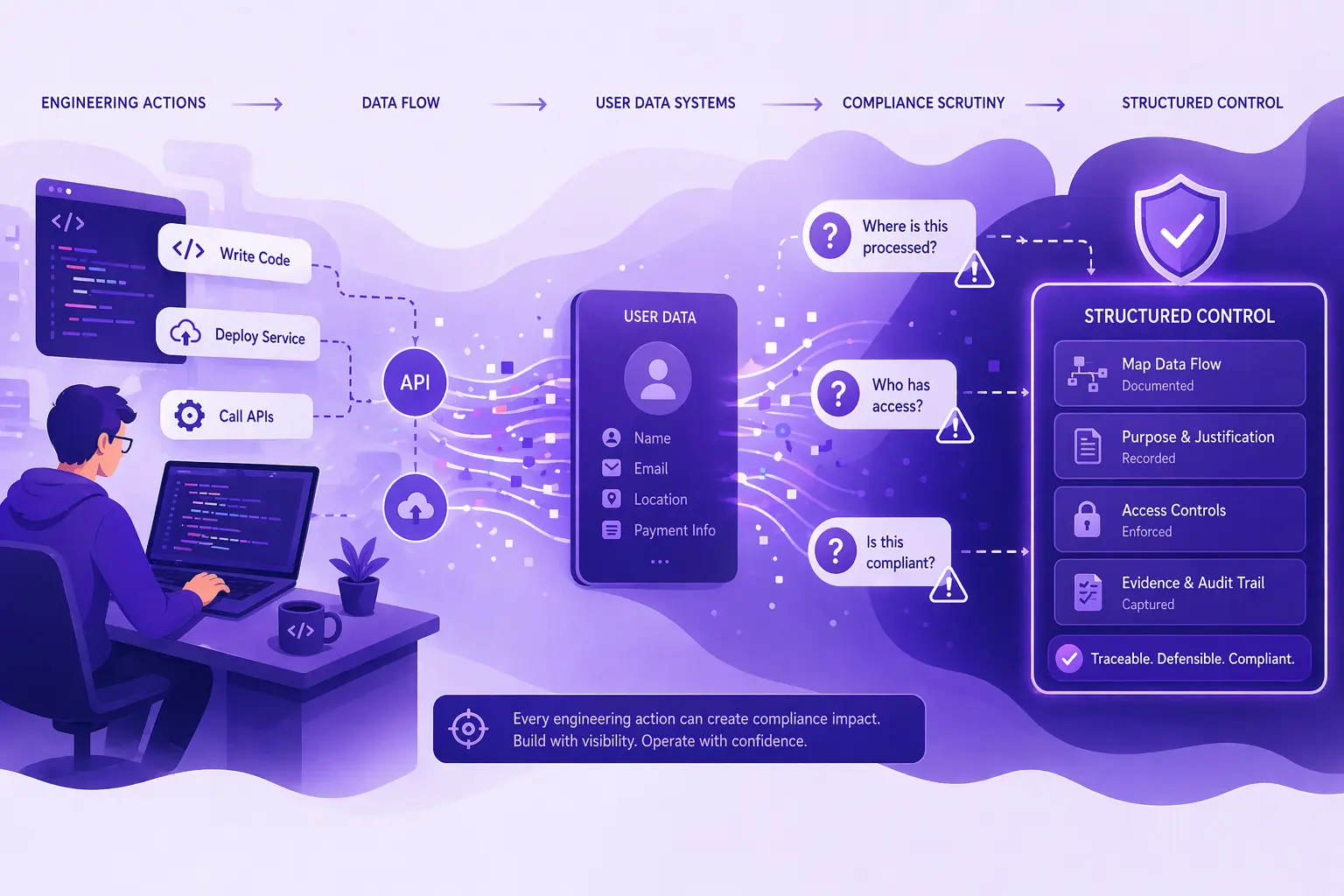
Most teams do not realize this until someone asks a very specific question.
More concretely:
Distributed Teams Need Operational Clarity
This is a common pattern in distributed environments. Not a failure of intent - a gap in operational clarity.
Most teams are comfortable saying →
“We believe DPDPA may not apply fully.”
“”
· Scene · What Happens Next
revisits the interpretation
Reopens the original applicability memo. Flags assumptions.
looks for existing controls
Searches policies, ticket history, control mappings.
explains actual data movement
Draws data flow from memory. Confirms with whoever shipped it.
fail to connect the answers
No single record of decision, control, and reality.
· Scene · The Reconstruction
Evidence isn’t produced. It’s excavated — page by page, thread by thread, from systems that were never designed to remember.
ARTIFACT — 01
Pulled from a Confluence page last edited 14 months ago.
ARTIFACT — 02
Searching #data-platform for the word "PII". 1,204 results.
ARTIFACT — 03
Designed months ago. Half the original team has since rotated.
· Final Scene · The Cost
Not into a breach. Not into a fine. Into meetings, message searches, and meticulous re-explanations of decisions no one wrote down.
Penalties can go up to INR 250 crore per violation category, and a non-defensible applicability position materially increases enforcement risk.
Enterprise customers now ask DPDPA-specific questions in vendor assessments. Deals stall when answers are inconsistent or unverifiable, and questionnaires escalate to live discussions. It usually breaks right before closure.
The same control is mapped multiple times, the same data flow is re-explained in different formats, and the same teams are pulled into every cycle. The cost is not one-time, it compounds quietly.
This usually does not fail early. It breaks close to audit closure or deal closure, when response windows are tighter and stakes are higher. Proving applicability late is disruptive, expensive, and visible.
Applicability in distributed IT environments is dynamic, cross-functional, and evidence-heavy. Without a shared system of record, answers drift across teams and audit preparation becomes manual.
It changes when new features are released, new integrations are added, and new markets are entered. But most organizations do not revisit applicability at that pace.
Legal defines interpretation, engineering owns actual data behavior, and security owns controls. With no shared system of record, alignment happens through meetings, not systems.
Consent sits in product systems, data flows sit in diagrams or people's heads, processing context lives in documents, and vendor obligations sit in contracts. During audits, all of this needs to come together. It rarely does without effort.
Built for global tech teams with engineering in India — connect the underlying reality across systems, so the same applicability question gets the same answer, every single time.
Consent, processing context, and data classification live in one connected record — instead of being scattered across product systems, diagrams, contracts, and people's heads.
Most engineering teams spend 3–5 days before every audit stitching together consent records, processing logs, and data flow maps that should have been one click away. The Evidence Collection Agent eliminates that scramble — pulling artifacts automatically from your connected systems and mapping them to DPDPA, ISO 27001, and SOC 2 controls before the auditor asks.
Applicability reflects what your systems are actually doing — right now — not a snapshot from a legal review months ago. New features, integrations, and markets are detected as they change the picture.
Your DPDPA applicability position is only as accurate as your last system scan. When a new API is added, a vendor is onboarded, or a schema changes, that position shifts — and most teams don't know until an auditor or customer asks. The Continuous Monitoring Agent tracks those signals in real time, so drift is flagged before it becomes a finding — not after.
When an auditor or regulator asks why you reached a position, you can show the complete reasoning trail — inputs, thresholds, evidence, and signatures — not just a one-line conclusion.
Audit defensibility doesn't begin at the audit. It begins with how consent, processing purpose, and data classification are recorded and maintained day-to-day. CISOGenie's Privacy Management module gives your team a single, structured record — so when the question arrives, the answer already exists.
Work done once for DPDPA carries forward into GDPR, ISO 27001, SOC 2, and sectoral regulations — eliminating the duplicate mapping, re-documentation, and re-validation that quietly compound costs across audit cycles.
For technology companies managing DPDPA alongside ISO 27001, SOC 2, and GDPR, the compliance burden compounds with every audit cycle. CISOGenie's IT compliance solution unifies control mapping across all four frameworks — so your team stops re-explaining the same data flow in four different formats, and stops rebuilding the same evidence base for every separate audit.
Before you can prove your DPDPA position, you need to know exactly where the gaps are. The DPDPA Compliance Checklist for Digital Businesses in India [2026] gives IT and engineering teams a control-by-control reference for data flow documentation, Data Fiduciary classification, consent governance, and audit readiness — so the first internal review doesn't become a multi-week exercise.
If your team is still building its DPDPA response from scratch, the DPDPA Toolkit removes the blank-page problem. It covers DPDPA readiness assessment, the DPDP Act 2023, the DPDP Rules 2025, Act-to-Rules mapping, and consent management — giving technology teams a structured starting point without requiring a cross-functional initiative to launch.
See how IT and engineering teams move from one-off applicability debates to a continuously-proven DPDPA position — without slowing the roadmap.
Applicability is debated once, written down, and revisited only when an audit forces the question — by which time the system has moved on.
Applicability is tied to live system signals — services, data stores, regions — so the position you defend matches what's actually running today.
Applicability is debated once, written down, and revisited only when an audit forces the question — by which time the system has moved on.
Applicability is tied to live system signals — services, data stores, regions — so the position you defend matches what's actually running today.
Your DPDPA applicability position is either continuously proven or silently drifting. Most teams discover which one it is at the worst possible moment — inside an audit, a customer security review, or a deal close. CISOGenie gives you the answer before anyone asks.
Most teams delay this because it feels like a large initiative. It does not have to be.
DPDPA compliance obligations are shaped by the data your organisation actually handles. If your teams support healthcare or fintech clients — or if those clients are asking DPDPA questions in vendor assessments — see how CISOGenie addresses the specific obligations for healthcare organisations and fintech companies operating under DPDPA.
For technology teams already managing GDPR obligations for European users while operating engineering teams in India, the regulatory overlap creates real operational risk — two consent regimes, two sets of Data Principal rights, two audit trails. DPDPA vs GDPR: Key Differences Indian Businesses Should Understand maps where the frameworks converge, where they diverge, and what that means for your compliance programme.