SOC 2 vs ISO 27001: Which Framework Should SaaS Prioritize?
Pick the framework your buyers ask for most — then build one control set, map evidence once, and automate upkeep across both programmes.
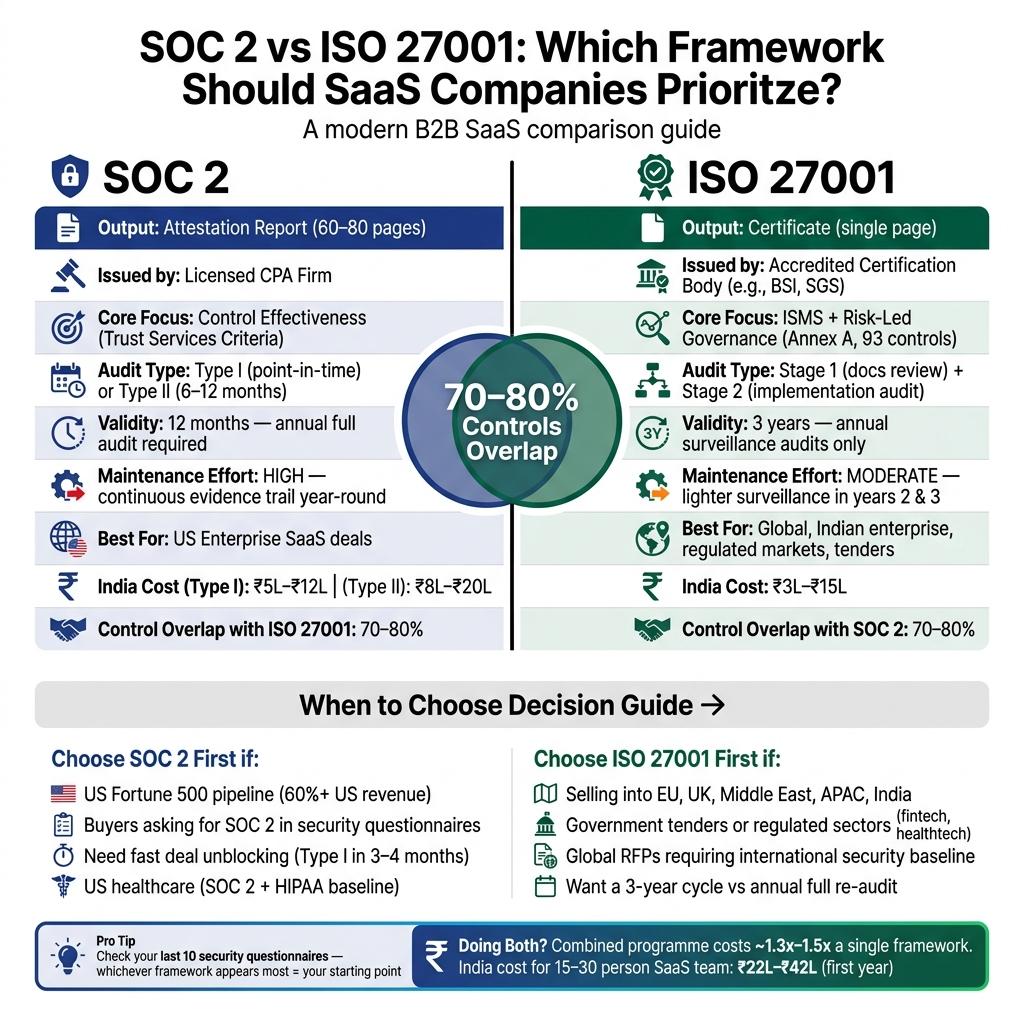
SOC 2 vs ISO 27001: Which Framework Should SaaS Companies Prioritize?
If I had to give the short answer first: pick the framework your buyers ask for most. If your near-term pipeline is mostly US enterprise, put SOC 2 first. If you sell more into Europe, the Middle East, APAC, government, fintech, healthtech, or large Indian enterprises, start with ISO 27001.
- SOC 2 is an attestation report from a CPA firm. Buyers in the US often ask for Type 2.
- ISO 27001 is a certificate from an accredited body — often the default ask in global and Indian enterprise deals.
- The two frameworks share about 70–80% of the same control areas.
- SOC 2 needs a stronger year-round evidence trail and a full yearly audit.
- ISO 27001 needs an ISMS, a risk register, a Statement of Applicability, internal audits, and yearly surveillance checks.
- In India, first-year costs often land around ₹5 lakh–₹20 lakh for SOC 2 and ₹3 lakh–₹15 lakh for ISO 27001, depending on scope and audit type.
- If both keep appearing in sales calls and security reviews, build one control set and do both in sequence.
The core point: SOC 2 proves that specific controls were checked. ISO 27001 proves that your security management system is in place and being run properly. That is why buyers react to them differently.
Quick Comparison
| Criteria | SOC 2 | ISO 27001 |
|---|---|---|
| What you get | Attestation report | Certificate |
| Issued by | Licensed CPA firm | Accredited certification body |
| Main focus | Control testing and effectiveness | ISMS and risk-led governance |
| Best fit | US enterprise SaaS deals | Global, Indian enterprise, regulated, and tender-led deals |
| Audit pattern | Type I or Type II; yearly full audit | Stage 1 + Stage 2; 3-year cycle with yearly surveillance |
| Buyer signal | Often expected in the US | Often expected outside the US |
| Effort after setup | Higher | Lower than yearly full re-audit |
| Best first move | US-led pipeline | Global/India-led pipeline |
Rule of thumb: check your last 10 security questionnaires. If most ask for SOC 2, start there. If most ask for ISO 27001, start there. If it is split, plan for both without building two separate compliance programmes.
What SOC 2 and ISO 27001 Are Each Designed to Prove
SOC 2 and ISO 27001 prove different things. That one difference shapes how buyers react, how much work the audit takes, and what ongoing upkeep looks like.
SOC 2: Attestation for Service Organisations Handling Customer Data
SOC 2 is not a certification. It is an attestation: a formal opinion issued by a licensed CPA firm. The end result is a detailed report, usually 60–80 pages long, that states whether your controls are designed well or worked as expected.
A Type I report checks whether controls are designed well at a single point in time. A Type II report tests whether those controls worked well over a period of 6–12 months, with at least 3 months of evidence.
- Security — required in every SOC 2 report
- Availability
- Confidentiality
- Processing Integrity
- Privacy
SOC 2 is mainly about control effectiveness. It tells buyers, auditors, and partners that the controls around customer data have been checked by an independent CPA firm.
ISO 27001: Certification of an Information Security Management System
ISO 27001 works differently. The end result is a formal certificate — a single-page document issued by an accredited certification body. It is simple to share with buyers and stays valid for three years, as long as you pass annual surveillance audits.
Where SOC 2 looks at specific controls, ISO 27001 looks at the management system that governs them. That means a structured, risk-led programme with a documented scope, Statement of Applicability (SoA), Risk Treatment Plan, internal audits, and formal management reviews.
The 2022 revision includes 93 controls grouped into Organisational, People, Physical, and Technological themes. Every Annex A control must either be put in place or justified in the SoA. The standard follows a Plan-Do-Check-Act (PDCA) cycle — continual improvement over time, not a one-time box-ticking exercise.
| Feature | SOC 2 | ISO 27001 |
|---|---|---|
| Output | 60–80 page attestation report | Single-page certificate |
| Issued by | Licensed CPA firm | Accredited certification body |
| Core focus | Trust Services Criteria (control effectiveness) | ISMS + Annex A (risk-led management system) |
| Validity | 12 months; annual full audit required | 3 years; annual surveillance audits |
SOC 2 vs ISO 27001: Buyer Expectations, Audit Effort, and Maintenance Compared
Where the Two Frameworks Overlap and Where They Differ
Roughly 70–80% of controls overlap between SOC 2 and ISO 27001. That shared layer usually covers access control, encryption, incident response, change management, and vendor oversight.
ISO 27001 requires formal ISMS governance — documented scope, SoA, Risk Treatment Plan, internal audits, and management review minutes. SOC 2 puts more weight on attestation requirements and continuous control effectiveness.
| Control Domain | SOC 2 Criteria | ISO 27001 Annex A (2022) |
|---|---|---|
| Access Management | CC6.1 – CC6.3 | A.5.15 – A.5.18, A.8.2 – A.8.5 |
| Encryption | CC6.1, CC6.7 | A.8.24 |
| Incident Response | CC7.3 – CC7.5 | A.5.24 – A.5.28 |
| Change Management | CC8.1 | A.8.32 |
| Vendor Risk | CC9.2 | A.5.19 – A.5.23 |
Audit Model, Evidence Demands, and Maintenance Workload
SOC 2 audits need a continuous evidence trail across the Type II period, plus an annual full audit. ISO 27001 starts with a two-stage certification audit, then moves into lighter surveillance in later years. Teams that collect evidence continuously tend to avoid the classic last-minute audit scramble.
| Dimension | SOC 2 | ISO 27001 |
|---|---|---|
| Auditor | Licensed CPA firm | Accredited certification body |
| Output | Private attestation report | Public certificate |
| Initial audit structure | Type II observation window of 3–12 months | Stage 1 documentation review + Stage 2 implementation audit |
| Validity | 12 months; annual full audit | 3 years; annual surveillance audits |
| Ongoing maintenance | High — annual full audit every year | Moderate — lighter surveillance in years two and three |
Customer Trust and Geography: US Enterprise vs International Recognition
| Go-to-Market Situation | Buyer Expectation |
|---|---|
| Selling to US Fortune 500 | SOC 2 Type II — widely required by US procurement teams |
| Expanding into EU or UK | ISO 27001 — strong preference; aligns with <a href="/gdpr/" class="cursor-pointer font-semibold text-[#9530E8] hover:underline hover:underline-offset-2">GDPR</a> Article 32 |
| Targeting Indian enterprise | ISO 27001 — standard for banks and large conglomerates |
| Responding to global RFPs | ISO 27001 — often the baseline international security requirement |
| US healthcare buyers | SOC 2 as baseline; domain-specific healthcare compliance as an additional layer |
Which Framework Should SaaS Companies Prioritize First
The first call is usually simple: follow the pipeline. Look at the last 10 vendor security questionnaires your team received. If most ask for SOC 2, start there. If most ask for ISO 27001 or an ISMS certificate, ISO 27001 usually comes first.
Choose SOC 2 First When US Enterprise Deals Are the Immediate Priority
If 60% or more of your near-term revenue is coming from US accounts, SOC 2 is usually the first move. US enterprise buyers often expect SOC 2, so starting with ISO 27001 can slow deals down.
SOC 2 Type 1 is often the fastest bridge — usually done in about 3–4 months and costing roughly ₹5 lakh to ₹12 lakh in India. Many US buyers accept it as an interim step if you commit to Type 2 within 12 months. SOC 2 Type 2 audits in India usually cost ₹8 lakh to ₹20 lakh.
Run a SOC 2 gap analysis early to avoid discovering blockers mid-deal.
Choose ISO 27001 First When Global Expansion or Regulated Markets Drive Demand
If your pipeline leans towards Europe, the Middle East, APAC, or large Indian enterprises, ISO 27001 is usually the better starting point. It has stronger international recognition and is often a baseline for government tenders and regulated sectors like fintech and healthtech.
Initial certification in India usually costs ₹3 lakh to ₹15 lakh. The 3-year certification cycle, with annual surveillance audits, is often easier to manage than doing a full SOC 2 re-audit every 12 months.
Starting with ISO 27001 gives you a formal ISMS backbone, which makes later SOC 2 work easier — less duplication when mapping controls and evidence. See our ISO 27001 certification checklist for pre-audit readiness.
Pursue Both When Enterprise Scale or Multiple Geographies Justify It
For Series B+ teams or SaaS companies selling across the US, EU, and India, doing both is often the best long-term move. SOC 2 and ISO 27001 share roughly 70–80% of their controls, so a combined programme usually costs about 1.3x to 1.5x of a single-framework programme.
In India, a combined first-year programme for a 15–30 person SaaS team usually runs between ₹22 lakh and ₹42 lakh. Build one control library, map it to both frameworks, and stagger audits — for example, ISO 27001 certification in months 4–6 and SOC 2 Type 1 in months 8–10. Indian SaaS teams also need to meet DPDP Act requirements alongside either framework.
| Company Stage | Recommended Path |
|---|---|
| Pre-revenue | DPDP baseline first; defer voluntary certifications |
| Series A: US-led | SOC 2 Type 1 → Type 2; add ISO 27001 after the US motion is stable |
| Series A: Global/India-led | ISO 27001 first; add SOC 2 when US deals demand it |
| Series B+: Mixed pipeline | Build a unified control set; pursue both within 10–12 months |
How to Run SOC 2, ISO 27001, or Both with Compliance Automation
Build One Control Set and Map It Across Frameworks
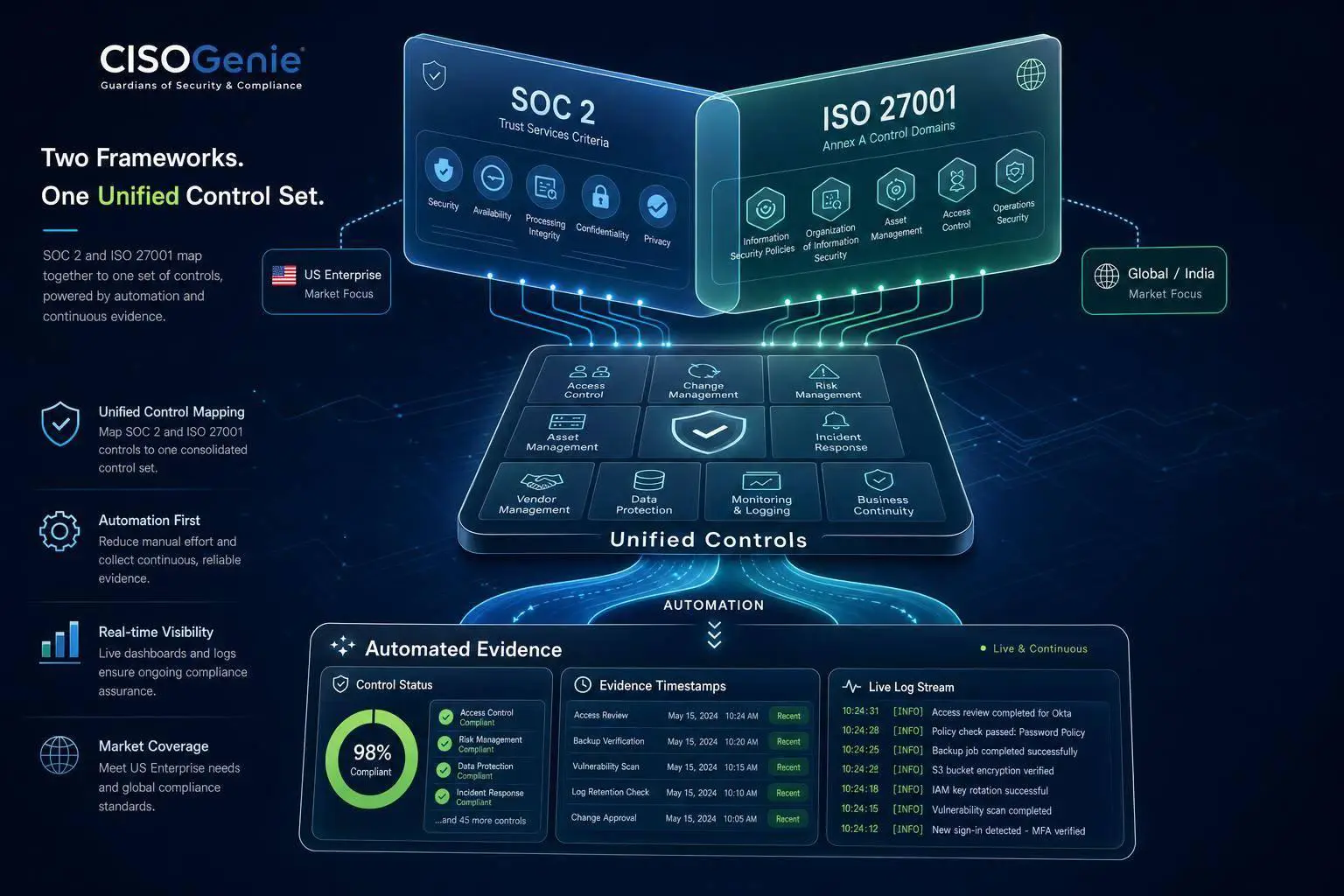
A unified control library means one control and one piece of evidence can satisfy both SOC 2 and ISO 27001. The biggest overlap sits in access control, incident response, change management, vendor risk, logging, and business continuity. That only works if evidence is collected once and reused — the approach behind multi-framework compliance monitoring.
Use AI-Native Workflows to Cut Audit Delays and Reduce Maintenance Effort
The biggest compliance cost usually isn't the audit fee — it's internal time spent by engineering and GRC teams. An AI-native GRC platform like CISOGenie continuously pulls logs, configuration snapshots, tickets, and vendor evidence, then maps them to SOC 2 and ISO 27001 controls. This tackles audit delays, scattered tools, and manual vendor risk reviews that slow down most SaaS teams.
It keeps policies, owners, and employee acknowledgements in one workflow. For ISO 27001, it maintains a live risk register and supports automated evidence collection for either a SOC 2 Type 2 audit or an ISO 27001 surveillance audit. Teams following structured readiness workflows report far less manual audit prep churn.
Conclusion: Match Your Framework Choice to Buyer Demand and Your Capacity to Maintain It
Choose the first framework based on buyer demand, then keep the work under control with automation. SOC 2 and ISO 27001 are not interchangeable signals — but they are highly mappable when you build one control set and automate evidence from day one.
Run a gap assessmentFrequently Asked Questions
Ready to choose SOC 2, ISO 27001, or both?
See how CISOGenie helps SaaS teams map one control set across frameworks, automate evidence collection, and stay audit-ready year-round.